


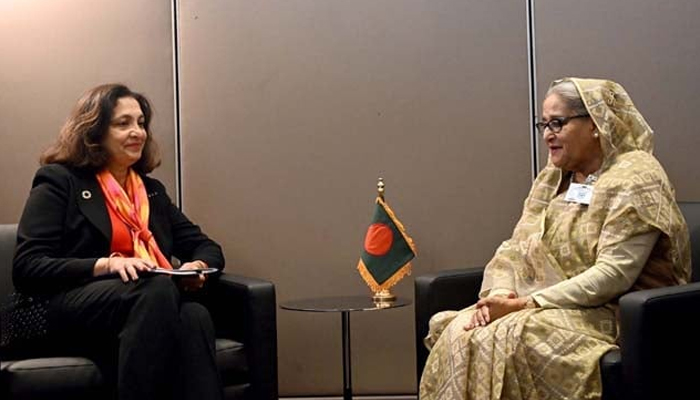
Diplomatic Correspondent, New York: In a recent development, Bangladesh has reiterated its commitment to ensuring the safe return of Rohingya refugees to their homeland in Myanmar.
Prime Minister Sheikh Hasina emphasized her government’s stance, declaring that granting the Rohingyas the right to return to their ancestral land in Myanmar is Bangladesh’s top priority.
During a meeting with Under-Secretary-General for Political and Peacebuilding Affairs, Uzra Zeya, on Thursday at the 78th United Nations General Assembly session, Prime Minister Hasina made this significant announcement.
Foreign Minister Dr. A. K. Abdul Momen briefed journalists about the discussions held at the meeting. Besides the Rohingya crisis, various global and regional issues were on the agenda.
During the meeting, both leaders reaffirmed their commitment to providing $116 million for the repatriation of Rohingya refugees to Bangladesh and Myanmar, with a focus on establishing sustainable livelihoods for them.
Uzra Zeya emphasized the need to ensure the safety and security of the Rohingya population before commencing their repatriation to Myanmar.
Prime Minister Hasina stressed the urgency of initiating the repatriation process promptly to avoid further endangering the region’s stability, as some Rohingya individuals have been involved in criminal activities, including violence, arms smuggling, and drug trafficking.
The Rohingya community has been left in a vulnerable state due to prolonged displacement, with no prospects of a secure future.
Sheikh Hasina also sought international support for the Rohingya case at the International Court of Justice (ICJ). Seven countries—France, Canada, the Netherlands, the United Kingdom, Denmark, and the Maldives—have expressed their solidarity with Bangladesh in this matter. Additionally, they discussed the upcoming general elections in Bangladesh during the meeting.
Uzra Zeya conveyed their desire for free, fair, and peaceful elections in Bangladesh, emphasizing that genuine elections require the internal cooperation of political parties.
She added, “Without the support of the people, no government can stay in power. Violence-free elections, particularly with the involvement of political parties, are crucial for the democratic process.”
With the general elections just a few months away in October, the United Nations election observers are preparing to oversee the electoral process.
In efforts to combat genocide, Alisa Weirimu, the United Nations Special Envoy for Genocide Prevention, also met with Prime Minister Sheikh Hasina during her visit.
At this time, Prime Minister Hasina appealed to the United Nations to classify the ongoing atrocities in Myanmar against the Rohingya population as genocide. Additionally, she urged the United Nations to collaborate closely to prevent genocide in Myanmar.