


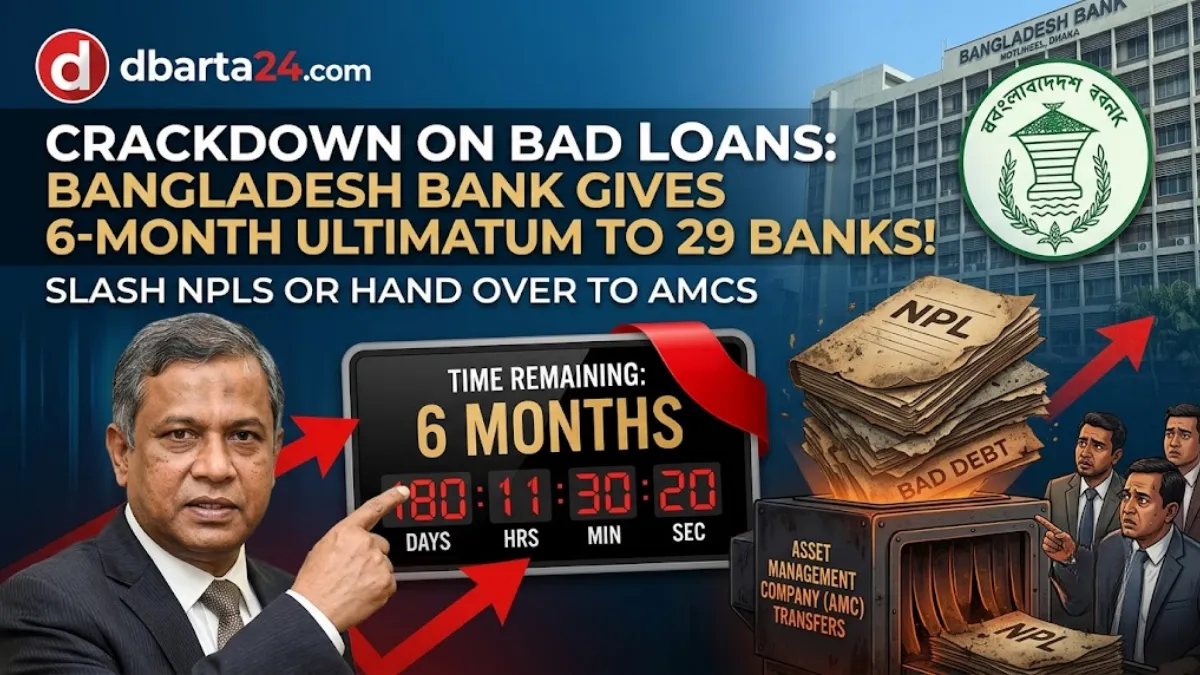
S A Khan — In a major regulatory push to restore discipline in the country’s financial sector, Bangladesh Bank has issued a strict six-month deadline to 29 commercial banks to significantly reduce their non-performing loans (NPLs).
Lenders failing to meet the specified targets within the timeframe will be required to offload their toxic debt to Asset Management Companies (AMCs).
Under the new directives issued by Bangladesh Bank Governor Mostakur Rahman, institutions with NPL ratios exceeding 20% must bring them below the 20% mark.
Similarly, banks with bad loans ranging between 10% and 20% have been instructed to trim their default rates to single digits (below 10%).
The orders came following a series of individual high-level meetings held between the Governor and the Managing Directors of the 29 affected banks from July 12 to July 19.
To achieve these targets, the central bank laid out a rigorous action plan. Lenders have been directed to curb the creation of fresh default loans, closely monitor rescheduled credits, intensify recovery efforts against large habitual defaulters, and maintain direct outreach with Agricultural and SME borrowers.
Central bank guidelines strictly forbid banks from keeping toxic assets on their balance sheets to inflate interest income and distribute unearned dividends.
Furthermore, the central bank urged financial institutions to resolve repeatedly rescheduled loans through Alternative Dispute Resolution (ADR), exit facilities, or expedited legal measures.
Banks were also encouraged to write off long-standing bad loans within current regulatory frameworks and take immediate measures to bolster their capital bases.
The drastic regulatory intervention comes against the backdrop of alarming asset quality indicators. According to central bank data, non-performing loans in Bangladesh’s banking sector surged to a staggering Tk 5,88,704 crore at the end of March—accounting for 32.26% of all disbursed loans. During the same period, provisioning shortfalls ballooned to nearly Tk 2,05,000 crore, making Bangladesh’s default loan ratio one of the highest in South Asia.
Several prominent institutions—including National Bank, First Security Islami Bank, Global Islami Bank, Union Bank, Padma Bank, ICB Islamic Bank, Social Islami Bank, EXIM Bank, Janata Bank, IFIC Bank, and Islami Bank—were identified among those suffering from critical levels of non-performing debt.
By tying compliance to asset offloading, Bangladesh Bank aims to force structural cleanup across balance sheets, penalize non-performing institutions, and safeguard depositor confidence in the banking system.