


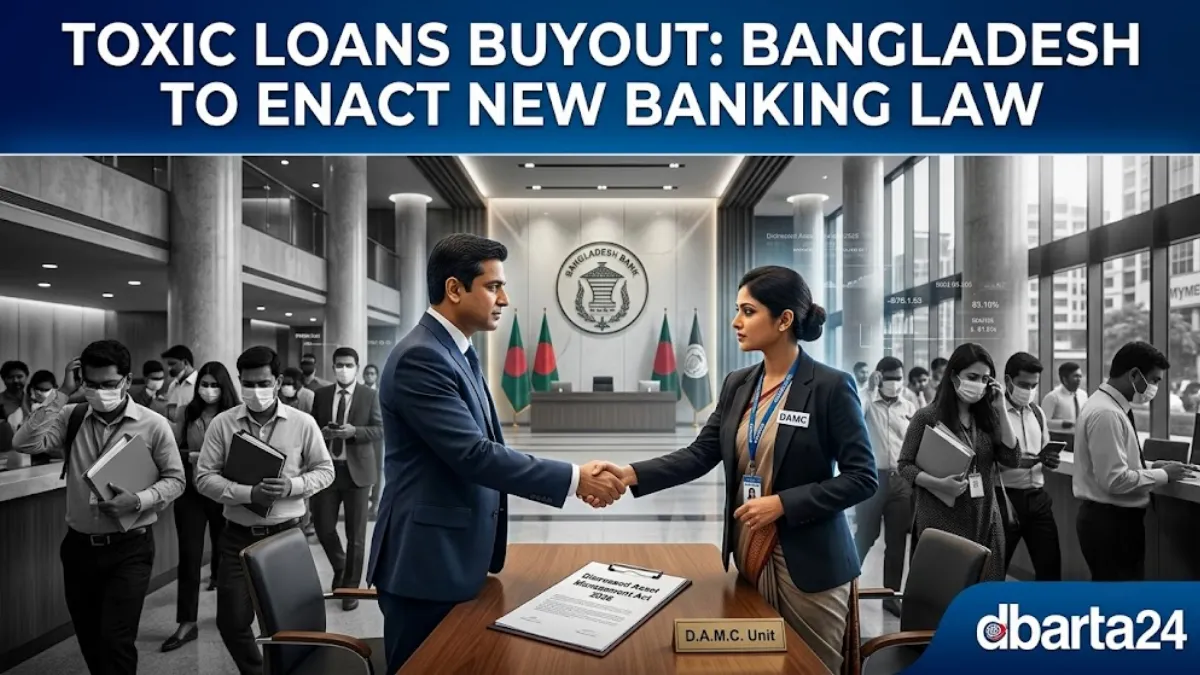
Raisul Khan ; Dhaka — In a major move to rescue Bangladesh’s banking sector from a mountain of non-performing loans (NPLs), the government is enacting a new law to establish specialized asset management companies.
These firms will be authorized to purchase, restructure, and manage toxic assets to relieve pressure on the struggling economy.
The Ministry of Finance has drafted the “Distressed Asset Management Act 2026”. The law will facilitate the formation of Distressed Asset Management Companies (DAMCs), which will handle defaulted and written-off loans through various mechanisms, including rescheduling, collateral seizure, asset sales, and converting debt into equity.
DAMCs will also be empowered to modernize and inject new investment into ailing industrial enterprises.
Currently, Bangladesh lacks an integrated legal framework to clear or sell non-performing and written-off loans to investors.
This regulatory gap has left massive amounts of risky assets trapped on bank balance sheets, choking new loan disbursements and disrupting normal financial operations.
The upcoming law aims to bridge this gap by attracting both domestic and foreign investors to participate in asset reconstruction funds.
Strong Oversight and Autonomous Governance
To prevent conflict of interest and misuse, the central bank will establish a distinct regulatory wing called the Distressed Asset Management Unit (DAMU). While administratively tied to Bangladesh Bank, the unit will operate with autonomous statutory powers.
It will be headed by an official holding a status equivalent to a Deputy Governor, appointed for a maximum term of three years. Eligible candidates must be under 65 years of age and possess at least 15 years of experience in banking economics or asset management.
Furthermore, a powerful “Distressed Asset Management Taskforce” will be formed to coordinate identification, data collection, and asset recovery. All public and private entities will be legally mandated to supply requested documents to this taskforce.
Strict Operation Framework & Anti-Graft Safeguards
To operate as a DAMC, entities must secure a license from the DAMU, meet strict paid-up capital requirements, and satisfy a “fit and proper” management test. Boards must comprise at least 20% independent directors with zero financial interest in the company.
Purchased bad loans will not be recorded as a company’s direct asset; instead, they will be held under separate independent trusts. This structure ensures that even if a DAMC faces bankruptcy, creditors cannot claim the assets held within the trust.
While DAMCs can source funds via shares, bonds, securitization, and foreign investments, they are restricted from taking direct loans from local banks and financial institutions to prevent conflicts of interest.
To assist in professional recovery, Loan Servicing Companies (LSCs) will be introduced to handle analysis, borrower negotiations, and legal assistance.
However, LSCs are strictly banned from accepting public deposits, filing lawsuits under their own names, or resorting to coercive or illegal recovery methods.
Any registered company found guilty of money laundering, terror financing, fraud, or activities against public interest will face immediate license cancellation, subject to a defined appeal process.
Expert Insight & Critical Challenges
Speaking on the draft legislation, prominent economist MK Mujeri highlighted both the potential and the hurdles of this initiative:
“There are some critical challenges in implementing this law, particularly the accurate valuation of distressed assets, ensuring implementation free from political influence, and maintaining strong oversight. If these hurdles can be effectively managed, it will be possible to swiftly eliminate massive bad loans from bank balance sheets. Consequently, it will boost the lending capacity of commercial banks.”
The Distressed Asset Management Act 2026 marks a decisive step toward clearing the toxic balance sheets of Bangladeshi banks.
While the legal structure introduces innovative protections—like independent trusts and autonomous central bank oversight—the ultimate success of this financial reform hinges on transparent asset valuation and absolute freedom from political interference.