


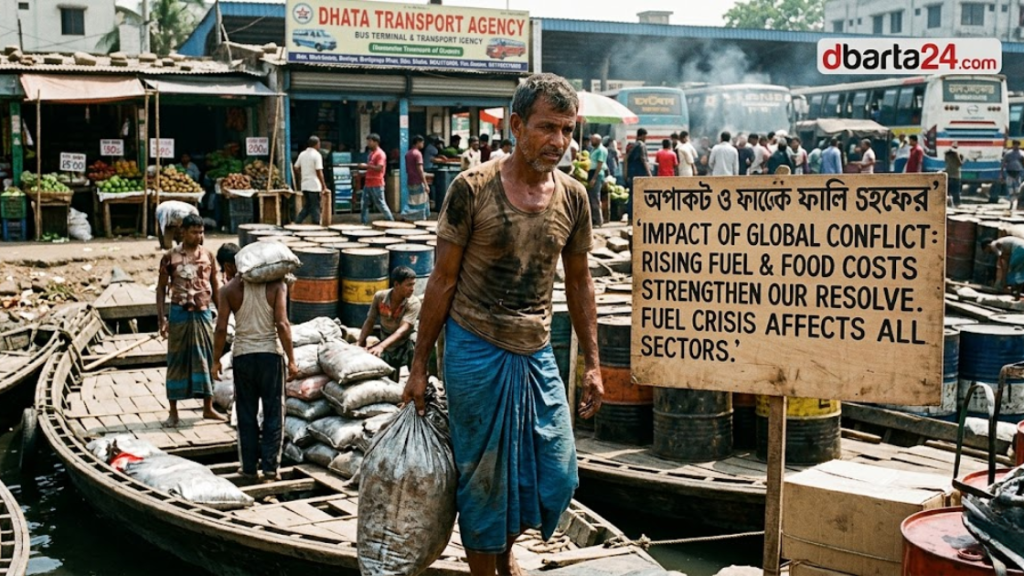
M K Alam ; Dhaka – The shadow of the conflict involving Iran, Israel, and the United States in the Middle East has cast a dark cloud over the global economy, and Bangladesh is no exception.
Every sector of the national economy—from transport and market prices to industrial production and international trade—is feeling the sting of rising costs and growing uncertainty.
GDP Growth at Risk
The World Bank has issued a stern warning regarding the crisis, projecting that Bangladesh’s GDP growth could slide to 3.9% in the current fiscal year. The organization also estimates that nearly 1.2 million people could remain trapped below the poverty line due to these economic shocks.
The Energy Crisis: A $2 Billion Burden
Energy is at the heart of the current struggle. Iqbal Hasan Mahmud Tuku, Minister for Power, Energy, and Mineral Resources, recently revealed that fuel import prices have nearly doubled compared to pre-war rates. This has forced the government to spend an additional $2 billion on energy imports alone.
Dr. Selim Raihan, Executive Director of SANEM, noted that the impact is not limited to fuel. “This shock is spreading through every layer of the economy,” he said. According to Bangladesh Bank, every $10 increase in oil prices per barrel raises import costs by 800 to 1,000 crore BDT.
Industrial and Trade Disruptions
The manufacturing sector is facing a “low volume, high cost” reality.
-
Production Costs: The Bangladesh Re-Rolling Mills Association reports that production costs have spiked by 20% due to gas and electricity shortages.
-
Apparel Sector: Mahmud Hasan Khan Babu, President of BGMEA, highlighted that while production and transport costs are rising, international buyers are not easily adjusting product prices, squeezing profit margins.
-
Logistics: Shipping costs have surged by 35-45%, and insurance premiums have jumped 50-60%, severely weakening the competitive edge of Bangladeshi exports.
Remittance and Labor Market Fears
While remittance inflows saw a temporary boost as expatriates sent home savings for security, the long-term outlook is grim. New recruitment in Middle Eastern labor markets has dropped significantly.
Dr. Zahid Hussain, former lead economist at the World Bank’s Dhaka office, warned, “This flow may not be sustainable. If the labor market shrinks, remittances will inevitably take a hit.”
The Impact on Daily Life
For the average citizen, the crisis translates to higher food and transport prices. March saw inflation hit 8.71%, and experts predict it could rise another 4% if energy prices continue to climb. Agriculture is also suffering, as the cost of irrigation and fertilizer transport rises, eating into farmers’ livelihoods.
Expert Advice: Urgent Action Needed
Economists urge the government to take swift, coordinated steps. Dr. Zahid Hussain suggested four key strategies:
-
Securing alternative energy sources.
-
Improving supply chain efficiency.
-
Exploring new export and labor markets.
-
Strengthening market monitoring to prevent price gouging.
Key Impacts:
-
Growth Slowdown: The World Bank predicts GDP growth will drop to 3.9%.
-
High Fuel Costs: The government is spending an extra $2 billion to import energy.
-
Industry in Trouble: Factory production costs are up 20%, and shipping costs have risen by nearly 45%.
-
Labor Market: While some money is still coming in, new jobs for Bangladeshis in the Middle East are decreasing.
Experts say the government must act quickly to find new energy sources and protect the poor from rising inflation.