


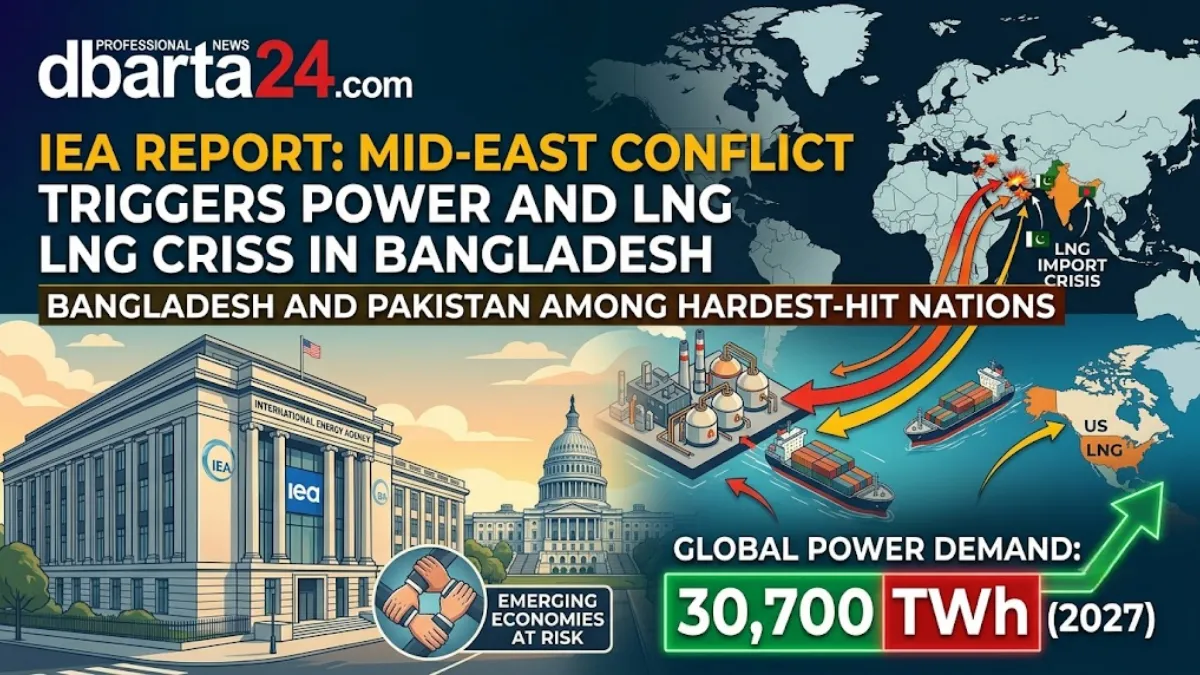
Dbarta24 Desk — Bangladesh has emerged as one of the most vulnerable nations heavily impacted by the ongoing Middle East conflict, which has sent shockwaves through the global energy market.
Due to its high reliance on Liquefied Natural Gas (LNG) imports and an economy highly sensitive to fluctuating fuel prices, the country has been forced to implement strict energy-saving measures, directly impacting nationwide electricity consumption.
These findings were highlighted in the Electricity Mid-Year Update 2026 report, published by the International Energy Agency (IEA) on Thursday.
The report underscores that emerging economies like Bangladesh and Pakistan are facing severe domestic strains due to their deep dependency on imported LNG.
The Hormuz Strait Bottleneck and Rising Costs
According to the IEA, recent supply disruptions in the Strait of Hormuz—a critical global transit route—have plunged import-dependent nations into a direct crisis.
The uncertainty surrounding fuel shipments, coupled with skyrocketing prices, has drastically inflated power generation costs.
To mitigate the soaring financial burden, the government has resorted to aggressive energy conservation initiatives, leading to a noticeable drop in overall electricity usage across the country.
The agency noted that months of regional warfare in the Middle East have kept the global energy sector highly volatile.
Consequently, Bangladesh is being forced to procure LNG at much higher rates than before.
The IEA explicitly warned that the country’s electricity supply and demand balance will likely remain under immense pressure throughout the remainder of the year.
Global Context: Surge in Electricity Demand
While countries like Bangladesh struggle with supply shortages, global demand for electricity continues to surge rapidly. The IEA attributes this international growth to:
-
The expansion of industrial manufacturing.
-
A rising adoption rate of electric vehicles (EVs).
-
Escalating global temperatures driving air conditioning usage.
-
The rapid, uninterrupted proliferation of data centers worldwide.
The IEA projects global electricity demand to grow by $3.6\%$ in 2026 and $3.8\%$ in 2027, up from a $3\%$ growth rate recorded in 2025. This trajectory will push worldwide electricity consumption to an unprecedented
by 2027, compared to
in 2025.
Return to Coal Amid Record Gas Prices
The disruptions in the Strait of Hormuz have pushed natural gas prices in Asia and Europe to their highest levels since the historic 2022–23 energy crisis.
While emergency LNG shipments from North America have provided slight relief to the global market, the price shock has forced several Asian and European nations to pivot back to coal-fired power generation to keep their grids stable.
For Bangladesh, the IEA’s mid-year update serves as a stark reminder of the risks tied to import-dependent energy policies.
As geopolitical tensions show no signs of easing, the country faces a difficult balancing act: managing soaring fiscal deficits from expensive fuel imports while trying to prevent widespread blackouts that could derail its economic growth.