


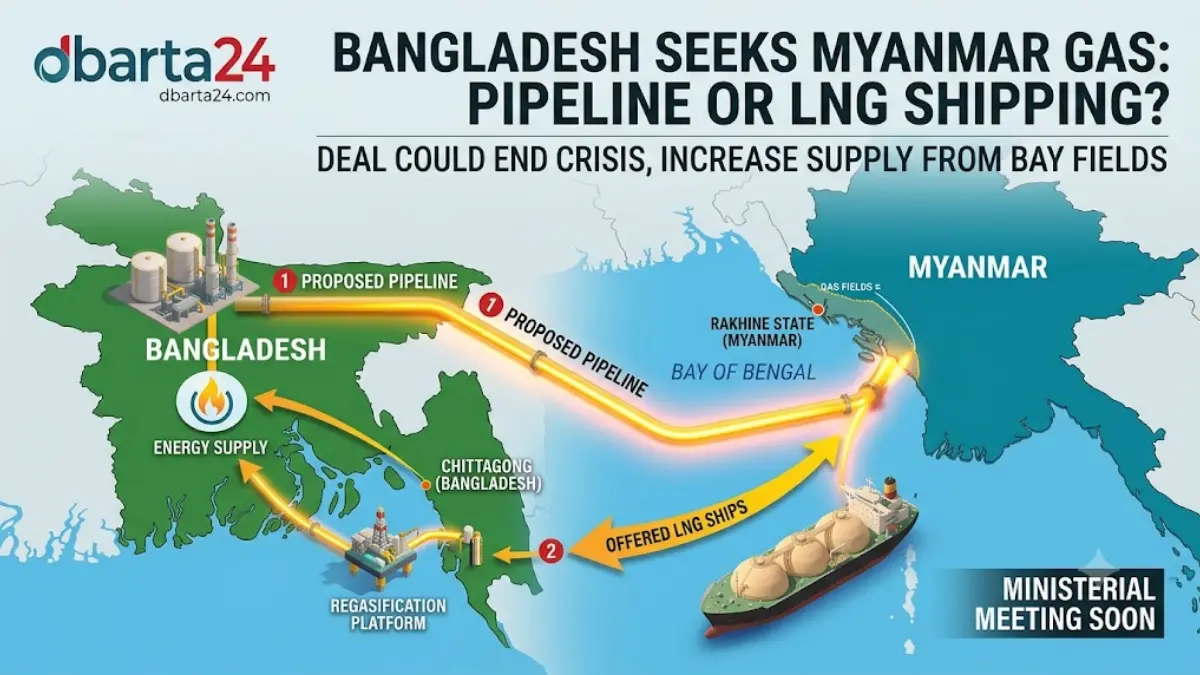
Md. Tareq; Dbarta24 — In a strategic move to alleviate the country’s worsening energy deficit, Bangladesh has formally proposed importing natural gas from neighboring Myanmar through a cross-border pipeline.
Myanmar has responded positively to the initiative, countering with a proposal to export Liquefied Natural Gas (LNG).
To evaluate the feasibility of both options, both nations have agreed to convene a ministerial-level meeting in the near future.
The breakthrough emerged during a high-level energy cooperation meeting held on Sunday at the Ministry of Power, Energy and Mineral Resources in Dhaka.
The Myanmar delegation, which included Ambassador to Bangladesh Kyaw Soe Moe and Commercial Counselor Myat Lwin, expressed a strong willingness to foster bilateral energy trade.
Bangladesh was represented by Power, Energy and Mineral Resources Minister Iqbal Hasan Mahmud, State Minister Anindya Islam Amit, Energy Secretary Mohammad Saiful Islam, and Power Secretary Mirana Mahrukh.
During the bilateral talks, Energy Minister Iqbal Hasan Mahmud emphasized Bangladesh’s soaring domestic demand for natural gas and highlighted the country’s keen interest in securing energy supplies via a direct pipeline from Myanmar.
An official present at the meeting confirmed that while Bangladesh pushed for a pipeline infrastructure, the Myanmar delegation offered LNG exports as an alternative.
To bridge the gap and assess the technicalities of both proposals, the two sides decided that the Bangladesh-Myanmar Joint Technical Committee would first review the options, followed swiftly by a formal ministerial summit.
Discussions also extended toward building long-term commercial ties and enhancing broader regional energy cooperation.
Furthermore, Minister Mahmud referenced Prime Minister Tarique Rahman’s recent visit to China, noting that the proposed China-Myanmar-Bangladesh economic corridor could serve as a highly supportive framework if a cross-border pipeline network is established.
Bangladesh is currently grappling with a severe energy crunch. Despite Myanmar being an immediate neighbor and a major gas exporter, Bangladesh traditionally imports a third of its gas from distant Middle Eastern nations and other global suppliers.
Even with these imports, the nation faces a daily gas shortage equivalent to one-fourth of its total demand.
According to the Energy Division, against a daily domestic demand of 3.8 billion cubic feet (bcf), the current supply hovers between only 2.7 and 2.8 bcf.
This supply includes 800 to 1,000 million cubic feet of gas imported via two floating LNG terminals in the Bay of Bengal.
The domestic crisis took a severe turn recently after one of the floating LNG terminals caught fire and was forced to shut down operations.
The resulting supply drop has severely disrupted industrial manufacturing and power generation across the country.
Commuters face grueling hours in long queues at CNG filling stations, while households suffer prolonged daily gas outages, leaving domestic stoves unlit.
To mitigate the crisis, Bangladesh has also initiated parallel talks with Malaysia to explore importing LNG via smaller cargo vessels to supply critical, underserved industrial zones through inland waterways.
Myanmar remains one of Asia’s primary natural gas exporters, generating approximately $2 billion annually from gas sales to Thailand and China despite its ongoing internal conflicts and civil war.
According to reports from the Singapore-based Business Times, Myanmar has discovered four major offshore gas fields to date.
Three of these fields export gas to Thailand via subsea pipelines, while the fourth field, located in the Bay of Bengal adjacent to the Rakhine State bordering Bangladesh, exports gas overland directly to China.
Natural gas currently stands as Myanmar’s second-largest export commodity, positioned just behind ready-made garments.