


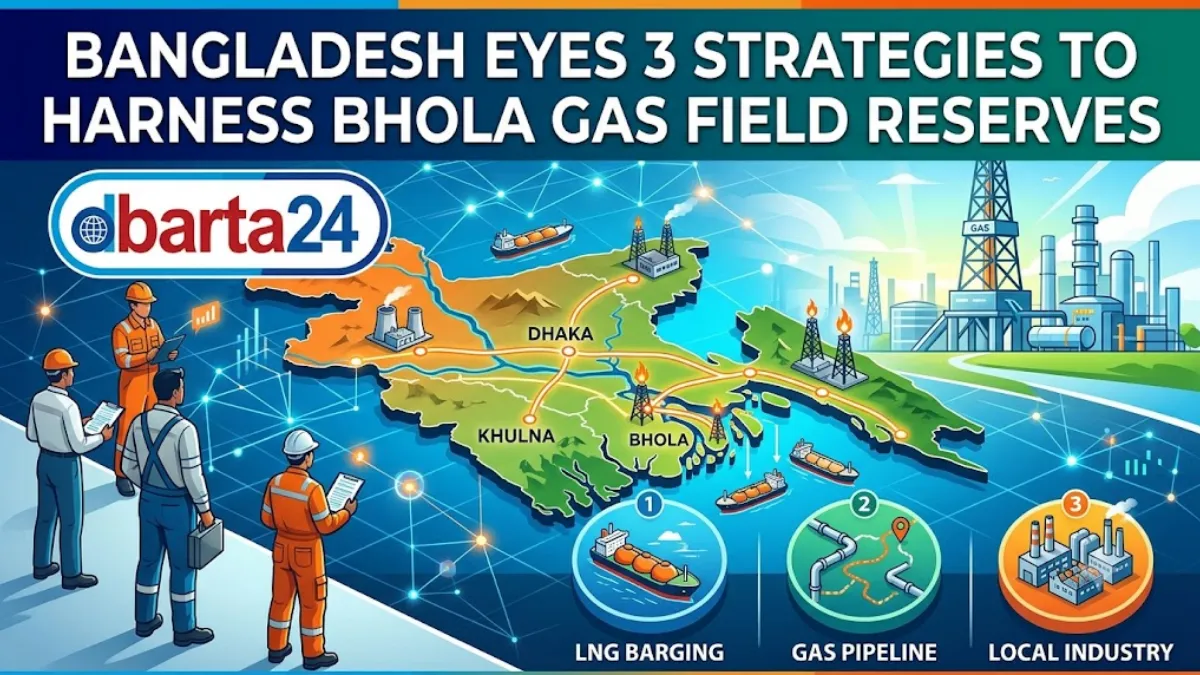
Muhammad Tareq — In a bid to rescue its power plants and manufacturing hubs from a crippling energy deficit, Bangladesh is actively evaluating three distinct strategies to transport surplus natural gas from the offshore island district of Bhola to the main grid.
The plans—ranging from short-term liquefied natural gas (LNG) barging to long-term cross-country pipelines and localized industrialization—come as industrial zones in Dhaka and Gazipur struggle with record supply shortfalls.
Following a high-level meeting on Tuesday, the Energy Division officially tasked the Gas Transmission Company Limited (GTCL) with conducting feasibility studies to evaluate the most viable logistics routes.
A Critical Asset Amid a National Energy Crunch
Bhola has emerged as the country’s primary energy beacon. While national gas production has plummeted from a peak of 2,700 million cubic feet per day (mmcfd) to just 1650 mmcfd, Bhola’s gas fields hold an estimated reserve of 5 to 8 trillion cubic feet (TCF).
Despite having a daily production capacity of 190 mmcfd across nine wells, Bhola currently produces only 70 to 80 mmcfd due to the absence of grid connectivity.
State-run Petrobangla is preparing to drill 15 additional wells, which could boost daily capacity by another 300 to 400 mmcfd.
“Bhola’s gas is no longer just a regional asset; it is a key pillar of national energy security,” noted energy expert Dr. Ijaz Hossain. “While short-term LNG transportation offers immediate relief, a long-term strategy combining pipelines, local industrialization, and continuous exploration is vital.”
Pipeline Debates: Dhaka vs. Khulna
While an earlier attempt during the previous administration to compress and haul gas via CNG trucks failed—yielding less than 1 mmcfd against a 25 mmcfd target—the current discussions center on pipeline routes.
Two distinct pipeline projects are currently under consideration:
-
The Dhaka Route: A proposed 175-kilometer pipeline connecting Bhola to Dhaka’s Aminbazar via Barishal. Industrial leaders strongly favor this path, arguing that the nation’s core manufacturing belt in Dhaka and Gazipur faces the most severe existential threat from gas shortages.
-
The Khulna Route: A 150-kilometer pipeline extending from Bhola to Khulna via Barishal. Under this plan, gas would power the Rupsha Power Plant, enabling electricity to be routed to Sirajganj, which in turn would free up existing gas supplies for the Chandra and Ashulia industrial clusters.
The Cost Barrier of Short-Term LNG
As an immediate fix, the government is considering converting Bhola’s gas into LNG using private facilities and shipping it via marine routes to mainland ports.
Nine international firms submitted Expressions of Interest (EOI), with four major companies—including Gazprom, CCDC, and CMC—being shortlisted.
However, commercial viability remains a major hurdle. During a recent public hearing hosted by the Bangladesh Energy Regulatory Commission (BERC), utility companies proposed a distribution price of ৳47.50 per cubic meter for converted LNG.
Business associations, including the FBCCI and BGMEA, expressed reluctance, warning that paying nearly double the standard industrial rate of ৳30 per cubic meter would severely hamper global competitiveness.
Looking Ahead: Local Development or National Grid?
Beyond transporting the gas, several economic analysts advocate for utilizing the reserves locally.
Ongoing projects—such as new fertilizer factories, BSCIC industrial estates, EPZs, and private sector investments by ceramic and conglomerate brands—could turn the southern region into a manufacturing powerhouse without incurring massive pipeline infrastructure costs.
Petrobangla Director (Planning) Abdul Mannan Patwary confirmed that all proposals remain under review.
“A variety of options to utilize Bhola’s gas were evaluated during Tuesday’s meeting,” Patwary stated. “Alongside LNG and pipeline proposals, we are examining local power generation and industrial expansion. No decision is final until the feasibility studies are complete.”