


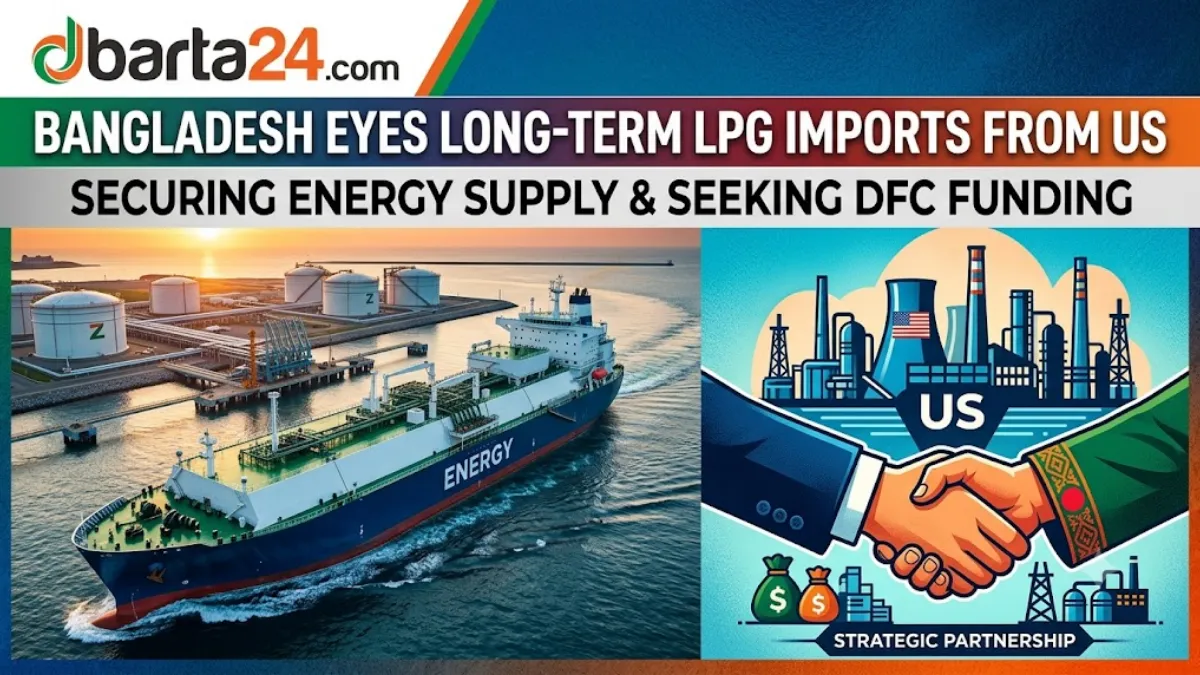
Dbarta24 Business Desk – Faced with escalating vulnerabilities in traditional global fuel supply chains, Bangladesh is moving forward with a strategic plan to secure long-term Liquefied Petroleum Gas (LPG) imports from the United States.
Alongside the procurement strategy, Dhaka is actively seeking financing from the US International Development Finance Corporation (DFC) to bankroll critical energy infrastructure developments, according to senior officials from the Ministry of Finance and the Ministry of Commerce.
The breakthrough comes on the heels of a bilateral trade pact signed just days before the interim government stepped down in February this year.
Aimed at balancing the trade deficit between the two nations, the 15-year framework mandates Bangladesh to source roughly $15 billion worth of Liquefied Natural Gas (LNG) and other primary energy resources from the United States.
The latest initiative to establish a steady pipeline of US LPG is a direct extension of that agreement.
Strategic Shifts and Diplomatic Mobilization
The details of the arrangement were hammered out during a bilateral meeting in Washington D.C. between Dr. Md. Fazle Rabbi, Economic Minister at the Bangladesh Embassy, and Laura Anderson, Senior Economic Advisor at the US Department of State.
During the discussions, Dr. Rabbi requested strong diplomatic backing from the US government to facilitate long-term LPG supplies and fast-track Bangladesh’s eligibility for DFC funding.
He disclosed that Bangladesh’s Energy and Mineral Resources Division has already reached out to 10 leading American energy conglomerates, inviting them to submit Expressions of Interest (EOIs) for LPG supply.
Responding positively to the proposal, Laura Anderson confirmed that the US State, Energy, and Commerce departments are working collectively on the matter.
She assured that Washington would engage directly with the targeted suppliers to streamline their participation, requesting Dhaka to swiftly provide the finalized shortlist of companies.
Mitigating Middle East Vulnerabilities
The pivot toward North American energy comes as Bangladesh looks to shield its economy from deep-seated geopolitical anxieties in the Middle East.
Energy ministry officials and analysts note that prolonged conflicts involving Iran, frequent regional production disruptions, and persistent instability around the strategic Strait of Hormuz have made supply diversification a matter of national security.
While spot imports of US LPG have climbed recently, scaling this up into long-term contracts presents a distinct logistical hurdle: the substantial freight costs associated with navigating long-distance maritime routes from the US to South Asia.
To offset these financial strains, tapping into low-cost development funds has become imperative.
The DFC Funding Hurdle: Focus on Labor Reform
Established in 2019 with a $60 billion capital base, the US DFC offers loans, loan guarantees, and political risk insurance to drive critical infrastructure, energy, and technology projects in developing economies.
Bangladesh has long eyed this fund, but Washington’s lingering concerns regarding labor rights, environmental benchmarks, freedom of association for trade unions, and overall workplace safety have so far blocked Dhaka’s eligibility.
However, the Washington meeting signaled a potential breakthrough.
Expressing optimism that Bangladesh could qualify for DFC financing in the near future, Anderson advised Bangladeshi diplomats to consistently raise the issue in all upcoming bilateral dialogues.
She further recommended that Dhaka maintain a ready portfolio of priority infrastructure projects tailored for potential American investors.
An official from the Bangladesh Investment Development Authority (BIDA) underscored the high stakes of these talks:
“Securing access to DFC funding would monumentally boost Bangladesh’s capacity to attract long-term foreign direct investment into major infrastructure, energy, and industrial development projects.”
Currently, Bangladesh has a massive annual LPG demand of roughly 1.5 million tonnes, a staggering 95% of which relies entirely on foreign imports—leaving the domestic market hyper-vulnerable to international supply shocks.
American Eyes on Major Energy Infrastructure
The Washington summit also highlighted growing American interest in Bangladesh’s mega-scale energy projects.
Specifically, US firms have expressed a keen interest in bidding for two high-priority tenders: the construction of a new Floating Storage and Regasification Unit (FSRU) and the long-delayed second unit of the state-owned Eastern Refinery Limited (ERL-2).
To ensure these initiatives transition from talks to execution, the Bangladesh Embassy in Washington has formally issued five strategic recommendations to the government:
-
Promptly dispatch the list of the 10 prospective US LPG suppliers to relevant American agencies.
-
Systematically table Bangladesh’s eligibility for DFC financing during every bilateral meeting.
-
Finalize a structural pipeline of priority projects to pitch to incoming investors.
-
Collaboratively identify high-yield sectors for future Bangladeshi trade delegations visiting the US.
-
Formally notify the US government as soon as the tenders for the FSRU and ERL-2 projects are officially opened.
Bangladesh’s aggressive push for long-term US LPG contracts and DFC backing represents a pragmatic shift toward structural energy security.
By diversifying its supplier base away from the volatile Middle East and linking its energy needs to institutional US trade pacts, Dhaka is attempting to buffer its economy against global shocks.
However, the ultimate success of this energy transition will hinge on the government’s ability to address Washington’s stringent labor and environmental benchmarks, unlocking the vital financing needed to support its grand infrastructure ambitions.