


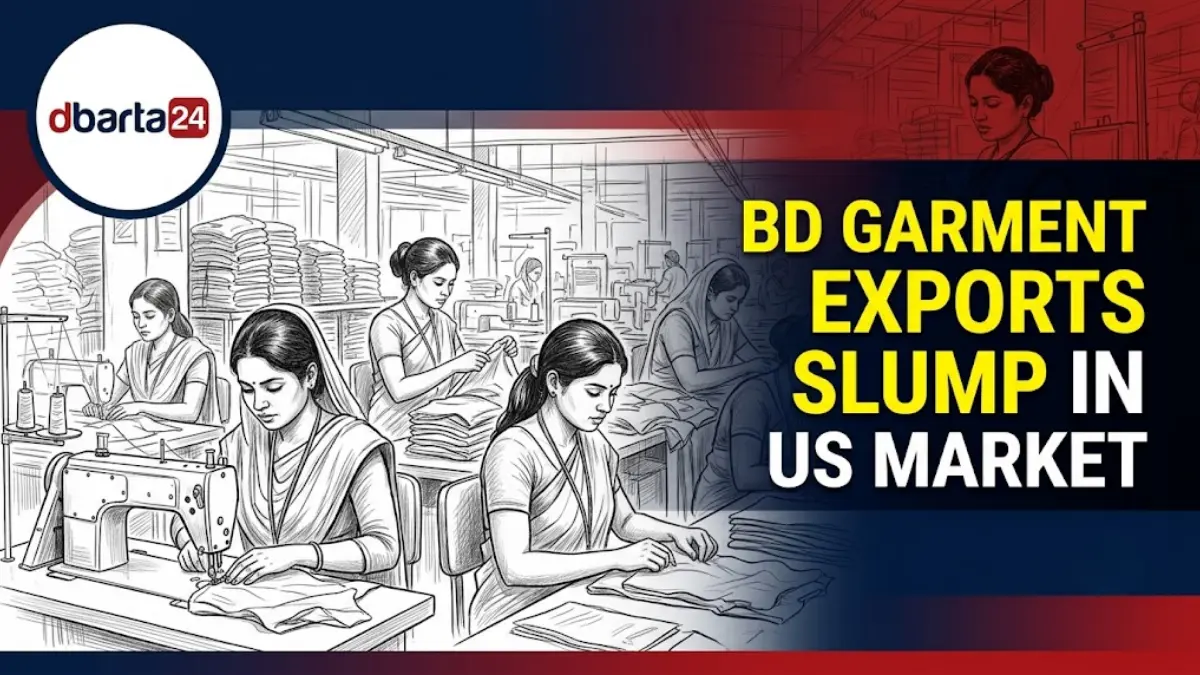
M A Rahim; Dbarta24 — Bangladesh’s readymade garment (RMG) exports to its largest destination, the United States, suffered a setback in the first half of 2026, contracting by 5.75% year-on-year.
According to recent data released by the Office of Textiles and Apparel (OTEXA), key Asian competitors—such as Vietnam, Cambodia, and Indonesia—bucked the trend to expand their market share, placing growing pressure on Bangladeshi apparel manufacturers.
Data published on August 5 shows that total US apparel imports fell by 8.04% to $35.09 billion during the January–June period of 2026, down from $38.15 billion in the same period last year.
Despite remaining the second-largest apparel supplier to the US, Bangladesh saw its export earnings slip from $4.25 billion to $4 billion.
In contrast, Vietnam consolidated its position as the top US market supplier, growing by 1.08% to reach $7.85 billion. Cambodia registered the strongest growth among major exporters, surging 12.32% to $2.13 billion, while Indonesia climbed 3.40% to $2.33 billion.
Major Asian peers like China and India registered sharper declines of 37.69% and 25.27%, dropping to $3.57 billion and $2.12 billion, respectively.
Industry leaders and economists attribute Bangladesh’s negative growth to global economic pressure, tariff uncertainties, shifting buyer policies, and elevated domestic production costs.
Dr. Fahmida Khatun, Executive Director of the Centre for Policy Dialogue (CPD), pointed out that global demand weaknesses and cautious buyer sourcing tactics are squeezing Bangladeshi exporters.
“It is not enough to look at the drop in Bangladesh’s exports alone. It is critical to analyze how our competitors are solidifying their foothold in the US market during the same period. Market shifts, price competitiveness, sourcing strategies, and supply capabilities are now more crucial than ever,” said Dr. Fahmida Khatun.
Mohammad Hatem, President of the Bangladesh Knitwear Manufacturers and Exporters Association (BKMEA), noted that international buyers are adopting shorter, smaller order cycles while applying double pressure on suppliers to reduce prices.
“Uncertainty surrounding US tariff policies, higher logistics costs driven by Middle East conflicts, energy shortages, and global economic headwinds have made international buyers extremely cautious. Many buyers are placing short-term, smaller orders and pushing for price cuts,” Hatem stated. He added that rising domestic cost of production, energy constraints, and logistical hurdles are impacting Bangladesh’s pricing power.
Echoing similar concerns, CPD Distinguished Fellow Professor Mustafizur Rahman described the negative trend as an alarm bell rather than an isolated incident. He emphasized that the combined effect of external market pressures and internal operational constraints demands urgent policy intervention.
“This negative growth in the US market reflects the broader pressures accumulating on our export sector. Immediate and effective measures are necessary to maintain our competitive edge,” Professor Mustafizur Rahman noted.
To reverse the downward trajectory, economists and apparel exporters urge the government to ensure an uninterrupted energy supply, improve the ease of doing business, reduce production overheads, and provide tailored policy support to help exporters navigate the changing global trade landscape.