


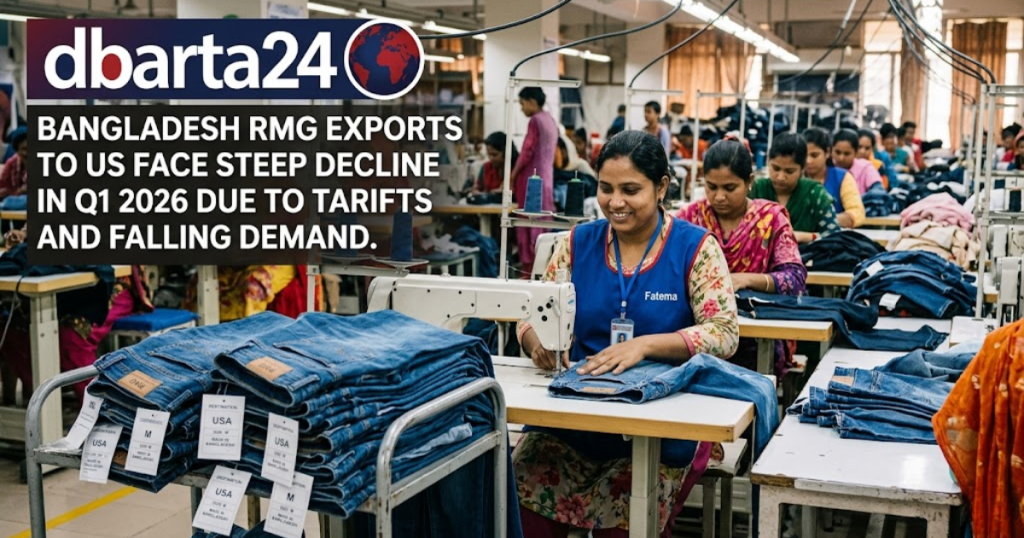
Khairul Alam ; Dhaka – Bangladesh’s Ready-Made Garment (RMG) sector is facing a major setback in its primary export destination, the United States.
Recent data reveals a sharp decline in export growth during the first quarter (January-March) of 2026, sparked by new US “reciprocal” tariff policies, high interest rates, and shifting consumer behavior.
The Numbers at a Glance
According to the US Department of Commerce’s Office of Textiles and Apparel (OTEXA):
-
Overall US Imports: Total US apparel imports fell by 11.63% in Q1 2026.
-
Bangladesh’s Performance: Exports from Bangladesh dropped 8.38%, totaling $2.04 billion.
-
Price Drop: The average unit price of Bangladeshi garments fell by 2.56% to $2.86 per piece.
-
Volume Decline: Export volume decreased by 5.97%.
Competitors Gaining Ground
While Bangladesh and China (which saw a massive 52.91% drop) are struggling, competitors like Vietnam and Cambodia are showing resilience. Vietnam saw a modest growth of 2.77%, while Cambodia surged with a 17.60% increase in the first quarter.
Expert Insights: A Perfect Storm
Mahmud Hasan Khan, President of BGMEA, highlighted the volatility of the current market. “We are battling a combination of US counter-tariffs, Middle East tensions, and domestic energy shortages.
Global buyers are moving away from bulk orders toward smaller, short-term commitments,” he stated.
Selim Rahman, Managing Director of KDS Group, emphasized that the transition out of the Least Developed Country (LDC) status adds another layer of complexity. He urged the industry to focus on:
-
Increasing production efficiency.
-
Diversifying into high-value “technical textiles.”
-
Strengthening trade diplomacy.
The “April Growth” Illusion
Although April 2026 showed a 31.21% growth compared to April 2025, analysts warn this is a “base effect” anomaly. April 2025 was an exceptionally poor month due to Eid holidays, shipment delays, and the initial shock of the “Liberation Day” tariff announcements.
The Path Forward
Industry leaders like Ashikur Rahman Tuhin of Tad Group argue that low-cost labor is no longer enough to win. To remain competitive, Bangladesh must:
-
Ensure Energy Security: Prioritize gas and electricity for factories.
-
Market Diversification: Look beyond the US toward Japan, Australia, and Africa.
-
Infrastructure: Modernize ports and reduce “lead time” (the time from order to delivery).
Despite the current hurdles, former BGMEA Director Mohiddin Rubel remains optimistic, noting that as China continues to lose US market share, a massive opportunity remains for Bangladesh if it can adapt quickly to the new tariff landscape.