


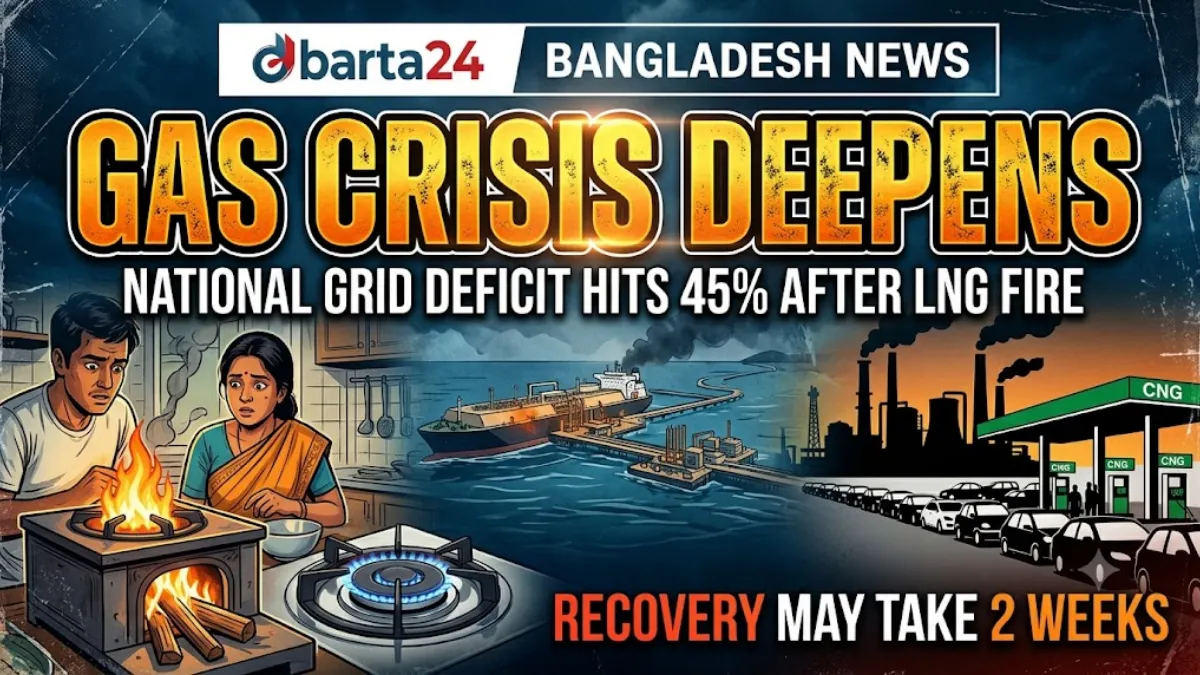
Muhammad Tareq ; Dbarta24 Report — The severe gas crisis gripping Bangladesh is likely to persist for at least another two weeks, threatening prolonged disruptions across households, industrial units, transport, and power generation.
The shortfall worsened dramatically following a fire at one of the country’s key Floating Storage and Regasification Units (FSRU) in Moheshkhali, leaving the national grid struggling with a near 45 percent deficit.
Residential consumers and industrial hubs are bearing the brunt of the shortfall, while power officials warn that load-shedding could escalate in the coming days as nationwide temperatures rise.
Terminal Fire Triggers Massive Grid Deficit
The disruption stems from an electrical short circuit that broke out last Tuesday at the FSRU operated by US-based Excelerate Energy.
The accident forced an immediate shutdown of the floating terminal, wiping out roughly 450 million cubic feet per day (mmcfd) of gas from the national grid.
Before the incident, Bangladesh was supplying around 2,650 mmcfd against a national demand of 3,800 mmcfd—a pre-existing shortfall of 30 percent.
With the Moheshkhali unit offline, total daily supply has plunged to approximately 2,200 mmcfd, pushing the national deficit up to nearly 45 percent.
Foreign engineers from the United Kingdom were brought in on Thursday to repair burnt electrical equipment and specialized cabling.
However, officials confirm that full restoration will take time due to complex technical and administrative procedures.
According to official sources, the facility may partially resume operation within five to eight days, restoring around 300 mmcfd to the grid.
Restoring full operational capacity, however, will require 10 to 15 days, as the international operator must also finalize insurance and safety protocols.
“The cables were burnt due to a short circuit. Foreign engineers are working on repairs. At this moment, it is not possible to confirm an exact completion date.”
— Rafiqul Islam, Director (Operations), Petrobangla
“Engineers from the UK are working round-the-clock. Some spare parts may need to be imported from abroad. Excelerate Energy has been urged to resume operations quickly, but they have not provided a fixed date.”
— Monir Hossain Chowdhury, Joint Secretary, Energy Division
Kitchens Go Cold, Vehicles Line Up at CNG Pumps
The crisis has upended daily life across major cities. In Dhaka neighborhoods such as Mohammadpur, Mirpur, Dhanmondi, Kalabagan, Badda, and Rampura, gas pressure has remained near zero for most of the day.
Many households have been forced to rely on electric induction cookers or traditional firewood, while others wait until late at night for minimal gas pressure to prepare meals for the following day.
“The gas pressure was so low since morning that cooking was impossible. Even after gas returned post 9:00 PM, it took nearly an hour just to cook rice.”
— Rozina Parveen, Resident of Moghbazar, Dhaka
“I kept a pan on the stove for nearly an hour at noon, but the oil didn’t even heat up. Unable to prepare timely meals for my toddler, I am forced to buy food from outside every day.”
— Jasmin Akter, Resident of Kathalbagan, Dhaka
The transport sector faces similar paralysis. CNG refueling stations across Dhaka and regional districts report drastically reduced pressure, forcing drivers to queue for hours—often overnight—only to find stations closed.
“A station requires at least 15 PSI of gas pressure to operate normally. However, many areas are currently receiving only 4 to 5 PSI, and in some places less than 2 PSI. Under these conditions, selling gas is virtually impossible.”
— Farhan Noor, General Secretary, CNG Filling Station and Conversion Workshop Owners Association
Industrial Output Slows, Power Cuts Loom
The industrial sector is rapidly feeling the strain. Manufacturing plants, particularly in the garment and textile hubs, have been forced to scale back production or switch to expensive alternatives like diesel and LPG, driving up production costs and risking export deadlines.
In the capital’s primary distribution area, supply has dropped significantly. Kazi Mohammad Saidul Hasan, General Manager (Operations) at Titas Gas Transmission and Distribution Company, noted that against a daily demand of nearly 1,900 mmcfd, supply has fallen from 1,500 mmcfd down to 1,200 mmcfd.
Meanwhile, gas supply to power plants has dropped from 900 mmcfd to roughly 700 mmcfd, reducing gas-fired electricity generation from its usual 5,000–6,000 MW capacity to around 4,000 MW.
While mild rainfall and weekend holidays temporarily kept widespread power outages at bay, Bangladesh Power Development Board (BPDB) officials warn that reduced rainfall and rising temperatures over the coming week will inevitably increase power demand and lead to heavier nationwide load-shedding.
Structural Vulnerabilities in Energy Supply
Bangladesh introduced imported Liquefied Natural Gas (LNG) in 2018 through Excelerate Energy’s 600 mmcfd capacity terminal under a 15-year agreement. Summit Group added a second floating terminal in 2020 with a 500 mmcfd capacity.
However, technical failures at either terminal repeatedly leave the national energy grid vulnerable.
With technical glitches disrupting floating terminal operations at least three times this year alone, energy analysts continue to emphasize the urgent need for onshore LNG land terminals, accelerated domestic offshore and onshore gas exploration, and structural diversification of the country’s energy mix.