


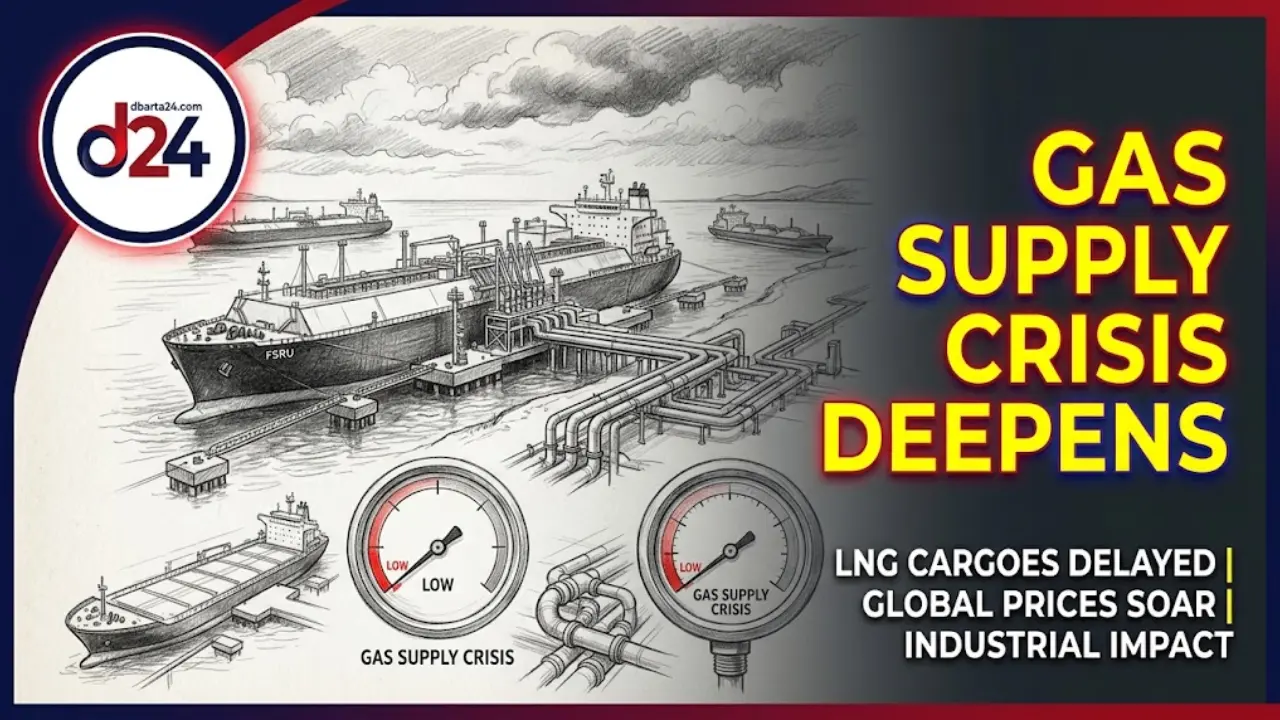
Md. Tareq; Dbarta24 — Bangladesh is on the brink of a intensified gas supply crunch as uncertainty looms over the timely arrival of crucial Liquefied Natural Gas (LNG) cargoes.
With skyrocketing global spot prices and low supplier response, Petrobangla is struggling to maintain current import levels, threatening both the country’s industrial sector and electricity generation.
LNG Shipments Face Unyielding Delays
According to officials from the Energy and Mineral Resources Division, an LNG cargo destined for the Summit FSRU terminal expected this week faces significant delivery uncertainty.
Meanwhile, no new shipment is slated to arrive at the Excelerate terminal before September 1.
Currently, Petrobangla feeds around 2,376 million cubic feet per day (mmcfd) of gas into the national grid, with imported LNG contributing roughly 762 mmcfd—nearly one-third of the total supply.
With Bangladesh’s real daily gas demand estimated between 5,000 and 5,500 mmcfd against an official requirement of 3,800 mmcfd, even a slight decline in LNG supply threatens to severely aggravate the ongoing energy crisis.
Soaring International Spot Prices Hurt Imports
While long-term contracts with Qatar and Oman provide a base volume at relatively lower rates, geopolitical tensions in the Middle East have disrupted regular supplies, forcing Bangladesh to rely heavily on the volatile spot market.
Global LNG spot prices have surged dramatically. In early 2024, spot LNG traded around $11 per MMBtu, rising to $14–$15 by April, and surpassing $24 to $25 per MMBtu in recent tenders.
European nations stockpiling energy ahead of winter have further tightened global supply.
An official from the Rupantarita Prakritik Gas Company Limited (RPGCL) noted that every $1 increase per MMBtu adds approximately BDT 41.33 crore to the cost of a single cargo.
Compared to April rates, the government now pays nearly BDT 400 crore more per shipment. Efforts to procure cargoes via Direct Purchase Method (DPM) also stumbled after four scheduled shipments failed to arrive this month.
Shifting Priority: Industrial Sector vs. Power Generation
To avert massive layoffs and factory closures, the government has decided to redirect gas supply from power plants to industrial units.
Gas allocation for power generation is being scaled down from 950 mmcfd to 750 mmcfd, freeing up 200 mmcfd for factories.
However, this shift risks triggering widespread electricity shortages. Engr. Md. Rezaul Karim, Chairman of the Power Development Board (PDB), stated that efforts are underway to boost furnace oil-based power generation to compensate for the shortfall.
Although oil-based plants have a total capacity of nearly 6,400 MW, they currently generate only 2,000 to 2,500 MW.
The government is preparing to scale up oil-fired output to 4,000 MW, though rolling load-shedding remains a backup plan, prioritizing Dhaka before hitting district towns and rural areas.
Industry Leaders and Experts Urge Structural Reforms
Commenting on the energy crisis, Mahmud Hasan Khan, President of the Bangladesh Garment Manufacturers and Exporters Association (BGMEA), highlighted that high LNG market prices make oil-fired power generation costs comparable.
He urged the government to reduce the 30% duty on furnace oil imports to 5% for the next six months to a year to cushion production costs.
Meanwhile, Consumer Association of Bangladesh (CAB) Energy Adviser Prof. Dr. M. Shamsul Alam emphasized the urgent need to address the industrial gas shortage while expediting solar energy integration and commissioning the Rooppur Nuclear Power Plant to build long-term energy resilience.