


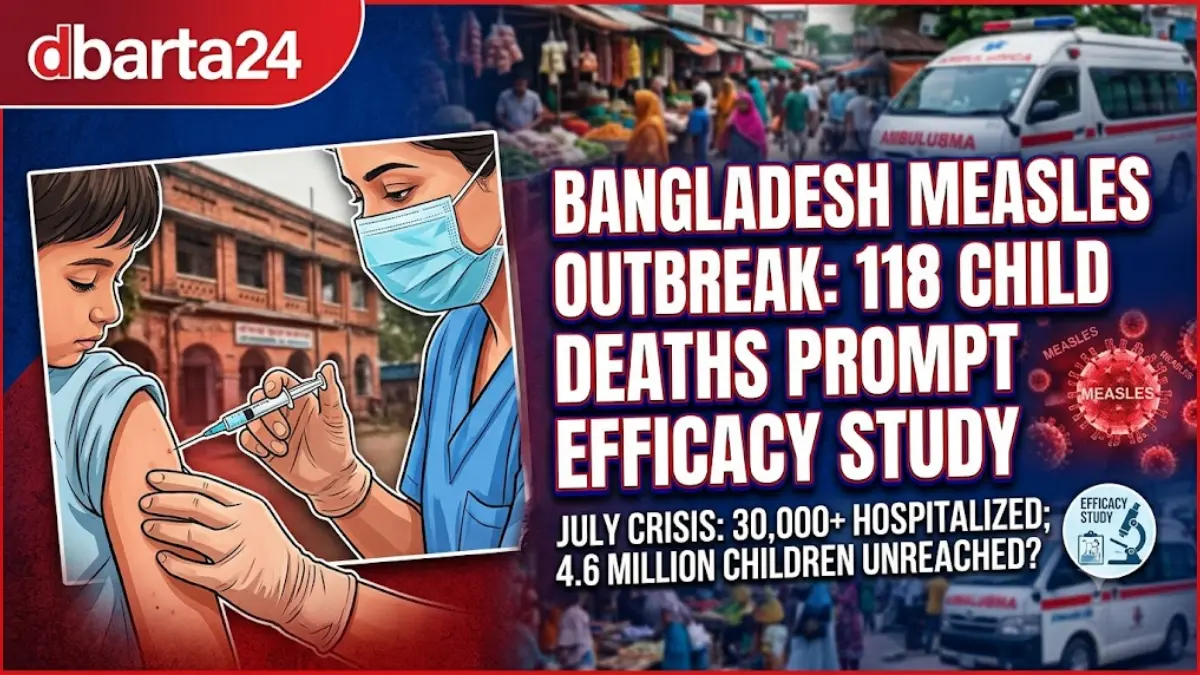
Muyabia Labony; Dbarta24 — The Government of Bangladesh has launched a nationwide research initiative to evaluate the efficacy of the Measles-Rubella (MR) vaccine following a alarming surge in child fatalities and hospitalizations.
The study aims to measure antibody levels in vaccinated children, with findings expected by mid-August.
The investigation comes amidst a severe measles surge that claimed the lives of at least 118 children in July alone, according to official data. Over 30,200 children were hospitalized during the same month, with roughly 1,000 new cases still being recorded daily across the country.
Targets Mismatched: Millions Left Unprotected
The outbreak began in March, prompting the Directorate General of Health Services (DGHS) to initiate targeted vaccination drives in April across vulnerable districts, municipalities, and major city corporations before expanding nationwide.
However, public health experts and officials point to a significant discrepancy in execution targets.
While the government claimed a 103% success rate by vaccinating 18 million children aged 6 to 59 months, the national Vitamin ‘A’ campaign for the same demographic targeted 22.6 million children.
This leaves a critical gap of roughly 4.6 million children who remained completely unreached by the special immunization drive.
Acknowledging the gap, Health Minister Sardar Md. Sakhawat Hossain stated that the situation remains critical.
“Measles is not yet under control. A major portion of those infected are either unvaccinated or suffering from malnutrition,” said Minister Hossain. “There were discrepancies in target calculations based on WHO guidelines, leaving around 4.6 million children outside the campaign. We will hold a fresh review meeting to formulate a plan to vaccinate these left-out children immediately.”
Vaccinated Yet Vulnerable
Disturbingly, severe infections and deaths are being reported even among fully vaccinated children, raising grave concerns over cold-chain integrity, vaccine potency, and individual immune responses.
At the Bangladesh Shishu Hospital and Institute in Dhaka, three-year-old Arafat Sajid was admitted on July 19 after contracting measles. Despite receiving two scheduled doses under the Expanded Programme on Immunization (EPI) as well as the recent special dose, he developed severe illness.
In a tragic case, ten-month-old Hafsa from Patuakhali passed away from post-measles complications despite having received her shot during the campaign.
Vaccine specialist Tajul Islam Bari emphasized the need for post-vaccination serological monitoring.
“An antibody level of at least 120 IU/mL is generally considered protective. If levels fall below this, revaccination must be evaluated,” Bari explained, adding that prioritized blood testing in high-transmission zones is essential to determine whether booster doses are necessary.
Gaps in Broader Public Health Strategy
Epidemiologists caution that relying solely on vaccination drives is insufficient to halt community transmission.
Professor Mahmudur Rahman, Chairman of the National Verification Committee (NVC) for Measles and Rubella Elimination, noted that basic infection control protocols—similar to those deployed during the COVID-19 pandemic—were largely neglected.
Measures such as isolating symptomatic children, promoting hand hygiene, and raising community awareness were severely lacking.
“For the past three to four years, we have seen an increasing trend of infants contracting measles before even reaching the eligible vaccination age,” Professor Rahman noted, attributing the susceptibility to maternal malnutrition, infant malnutrition, Vitamin A deficiency, and lack of exclusive breastfeeding.
Dr. Mushtaq Hussain, a prominent public health expert, added that post-marketing surveillance and efficacy evaluations are standard global practices after major immunization drives to assess real-world protection levels.
What Lies Ahead
Blood samples are currently being collected from 18 selected upazilas across the nation by the Institute of Epidemiology, Disease Control and Research (IEDCR).
Acting Director Dr. Kazi Ahmed Zaki confirmed that testing is underway to determine what percentage of vaccinated children have successfully developed adequate immunity.
The upcoming mid-August report will be pivotal in determining whether Bangladesh needs to alter its immunization strategy, administer booster doses, or execute an emergency catch-up campaign to bridge the massive gap in child coverage.