


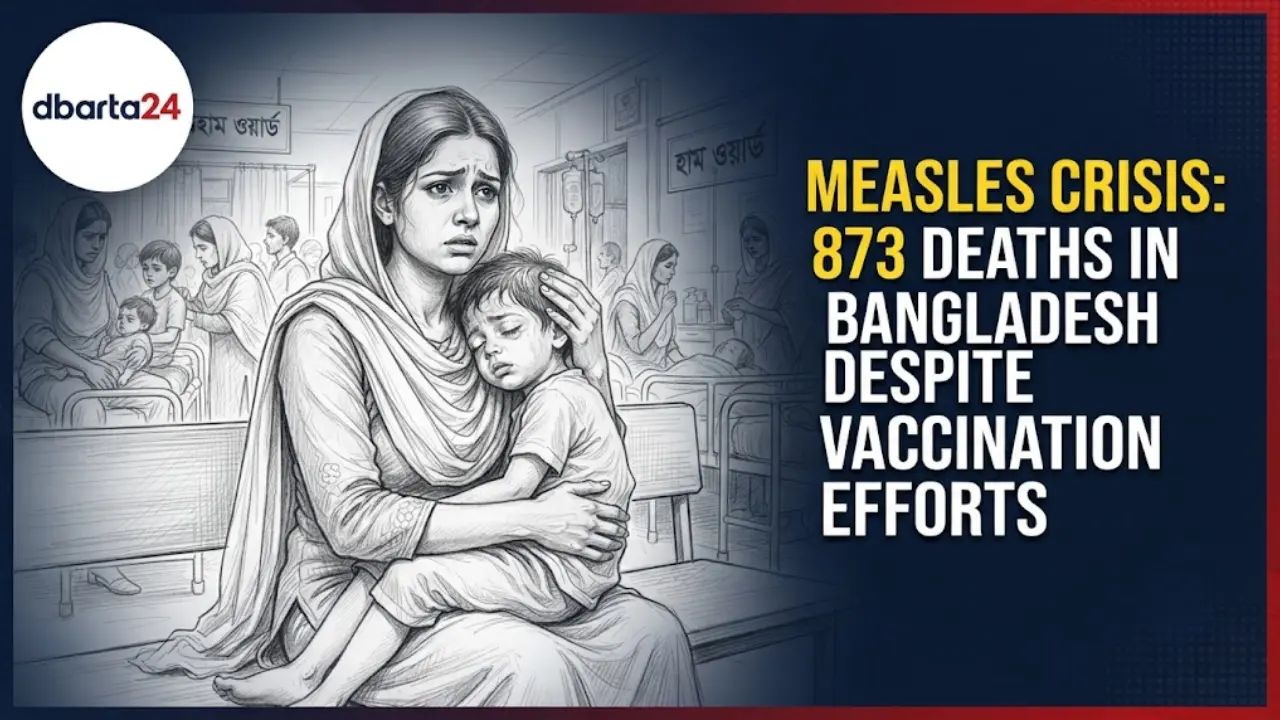
Khairul Alam; Dbarta24- A relentless measles outbreak across Bangladesh continues to claim young lives, pushing the national death toll to 873.
Despite extensive nationwide vaccination campaigns that authorities report have exceeded coverage targets, the virus is still spreading rapidly, leaving families devastated and overwhelming pediatric hospital wards.
Since the onset of the current outbreak, the Directorate General of Health Services (DGHS) has recorded 153,435 measles and suspected measles cases, including 17,115 confirmed cases.
A total of 118,382 patients have required hospital admission, with the crisis hitting infants and toddlers the hardest.
The government launched an extensive measles-rubella vaccination campaign starting in April, successfully reaching over 2 million children in city corporations (107% of the target) and more than 1.9 million children across regional divisions.
However, the emergence of widespread infections among both vaccinated and unvaccinated minors has sparked intense public scrutiny and profound concern among families.
Hospital management systems are buckling under the pressure. Families report enduring grueling journeys, moving from one facility to another in search of specialized pediatric wards, intensive care units (ICUs), and neonatal intensive care units (NICUs). Many hospitals lack adequate specialized care infrastructure for severe cases.
Recent joint investigations by the International Centre for Diarrhoeal Disease Research, Bangladesh (icddr,b) and the Bangladesh Shishu Hospital and Institute analyzed 341 suspected cases among children under 14.
Laboratory results confirmed measles in 324 of these cases. Notably, the study found that 92% of children who received one vaccine dose and 76% of those who received the recommended two doses still contracted the virus, primarily affecting infants too young for routine vaccination or those within the vulnerable 3-to-8-month age bracket.
Experts emphasize the urgent need for comprehensive research. Renowned medicine specialist Professor Dr. ABM Abdullah noted that vaccines typically require several weeks to build full immunity, but stressed the necessity of investigating potential viral mutations, immunization delivery processes, and underlying malnutrition rates among affected children.
Dr. Kazi Ahmed Zakir, Director of the Institute of Epidemiology, Disease Control and Research (IEDCR), confirmed that preliminary tests show the circulating virus is a local strain rather than a new foreign variant, with targeted studies on vaccine efficacy currently underway.
Furthermore, a joint assessment by the Bangladesh Red Crescent Society (BDRCS) and the International Federation of Red Cross and Red Crescent Societies (IFRC) revealed severe financial fallout.
Nearly 89% of affected families have taken on debt to cover medical expenses, while 61% have exhausted their personal savings, spending an average of 16,000 Taka per family amid lost wages and employment.
The human cost of the outbreak is immense, reflected in the grief of parents navigating the strained healthcare system.
Sanjida Akhter, whose 9-month-old son Osman contracted measles despite receiving the government-administered vaccine at six months of age, shared her ordeal with Dbarta24 News:
“We vaccinated our child according to the government’s advice, yet he still caught measles. We ran from hospital to hospital… The government could not give us safety or peace. The suffering at every step was indescribable. No one helps, no one offers reassurance. The journey was agonizing beyond words.”
Another parent, mourning the loss of their child Esha, expressed the helplessness felt by many families:
“We couldn’t save our child even after moving from hospital to hospital. The situation deteriorated before we even realized it. Sending us from one hospital to another—in the end, we are ruined, and our child is gone. Whose fault is it? Who do we turn to? Does anyone care about what we are going through?”
The escalating measles crisis in Bangladesh highlights a critical juncture for public health infrastructure.
While mass immunization efforts have achieved high coverage rates, the ongoing fatalities and breakthrough infections underscore the urgent necessity for advanced epidemiological research, enhanced hospital capacity, and targeted financial and medical support for vulnerable families bearing the brunt of the outbreak.