


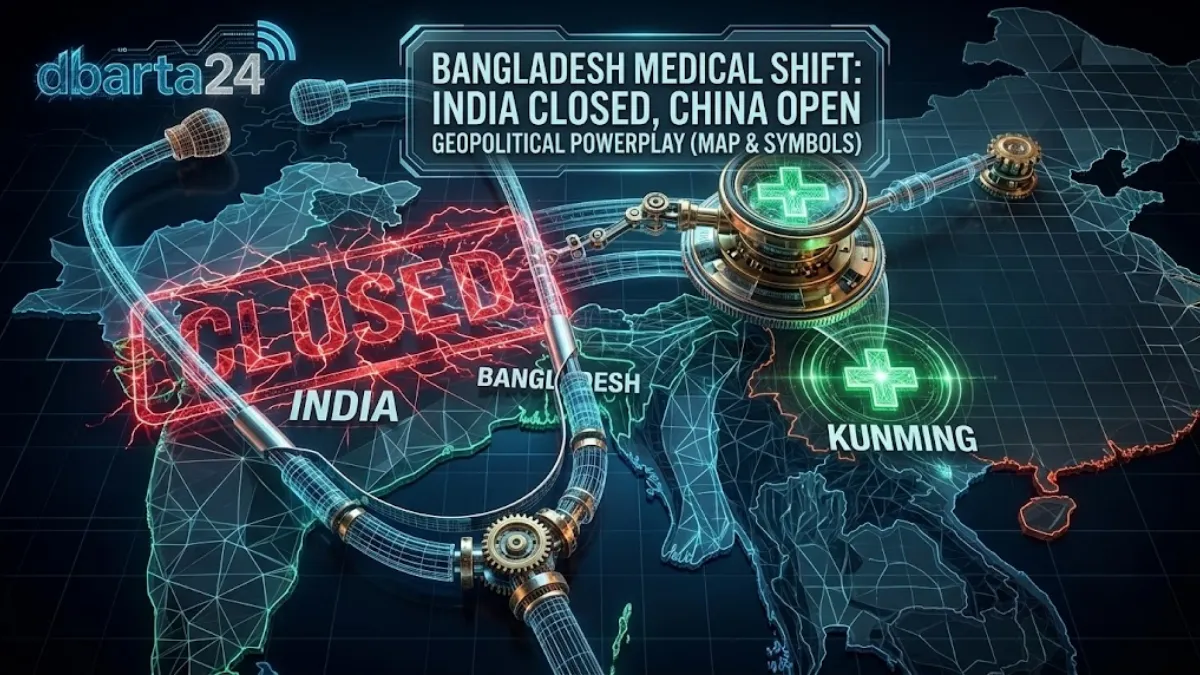
Khairul Alam ; Dhaka – The landscape of South Asian medical tourism is undergoing a seismic transformation. For decades, India was the default destination for Bangladeshi patients seeking specialized care.
However, a deepening visa crisis, triggered by the diplomatic friction following the July Revolution, has paved the way for a new player: China.
Through strategic “Medical Diplomacy” and the “Kunming Model,” Beijing is rapidly positioning itself as the primary alternative for a $5 billion healthcare market.
The Human Cost: A Compelling Lead
For a patient from Mymensingh who had been receiving treatment at Tamil Nadu’s Christian Medical College since 2015, the diplomatic rift is not just a matter of policy—it is a matter of survival.
After four successful operations, a critical follow-up scheduled for October 2024 was missed because a visa was never granted. Despite visiting the Indian Assistant High Commission with an active infection at his surgical site, the door remained closed.
This is the reality for thousands, including patients like Jesmin at AIG Hospital in Hyderabad, whose follow-up care was delayed by more than four months due to visa bottlenecks, and Akhtari Banu, who represents the many caught in a frantic search for alternative destinations.
These are not isolated incidents; they are the human casualties of a regional friction where routine medical appointments have become a “life-or-death” gamble.
The Crisis in Numbers: The India-Bangladesh Visa Rift
The decline in medical mobility between Bangladesh and India is stark. Following the political upheaval of August 5, 2024—often referred to as the July Revolution—the Indian government made a unilateral decision to drastically reduce visa approvals.
While the border has not officially closed to patients, the system has effectively stalled. According to data reported in early 2025, the daily volume of medical visas issued has plummeted from 5,000–7,000 in 2023 to less than 500 in early 2025.
Key Statistic: In September 2024 alone, the Indian visa office in Dhaka rejected more than 20,000 applications. Many of these belonged to patients in critical condition who had been receiving long-term, life-saving care in India.
The $5 Billion Healthcare Drain
Bangladeshi citizens represent one of the world’s largest medical tourism cohorts. Annually, between 450,000 and 800,000 people travel abroad for treatment, spending over $5 billion—an amount that exceeds the national health budget of Bangladesh.
Historically, more than half of this expenditure went to India. The preference was logical: proximity, lower costs, and a shared language in hubs like Kolkata or Chennai.
However, as the diplomatic relationship remains strained, this massive capital outflow is seeking new destinations. While those with higher means are turning to Thailand or Turkey, the middle class is increasingly looking North.
The Kunming Pivot: China’s Strategic Response
As India’s doors closed, Beijing moved with calculated speed. In January 2025, Foreign Advisor Touhid Hossain visited Beijing to request that hospitals in Kunming be opened to Bangladeshi patients.
The response was immediate. By March 2025, the first official group of 14 patients, accompanied by physicians and journalists, arrived in Kunming.
This initiative is centered on the “Kunming Model,” designating four specific hospitals for Bangladeshi patients:
- The First People’s Hospital of Yunnan Province
- The First Affiliated Hospital of Kunming Medical University
- Fuwai Yunnan Hospital (Chinese Academy of Medical Sciences)
- The Traditional Chinese Medicine (TCM) Hospital
Chinese Ambassador Yao Wen has been a central figure in this pivot, projecting that the number of Bangladeshi patients in China will exceed 4,000–5,000 by the end of 2025.
Comparative Analysis: China vs. The Region
China is positioning Kunming as a superior alternative by focusing on efficiency and a competitive cost-to-quality ratio. Notably, while Kunming is more expensive than India, it remains significantly more affordable than traditional high-end hubs like Bangkok.
| Feature | Kunming (China) | Chennai/Delhi (India) | Thailand/Malaysia |
| Travel Time (from Dhaka) | 2 Hours 20 Minutes | 2 Hours 50 Minutes (Chennai) | ~2.5 – 3 Hours |
| Visa Processing | 1 Working Day (With Hospital Invitation) | Restricted / Severe Delays | Standard Processing |
| Cost Comparison | 10% Higher than Delhi | Base Reference (Lowest) | 400% Higher (4x Kunming cost) |
| Quality of Care | Matches Thailand Standard | High / Specialized | Global Gold Standard |
Lu Jiang, Vice President of Fuwai Hospital, emphasizes that the quality of care in Kunming matches that of Thailand at only one-fourth the price.
For the Bangladeshi middle class, paying 10% more than a major Delhi hospital is a small price for the certainty of a one-day visa and immediate care.
Traditional Chinese Medicine (TCM) and Cultural Diplomacy
A unique pillar of this shift is the role of the TCM Hospital. China is leveraging its “thousand-year-old culture” as a potent tool of soft power.
By offering acupuncture—recognized by UNESCO in 2010 as an Intangible Cultural Heritage—alongside herbal medicine and Qigong, Beijing is introducing Bangladeshi patients to a philosophical tradition of healing. This “Kunming Model” is as much about cultural integration as it is about clinical outcomes.
Existing Barriers and Bottlenecks
Despite the rapid growth, China faces structural challenges in fully replacing the Indian medical ecosystem:
- Logistics: With only one direct flight per day from Dhaka to Kunming, ticket prices remain high. Families who once traveled to Kolkata for 30,000 BDT find the costs of flights to China a significant barrier.
- Language Barrier: Unlike the linguistic ease of West Bengal, patients in Kunming require interpreters. While costs have dropped from 500 Yuan to 200–300 Yuan per day, it remains an added expense.
- Cuisine: The easy accessibility of Bangladeshi food found in Chennai or Kolkata is currently missing in Kunming, though efforts are underway to address this.
Looking Inward: Infrastructure and Self-Reliance
The pivot to China provides short-term relief, but it exposes a long-term vulnerability. To stop the $5 billion annual drain, Bangladesh must improve its own infrastructure.
China is currently assisting in this shift by beginning the construction of three 1,000-bed “Bangladesh-China Friendship Hospitals.”
The analytical question remains: Is Bangladesh ready to learn from the Chinese model?
The ultimate goal is not merely to find a new destination for exports of patients, but to transform Bangladesh into a regional healthcare hub capable of serving its own citizens and its neighbors.