


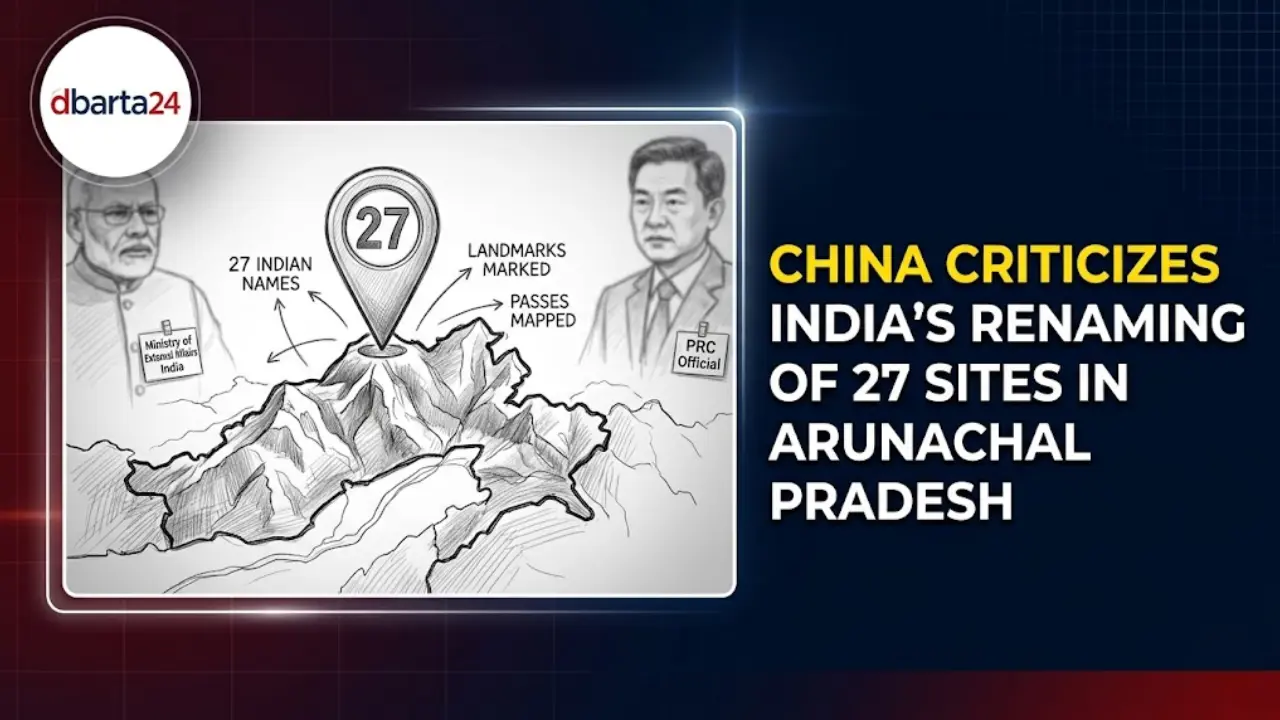
Dbarta24 International Desk — Chinese official media and policy experts have strongly criticized India’s recent decision to name and officially map 27 locations in the northeastern state of Arunachal Pradesh.
Beijing termed the administrative action “unilateral” and warned that such moves could derail the ongoing stabilization of bilateral relations between the two Asian powers.
The developments follow New Delhi’s formal naming and mapping of 27 geographical features—including land areas, mountain passes, and historic monuments—in Arunachal Pradesh.
The move came as a direct counter-response to Beijing’s repeated attempts to assert territorial claims over the region by assigning Chinese names to local features.
Reciprocal Naming and Territorial Rivalry
The territorial dispute over Arunachal Pradesh—which China claims as part of southern Tibet and refers to as “Zangnan”—has long been a major flashpoint between New Delhi and Beijing.
China’s Ministry of Culture and Tourism has systematically released six batches of geographical names for locations within the state since 2017.
Most recently, in April 2026, Beijing announced standard names along with precise geographical coordinates for 112 sites, encompassing villages, mountain passes, rivers, and peaks.
India’s recent mapping initiative directly addresses those earlier announcements, establishing official Indian geographical nomenclature on state maps.
Chinese Reactions and Diplomatic Stance
Reacting to India’s decision, Chinese state-backed media and foreign policy analysts argued that New Delhi’s actions risk reigniting border friction.
Qian Feng, Director of the Research Department at Tsinghua University, cautioned against escalation, emphasizing that the border issue should not be driven toward greater confrontation, as it directly impacts the broader stability of bilateral relations.
Expressing a similar sentiment, Guo Xuetang, a professor at the Center for South Asia and Indian Ocean Studies at Shanghai International Studies University, described India’s naming effort as a unilateral administrative step that fails to alter the region’s legal status under international norms.
Reiterating Beijing’s long-standing diplomatic position, Chinese Foreign Ministry spokesperson Guo Jiakun stated during a press briefing that China does not recognize the establishment or legal validity of the state of Arunachal Pradesh.
“Zangnan is Chinese territory,” Guo Jiakun stated. “India’s attempt to alter the names long used by China is illegal, null, and void. It does not change the fact that the Zangnan region belongs to China.”
Despite the sharp rhetoric, the spokesperson noted that broader diplomatic ties between the two nations remain relatively stable, adding that China remains committed to working alongside India toward constructive bilateral engagement.
New Delhi’s Position
The Indian government has consistently rejected Beijing’s territorial claims and renamings. New Delhi maintains that Arunachal Pradesh is an integral and inalienable part of India, asserting that assigning foreign names to places within Indian territory carries no legal or sovereign effect.
While both nations continue diplomatic efforts to manage border tensions along the Line of Actual Control (LAC), the tit-for-tat naming actions highlight the underlying friction surrounding sovereignty, mapping, and territorial jurisdiction in the eastern Himalayas.