


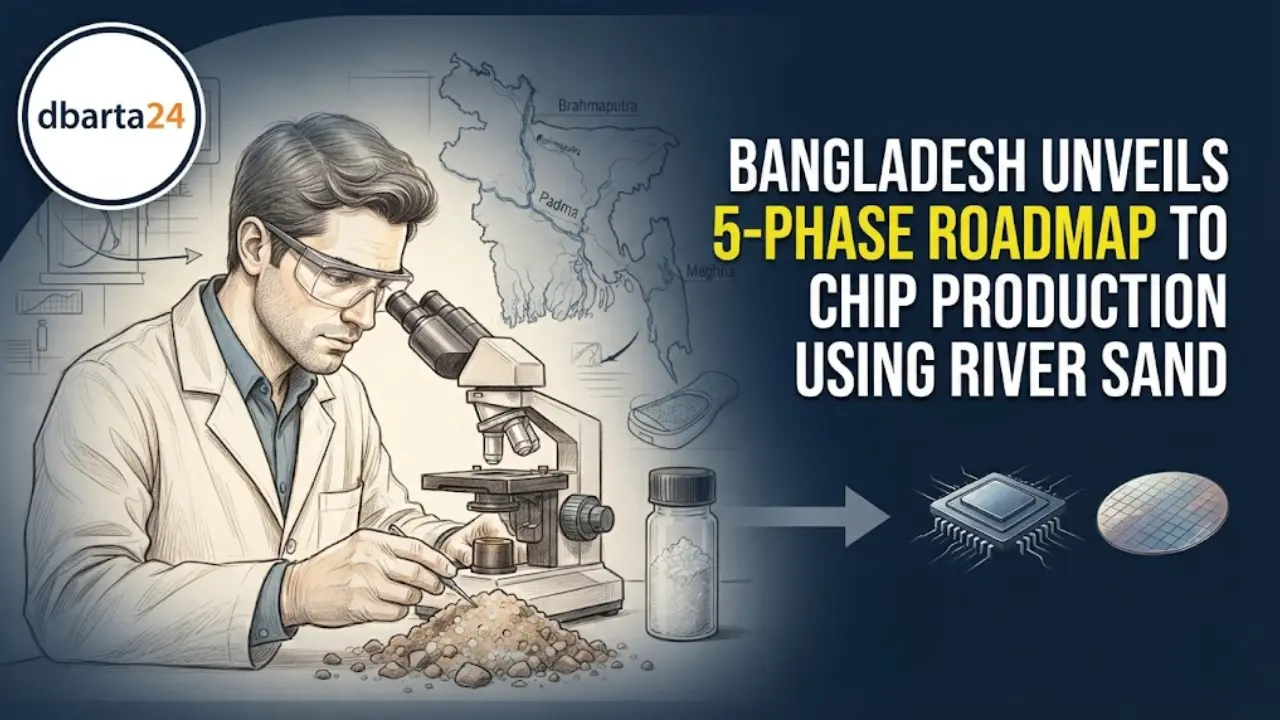
Researchers propose a 2026–2050 roadmap to tap into Bangladesh’s river sand for high-purity silica, aiming to establish the nation as a semiconductor industry player. Report By M K Alam; Dbarta24.com.
Bangladesh has taken a landmark step toward potentially entering the global semiconductor supply chain.
Following a comprehensive survey of the nation’s major river systems, researchers have proposed a strategic five-phase national roadmap (2026–2050) to harness the country’s river sand for high-purity silica production—a critical component in chip manufacturing.
Unlocking the Potential in Riverbed Sand
The study, the first of its kind in the country, analyzed over 6,600 samples collected from 5,481 square kilometers across eight major river basins, including the Brahmaputra-Jamuna, Padma, Teesta, and Meghna.
The research revealed that Bangladesh’s riverbeds contain over 300 billion tons of sand, with roughly 1 to 1.5 billion tons of fresh deposits added annually from Himalayan runoff. Crucially, the analysis showed that the sand contains approximately 88.7% quartz—the essential raw material for silicon-based semiconductor technology.
From Sand to Semiconductor
Dr. Md. Sohel Rana, Deputy Director (Geology) at the Geological Survey of Bangladesh, spearheaded the research. His team successfully produced silica with 99.5% purity using flotation technology, a grade suitable for the glass industry.
However, the semiconductor industry requires “High-Purity Quartz” (HPQ) with a purity level between 99.99% and 99.997%. Achieving this standard requires advanced mineral processing infrastructure and sophisticated diagnostic capabilities.
“Instead of rushing into expensive wafer fabrication factories, we must proceed in stages,” Dr. Rana noted. “Initial focus should be on sectors like specialized glass, optical fibers, and IC design, which can bridge the gap toward semiconductor manufacturing.”
The 2026–2050 Roadmap
The proposed roadmap outlines a pragmatic journey for Bangladesh to build its semiconductor capacity:
-
Phase 1 (2026–2030): Creation of a comprehensive mineral map of river sands and the establishment of a specialized “Sand Processing and Research Center.”
-
Phases 2 & 3 (2031–2040): Scaling production to over 5,000 tons of high-purity silica annually and strengthening the national IC design ecosystem.
-
Phases 4 & 5 (2041–2050): Finalizing the infrastructure to support commercial wafer production and full-scale chip manufacturing plants.
Challenges and Future Outlook
While the potential is significant, the path to becoming a chip manufacturer is fraught with hurdles. Bangladesh faces a critical shortage of advanced mineral processing facilities and skilled manpower.
Furthermore, the industry is highly competitive, requiring immense long-term investment and consistent policy support.
Industry experts emphasize that transitioning from a raw material provider to a high-tech manufacturer requires a stable, long-term strategic vision.
By focusing on intermediate products first, Bangladesh could lay the foundation for a sustainable high-tech future, turning the vast mineral wealth of its rivers into a pillar of the nation’s digital economy.