


M Khan; Dbarta24 — To ensure a smooth, sustainable, and resilient transition from LDC (Least Developed Country) status, the Bangladesh government has drafted a national roadmap spanning 2026 to 2029.
This strategic framework follows Bangladesh’s formal request to extend its graduation timeline to November 24, 2029.
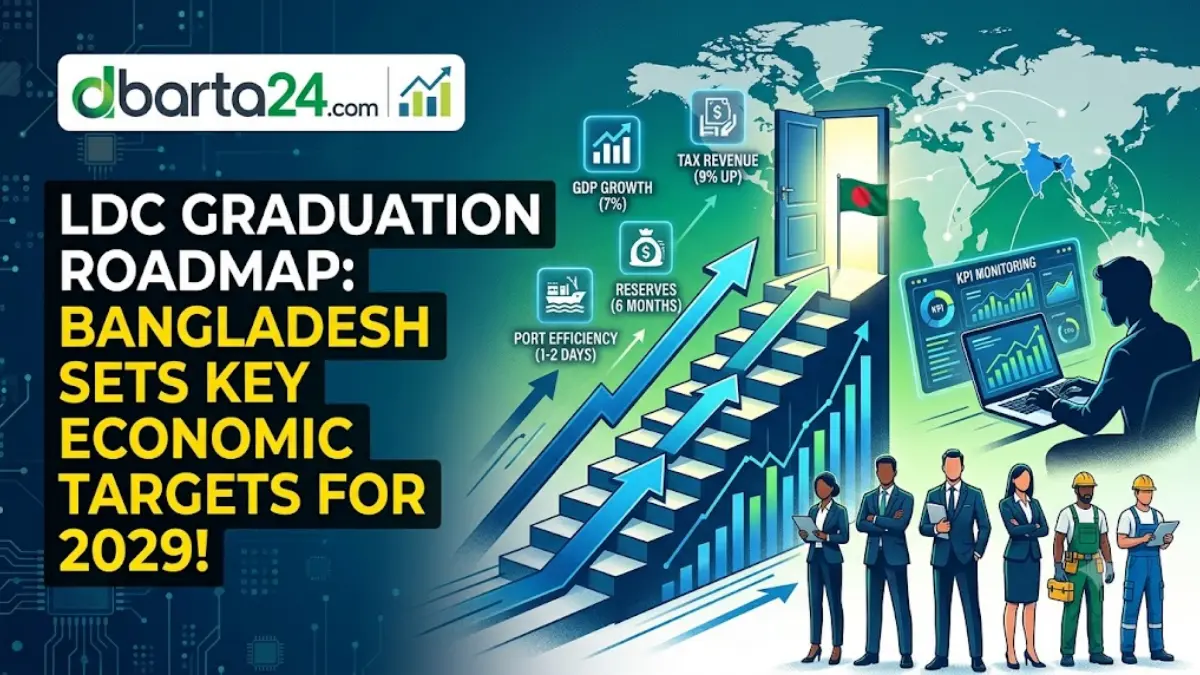
To closely track progress, the government will launch a real-time digital dashboard under the Economic Relations Division (ERD).
According to sources in the Ministry of Finance, this dashboard will monitor 14 key performance indicators (KPIs) covering macroeconomic stability and trade dynamics.
Ambitious Macroeconomic & Structural Targets
Under the roadmap, Bangladesh aims to achieve a 7% GDP growth rate and bring inflation down to 6% by 2029. Additional key operational and structural goals include:
-
Tax-to-GDP Ratio: Raising the tax-to-GDP ratio to at least 9%.
-
Foreign Reserves: Rebuilding foreign currency reserves to cover at least six months of imports.
-
Non-Performing Loans (NPLs): Reducing NPLs from the current ~30% level to below 20%.
-
Private Credit & Exports: Pushing private sector credit growth above 10% and driving non-RMG (Ready-Made Garments) exports to account for at least 25% of total export earnings.
-
Port Efficiency: Cutting average container clearance times at ports from 10 days to just 1–2 days.
-
Governance & ESG: Fully digitizing public business services, training 3 million skilled workers, increasing renewable energy’s share in the energy mix to 15%, and encouraging ESG (Environmental, Social, and Governance) compliance among exporters.
Government officials emphasized that asking for a three-year extension is not an attempt to delay graduation, but a necessary step to execute deep structural reforms amid global economic volatility and energy crises.
Intensive Diplomatic Outreach
Bangladesh previously submitted a request to the UN Committee for Development Policy (CDP) to extend its preparation window until November 24, 2029.
Prime Minister Tarique Rahman addressed a letter to the UN Secretary-General seeking support for the extension.
While the CDP endorsed the extended timeline in principle, it did not explicitly specify dates, passing the final decision to the UN General Assembly via ECOSOC.
To rally support among UN member states, a high-level Bangladeshi delegation led by Commerce Minister Khondokar Abdul Muktadir visited UN Headquarters in New York.
The delegation briefed key officials from the CDP, ECOSOC, the European Union, and the G-77 & China group, clarifying that the extra time will strictly be used to execute time-bound reform measures suggested by development partners.
A 15-member LDC Monitoring and Coordination Committee, headed by Finance Minister Amir Khasru Mahmud Chowdhury, has been formed to oversee implementation. The finalized roadmap will be formally presented to the UN and international stakeholders.
Four-Phase Reform Program
The three-year reform timeline is structured into four distinct execution phases:
| Phase | Timeline | Primary Objectives & Deliverables |
| Phase 1: Quick Wins | By June 2027 | Establish a framework for NPL recovery, conduct bank stress tests, issue business licenses within 7 days, launch a digital One-Stop Service, extend trade license validity to 5 years, and adopt a national ESG framework. |
| Phase 2: Deep Automation | By 2028 | Fully automate NBR, expand the tax net, introduce digital taxation, restructure unprofitable state enterprises, create a Technology Modernization Fund, and operationalize API parks. |
| Phase 3: Diversification | By June 2029 | Drive export diversification (pharma, ICT, agro-processing, leather), conclude Preferential Trade Agreements (PTAs), scale up renewable energy, and cut port clearance times below 2 days. |
| Phase 4: Final Evaluation | July–Dec 2029 | Assess overall progress, address remaining reform gaps, and publish the final post-graduation strategy report. |
Active Private Sector Integration
Recognizing the private sector as the central engine of growth, the roadmap assigns 15 specific action items for businesses.
These focus on industrial automation, digital manufacturing, clean technology investments, and establishing tech-support centers to integrate SMEs into global export value chains.
To ensure governance and policy alignment, a new Public-Private Sector Task Force will identify regulatory bottlenecks and recommend legal reforms.
Expert Analysis
“Although LDC graduation preparations have been discussed for a long time, progress in trade-related reforms has been limited,” noted Dr. Zaidi Sattar, Chairman of the Policy Research Institute of Bangladesh (PRI).
“Following graduation, market competition in key export destinations like the EU and the US will intensify sharply. To survive in that landscape, swift reforms in trade and tariff structures are essential, alongside proactive export diversification. Whatever extra time Bangladesh secures—be it two or three years—presents a crucial window. The government must act fast, present transparent and trackable reform plans, and show visible progress to secure a favorable decision at the UN General Assembly.”