


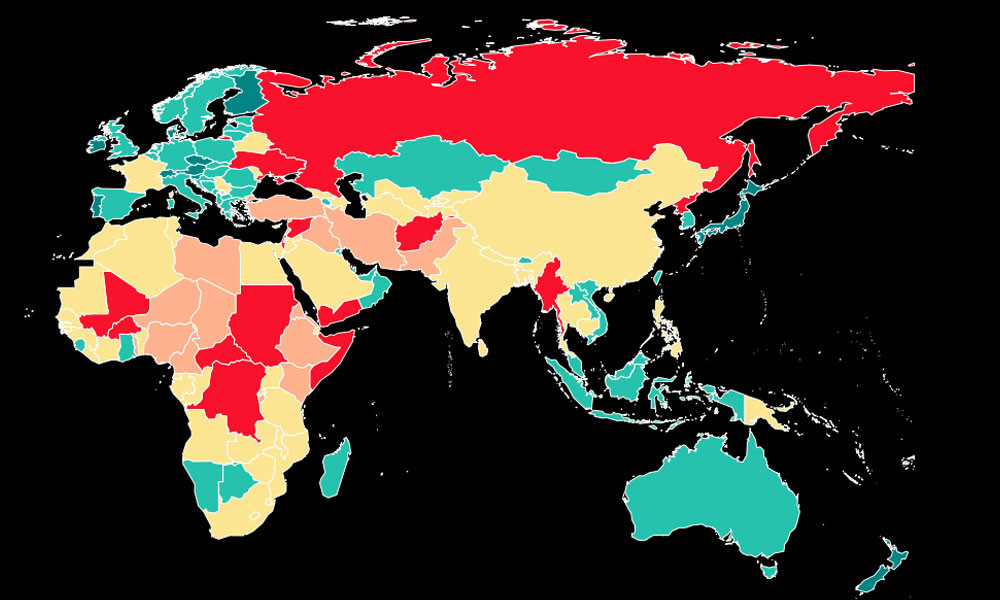
Special Report: Bangladesh has fallen 33 spots to 123rd place in this year’s Global Peace Index (GPI), published by the Institute for Economics & Peace (IEP), an international research organization based in Sydney, Australia. This decline is causing significant concern among experts.
They point to political instability, economic inequality, corruption, social unrest, public dissatisfaction, mob violence, and global conflicts as major reasons for this decrease in peace.
They emphasize the urgent need for specific actions to ensure peace, considering the overall situation.
According to IEP data, despite some improvement in 2023, Bangladesh’s overall score dropped by 13.2% in 2024. The main reason cited is widespread citizen dissatisfaction, which later turned into deadly violence.
In July and August 2024, intense public protests led to the end of former Prime Minister Sheikh Hasina’s rule, and she left the country. Although an interim government was formed afterward, the situation has not improved as expected.
Instead, alongside global unrest, concerns are growing in Bangladesh, further intensified by recent events.
Advocate Hasan Tarique Chowdhury, Secretary of the Bangladesh Peace Council, called Bangladesh’s 33-step drop in the global peace index “undoubtedly regrettable” and “a matter of concern.”
He stated that since the IEP considers factors like economic and social security, and military tensions for its ratings, this decline will send a negative message about Bangladesh’s image to the outside world. He also raised the question of who is responsible for this decline in Bangladesh’s peace index.
Chowdhury suggested that ongoing mob violence, a decline in the rule of law, increasing economic inequality, and security risks for religious and ethnic minority communities could be reasons for this drop, urging the government to review these issues and take immediate specific steps for improvement.
Professor Mir Mohammad Ali of Sher-e-Bangla Agricultural University noted that “instability in society is continuously increasing.”
He added that young people are being misguided into violence. A culture of impunity, lack of good governance, and social and moral decay are deepening this violence.
The professor explained that violence and instability have reduced investor confidence, directly impacting the economy.
He cited a survey revealing that 32% of adults in the country suffer from poor mental health due to political violence, which could lead to a significant long-term breakdown in the stability of the local population.
The same survey found that 25% of the population felt they had lost their normal sense of security due to political violence.
Furthermore, Bangladesh’s reputation has been damaged internationally due to political violence and human rights violations, posing a major challenge for the country.
He concluded that stopping violence is crucial not just for improving the peace index, but for the overall well-being of the nation.
He stressed the need to restore ethics and accountability among political leaders, take strong measures to ensure a fair justice system and maintain law and order, and for the government to show genuine initiative in addressing these overall issues.