


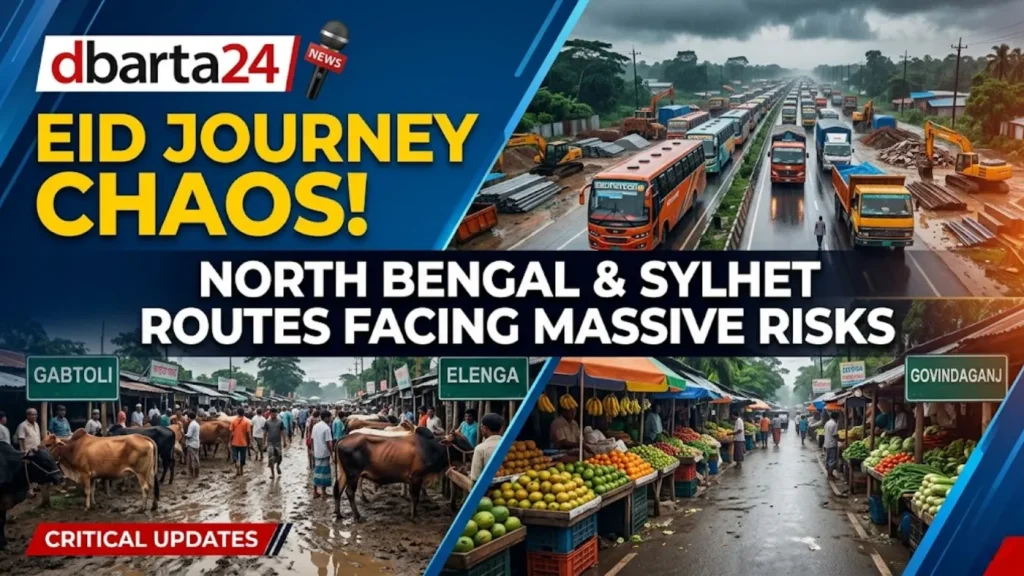
Ifaz Sazid ; Dhaka – Despite various initiatives taken by the police and local administrations to ease the hassle for holidaymakers, severe disruptions are feared along the North Bengal and Sylhet routes during this upcoming Eid-ul-Adha rush.
Ongoing highway construction, illegal roadside markets, and cattle markets designated for the sacrificial festival are multiplying public anxieties for Northern-bound travelers.
Concurrently, the massive expansion work on the Dhaka-Sylhet highway is turning into a primary source of concern for commuters heading to the Sylhet region.
Routes Likely to Suffer the Most
During the previous Eid-ul-Fitar, traffic conditions initially remained orderly but deteriorated drastically in the final days. Driven by intense rushes two days before Eid, many home-bound travelers from Dhaka spent over 24 hours just to reach their northern destinations.
Spot reports from the northern routes indicate that commuters will encounter severe bottlenecks immediately after exiting the capital, particularly in:
-
Savar and Gazipur areas
-
Tangail and Sirajganj
-
Gaibandha
For the Sylhet route, highway expansion works in Narayanganj and Narsingdi are projected to cause major delays.
Exit Points Bottlenecked by Cattle Markets and Construction
The exit gateways of the capital are heavily vulnerable. One of Dhaka’s largest permanent cattle markets at Gabtoli has already started receiving cattle inflows. A massive chunk of vehicles arriving from the northern districts enters and exits Dhaka via the Aminbazar-Gabtoli corridor.
The pressure from loading and unloading sacrificial animals, combined with terminal-centric traffic, caused massive tailbacks on the Gabtoli-Aminbazar road as early as Thursday. Once the Eid rush officially peaks, these gridlocks are expected to intensify, potentially trapping commuters for hours right at the city’s exit points.
Further ahead, major delays await travelers in Savar and Gazipur. Construction on the Ashulia-Baipail-DEPZ Elevated Expressway is moving at full scale. Law enforcement officials have expressed concern that ongoing construction, massive potholes, and scattered construction materials will seriously hamper traffic flow.
A physical inspection revealed a two-kilometer stretch from Baipail to Sripur riddled with deep potholes, forcing vehicles to move at a snail’s pace. Heavy machinery and construction materials left on the road further complicate the situation—a similar scenario is visible on the Abdullahpur-Baipail road.
Adding to the chaos, preparations are underway to set up a cattle market right next to the Dhaka-Tangail highway near the Mayanagar area, north of Ashulia’s Sripur bus stand.
Authority Concerns: Savar Highway Police Inspector Sheikh Shahahan noted, “The ongoing construction, coupled with heavy potholes and roadside building materials, creates a strong risk of suffering during the Eid journey. We have notified higher authorities and will take necessary steps based on the situation.”
However, Project Director Shafiqul Islam reassured that carpeting works on the Elevated Expressway are accelerating to minimize public distress.
Illegal Markets and Road Narrowing in Gazipur
In Gazipur, unauthorized roadside markets pose the biggest threat to smooth transport. The Dhaka-Mymensingh and Dhaka-Tangail highways running through this district serve as the primary transit routes for people from 22 northern and north-western districts.
Recent inspections highlighted at least 15 chronic traffic flashpoints across these two highways, largely driven by illegal structures occupying active lanes.
Key illegal market points include:
-
Chandra Intersection (Kaliakair), Maona Crossroads, Bhabanipur Bazar
-
Bagher Bazar, Gorgoria Masterbari Bazar, Maona Crossroads Palli Bidyut Junction
-
Nayanpur Bus Stand, MC Bazar, and Joina Bazar
In Tongi’s Cherag Ali area, severe encroachment has reduced the wide highway into a narrow lane, allowing only one vehicle to pass at a time.
Gaziper Roads and Highways Department (RHD) Executive Engineer Tanvir Ahmed stated that official notices have been served to market leaseholders to remove illegal structures immediately. He warned that a demolition drive will be carried out if the spaces are not cleared voluntarily.
Tangail, Elenga, and the Jamuna Bridge Bottleneck
Past Gazipur, slow-paced construction of flyovers, underpasses, and four-lane expansions in Tangail will likely bottleneck the traffic. While vehicles currently flow smoothly from Chandra to Elenga, they are forced to drop their speeds from 5 km/h to an absolute standstill upon reaching Elenga.
Due to the construction of a flyover at Elenga Bus Stand, a protective tin fence has contracted the 26-meter-wide road down to just 10 meters. Tangail Superintendent of Police (SP) Shamsul Alam Sarkar stated that strict vigilance will be maintained so that arbitrarily parked vehicles do not exacerbate the Elenga gridlock.
Furthermore, the regional Tangail-Mymensingh-Jamalpur highway converges just 300 yards ahead of the Elenga Bus Stand, creating cross-traffic that forces northern-bound vehicles to halt continuously.
Additional choke points with illegal bus and auto-rickshaws stands have been identified along the Mymensingh highway bypass, Churkhai, Trishal, Bhoradoba, and Bhaluka.
The structural bottleneck at the Jamuna Bridge remains a massive issue: the highway spans 6 lanes from Chandra to Elenga, transitions into 4 lanes from Elenga to the bridge, and shrinks down to just 2 lanes over the bridge itself, heavily compounding tailbacks.
Gaibandha’s Final Hurdle
For northern commuters, the final bottleneck lies at Gobindaganj in Gaibandha. Ongoing flyover construction at the town’s four-way intersection stretches for 1.5 kilometers up to Gobindaganj Women’s College.
Construction equipment occupies large chunks of the road, and the newly opened side lanes have already been illegally occupied by local footpaths vendors and auto-rickshaws. Local drivers report that crossing a stretch that usually takes two minutes now takes over half an hour.
Dust, Mud, and Expansion Crises on the Sylhet Route
For travelers heading toward Sylhet, congestion starts right outside Dhaka at Eastern Purbachal’s Kanchan Bridge west side, Gausia Bazar, Rupsi Bus Stand, Borpa Bus Stand, and Chonpara. Markets sitting directly on the roads are the primary culprits.
The broader Dhaka-Sylhet highway is undergoing a massive upgrade to six lanes from Kanchpur to Banti Bazar. The construction has left the entire corridor covered in thick dust, which turns into an unnavigable muddy trap whenever it rains. RHD Executive Engineer Abdur Rahim stated that inter-departmental coordination is underway to minimize congestion before Eid.
Within Narsingdi’s 52-kilometer stretch, flyover and expansion works at Itakhola, Velanagar, Jailkhana Intersection, and Panchdona have severely narrowed the driving spaces. Adding to the woes, seasonal markets for local fruits like lotkon and vegetables operate daily right next to the highways at Morjal and Gokulnagar, adding layers of traffic risk.
A Multi-Dimensional Challenge
While the Dhaka Metropolitan Police (DMP) has rolled out several exit strategies for the capital, top state officials admit the scale of the challenge.
Road, Rail, and Water Transport Minister Sheikh Rabiul Alam termed the task of managing the migration of nearly 15 million citizens alongside the transit of 10 million sacrificial animals an extraordinary challenge.
Speaking at a preparation meeting, he concluded, “Ensuring the undisrupted movement of such a massive volume of people and animals simultaneously has evolved into a mountain of a challenge.”