


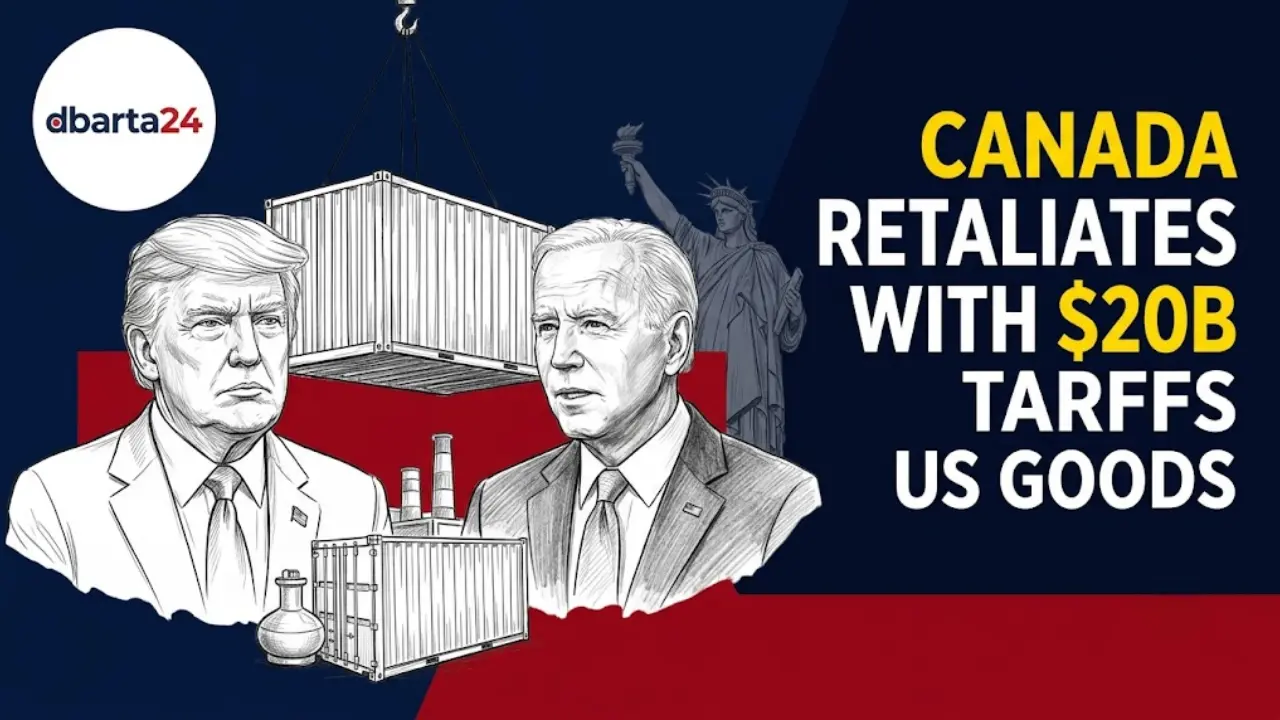
Dbarta24 Business Desk — Canada has announced a massive CAD 27.6 billion ($20 billion) retaliatory tariff package targeting more than 700 American goods.
The dollar-for-dollar countermeasure responds directly to new 50% US import levies, plunging North American trade relations into deeper turmoil. The targeted surcharges, ranging from 15% to 50%, will take effect on September 8.
The Canadian government confirmed that the retaliatory levies will apply to key American export sectors, including steel, aluminum, dairy, home appliances, agricultural equipment, pulp and paper, plastics, and electronics.
To shield local businesses from economic fallout, Ottawa also unveiled a CAD 7.5 billion ($5.42 billion) financial assistance fund for small and medium-sized enterprises.
Key Trade War Developments & Economic Impact
The sharp escalation follows recent US policy shifts and aggressive rhetoric from Washington:
| Category | US Actions | Canadian Countermeasures |
| Tariff Value | $20 Billion in Canadian goods targeted | $20 Billion (CAD 27.6B) in US goods targeted |
| Targeted Sectors | Canadian exports; auto tariffs doubling to 50% on Jan 1 | Steel, aluminum, dairy, appliances, paper, electronics |
| Business Support | None announced | CAD 7.5 Billion ($5.42B) relief fund for SMEs |
| Effective Date | Already active / Phased through Jan 1 | September 8 |
Tensions flared further after US President Donald Trump announced plans to double tariffs on Canadian automobiles to 50% starting January 1.
Trump also raised eyebrows by referring to Canadian Prime Minister Mark Carney as “Governor Carney” and suggesting renaming Lake Ontario to “Lake America”.
Market Fallout & Consumer Consequences
While Washington claimed the US loses $60 billion annually to Canada, Statistics Canada data highlights that Ottawa maintains a modest CAD 9.9 billion ($7.1 billion) trade surplus with the US.
Economic analysts warn that American consumers will bear the brunt of the dispute. Studies by the Kiel Institute for the World Economy indicate that importers and consumers ultimately absorb up to 96% of tariff costs.
US households face rising prices on over 550 Canadian consumer goods, including toilet paper, paint, and select beverages.
Despite the heightened policy volatility, financial markets remained steady. Gold held flat near $4,696 per ounce, while stock indices in both Toronto and New York recorded modest gains.
However, as September 8 approaches, the integrated supply chains of North America’s auto, agricultural, and industrial sectors face prolonged disruption.