


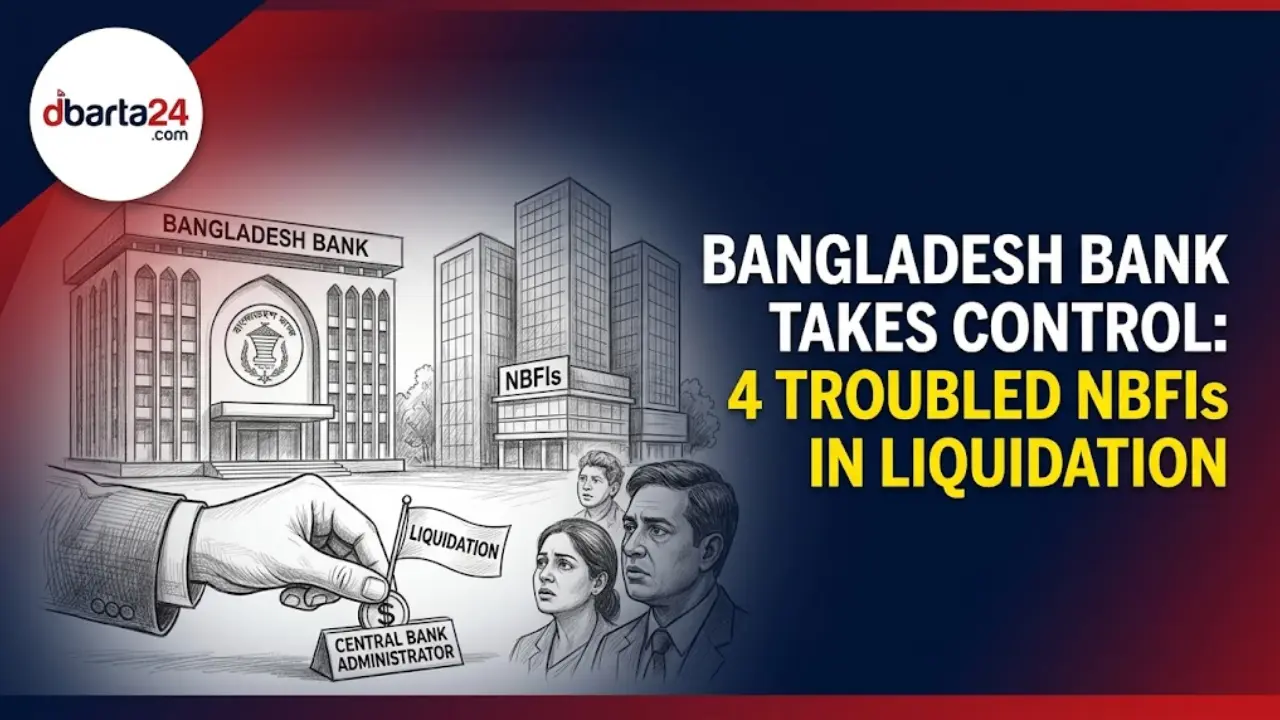
S alam Khan; Dbarta24— In a decisive move to address prolonged financial irregularities and safeguard public money, Bangladesh Bank has appointed administrators to four Non-Bank Financial Institutions (NBFIs) entering the final stage of liquidation.
The step follows years of systemic distress during which the institutions were unable to return funds to depositors.
The four affected institutions are International Leasing and Financial Services, Aviva Finance, FAS Finance and Investment, and Fareast Finance and Investment.
To cushion the impact on small depositors, the government has announced a special allocation of Tk 2,700 crore. Under this initiative, individual depositors will initially receive refunds of up to Tk 10 lakh each. Any remaining balance beyond this threshold will be settled systematically in subsequent phases as the institutions recover defaulted loans and liquidate assets.
Central Bank Directors Take Charge
Each of the four liquidating institutions will be managed by a designated administrator of Director rank from Bangladesh Bank, supported by two associate administrators.
-
Aviva Finance: Md. Alauddin Hossain
-
FAS Finance & Investment: Abu Sama Md. Ataur Rahman
-
International Leasing & Financial Services: Mohammad Iqbal Hossain
-
Fareast Finance & Investment: Md. Sadekur Rahman
Meanwhile, People’s Leasing and Financial Services—another institution slated for final liquidation—is also set to receive an administrator. However, because a court-appointed board of directors is currently overseeing People’s Leasing, Bangladesh Bank has filed a petition with the court seeking the board’s dissolution before taking further administrative action.
Additionally, four other weak financial institutions—Bangladesh Industrial Finance Company (BIFC), Premier Leasing & Finance, GSP Finance & Company, and Prime Finance & Investment—have been granted a temporary timeline to rehabilitate their financial standing.
Central bank sources confirmed that failure to demonstrate swift operational recovery will result in liquidation proceedings against them in the next phase.
Background and Financial Exposure
Under standard regulatory provisions in Bangladesh, if a bank or NBFI undergoes liquidation, individual depositors are guaranteed a maximum payout of Tk 2 lakh from the Deposit Insurance Trust Fund, with remaining claims contingent on asset recovery.
However, given the severe impact on retail investors, the government stepped in with a special intervention to raise the initial payout limit to Tk 10 lakh.
The move comes after a multi-stage review that began last year when Bangladesh Bank issued show-cause notices to 20 underperforming financial entities.
After evaluating their financial positions, nine institutions were ultimately identified for closure, five of which have now reached the final liquidation phase (including People’s Leasing).
According to central bank data, the total financial liability of these five liquidation-bound institutions stands at Tk 13,030 crore in total deposits and Tk 2,202 crore in inter-bank and institutional borrowings. Of the total liability, individual retail deposits account for Tk 3,003 crore.
Breakdown of Exposure:
-
People’s Leasing: Holds Tk 3,415 crore in deposits and Tk 464 crore in inter-bank debt (Individual deposits: Tk 1,406 crore).
-
International Leasing: Holds Tk 3,560 crore in deposits and Tk 1,505 crore in institutional loans (Individual deposits: Tk 646 crore).
-
Aviva Finance: Holds Tk 5,217 crore in deposits and Tk 3.5 crore in inter-bank loans (Individual deposits: Tk 810 crore).
-
FAS Finance: Holds Tk 389 crore in deposits (Individual deposits: Tk 105 crore).
-
Fareast Finance: Holds Tk 450 crore in deposits and Tk 347 crore in institutional borrowing (Individual deposits: Tk 36 crore).
Path Ahead for Depositors
The appointment of central bank directors as administrators marks a crucial turning point in restructured governance for these failing institutions.
By securing government backing for initial depositor relief and pursuing aggressive loan recoveries, the central bank aims to restore discipline and boost public trust in Bangladesh’s non-banking financial sector.