


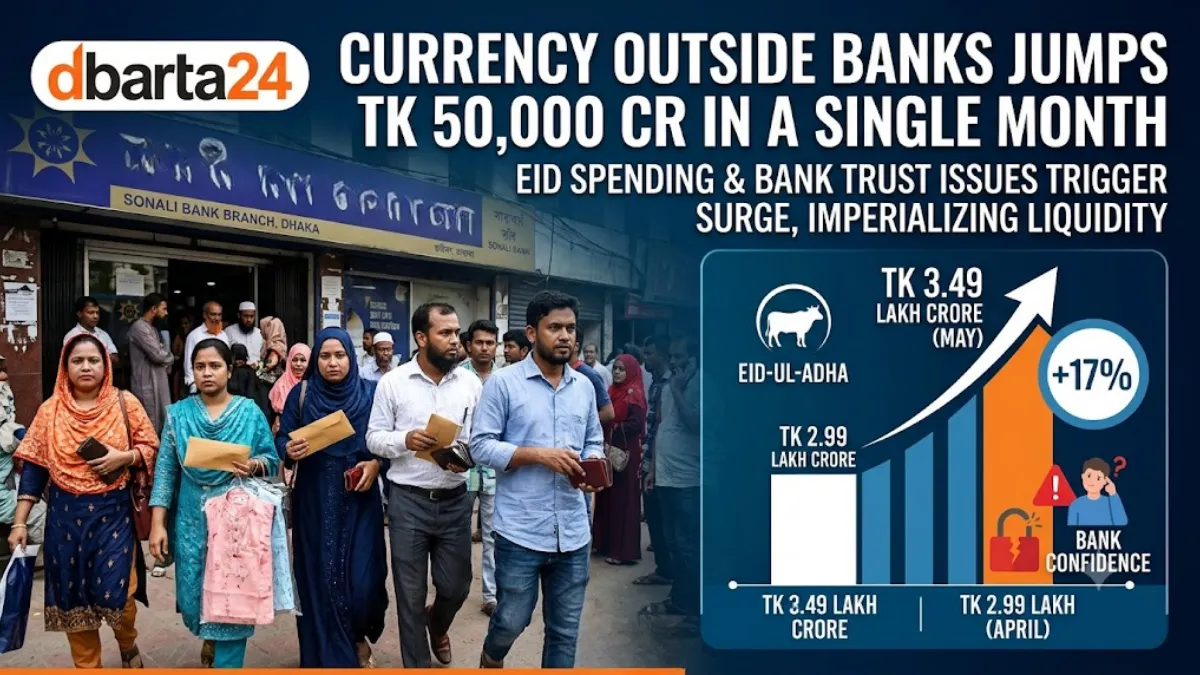
Business Desk — Cash held outside Bangladesh’s banking system experienced a dramatic spike of nearly Tk 50,000 crore in just one month, raising serious concerns among economists and policymakers regarding banking liquidity, deposit mobilization, and overall credit availability.
Central bank data indicates that the sudden outflow was primarily driven by high seasonal transactions surrounding Eid-ul-Adha and growing depositor anxiety stemming from trust deficits in select commercial banks.
According to the latest monetary policy report released by Bangladesh Bank, physical currency held by the public stood at Tk 299,425 crore at the end of April.
By the close of May, that figure rapidly swelled to Tk 349,374 crore—marking a sharp month-on-month surge of Tk 49,949 crore.
In tandem with out-of-bank currency growth, the central bank’s reserve money (printed currency) recorded a parallel jump.
Reserve money escalated from Tk 435,407.10 crore in April to Tk 485,542.10 crore in May, reflecting a massive single-month expansion of Tk 50,135 crore.
┌─────────────────────────────────────────────────────────────┐
│               CURRENCY OUTSIDE BANKS (2025)                 │
├───────────────┬──────────────────────────┬──────────────────┤
│ Month         │ Amount (Tk in Crore)     │ Trend            │
├───────────────┼──────────────────────────┼──────────────────┤
│ January       │ 282,626                  │ Rising           │
│ February      │ 286,404                  │ Rising           │
│ March         │ 303,018                  │ Rising           │
│ April         │ 299,425                  │ Slight Dip       │
│ May           │ 349,374                  │ Sharp Surge (+17%│
└───────────────┴──────────────────────────┴──────────────────┘
(Source: Bangladesh Bank Report)
Background: Shift in Depositor Behavior
The recent spike disrupts a brief stabilization period. Between September 2024 and February 2025, cash held outside banks consistently declined as public trust gradually returned to the formal financial system, driving steady deposit growth.
However, cash holdings resumed an upward trajectory starting in March. While April experienced a temporary dip, May witnessed an unprecedented jump.
Officials at Bangladesh Bank confirmed that higher-than-usual withdrawals were recorded from several institutions—most notably Islami Bank and a few other distressed lenders—as nervous clients sought precautionary liquidity.
Expert Analysis & Financial Implications
Financial experts point out that while festive spending creates short-term cash demand, a failure of these funds to re-enter bank vaults could signal deeper systemic issues.
Dr. M. Ejazuel Islam, Director General of the Bangladesh Institute of Bank Management (BIBM), highlighted two main factors behind the May spike:
“First, with Eid-ul-Adha taking place in late May, people withdrew substantial sums for cattle trading and seasonal expenses. Second, a crisis of confidence surrounding certain banks prompted caution, leading people to keep cash in hand. The critical question now is whether this money flows back into banks. If it remains outside for long, bank deposits will shrink, creating severe constraints on lending, investment, production, and employment creation.”
Banking analyst Helal Ahmed Joni, Research Fellow at Change Initiative, emphasized the upcoming months as a litmus test for sector stability:
“A temporary surge in physical cash due to Eid is normal. However, if this cash fails to return to the banking system post-Eid, it indicates a underlying trust deficit. This could severely strain deposit collection, liquidity management, and credit flows. Data over the next few months will reveal whether this is merely seasonal or a prolonged crisis of confidence.”
The coming months will prove decisive for Bangladesh’s banking sector. Central bank officials are currently analyzing the sudden liquidity drain to determine appropriate policy interventions.
If market confidence is not restored quickly and cash remains unbanked, commercial lenders will face tightening liquidity conditions that could hamper private sector borrowing and broader macroeconomic recovery.