


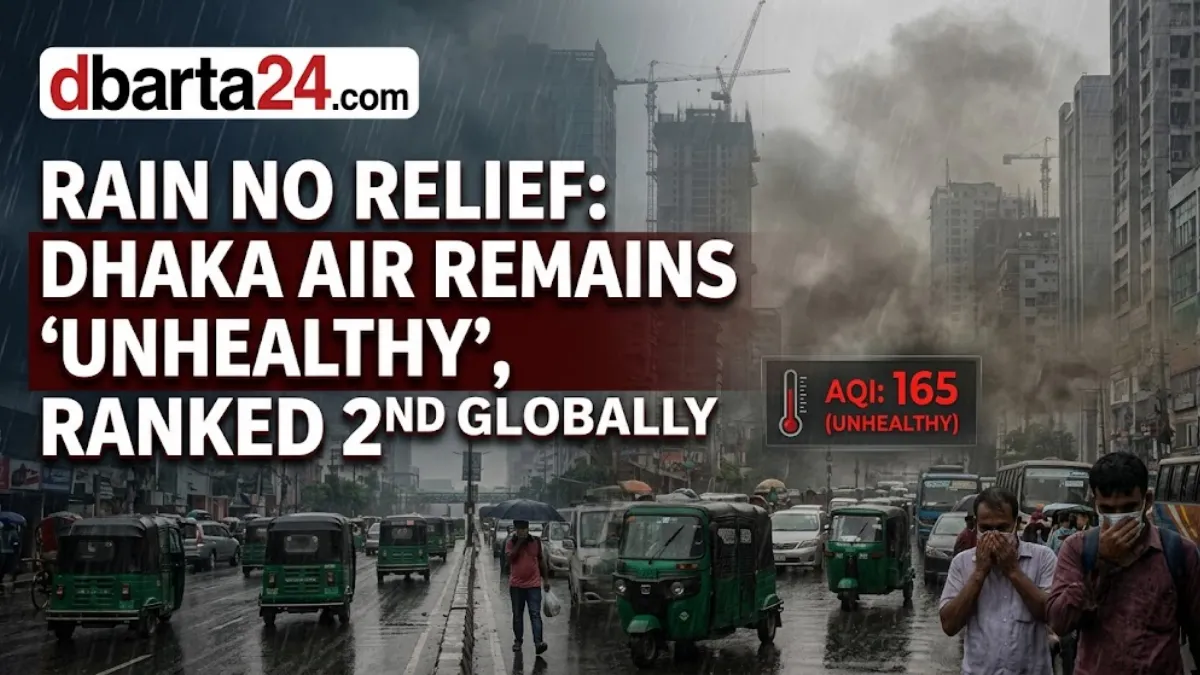
Desk Report – Even after recent rainfall, which typically cleanses the atmosphere, the air quality of Bangladesh’s capital city has failed to show any significant improvement.
Dhaka has once again climbed back to the top tier of the world’s most polluted cities, highlighting the deep-rooted and persistent nature of its air pollution crisis.
On Tuesday morning, Dhaka recorded an Air Quality Index (AQI) score of 165, classifying its air quality as “unhealthy.”
This high reading positioned the megacity as the second most polluted major city globally, as climate change and rampant urban development continue to degrade the region’s atmosphere.
Global Air Pollution Standings
According to data released on Tuesday (July 14) by IQAir, a Switzerland-based air quality monitoring organization, Jakarta, Indonesia, topped the global list of polluted cities with a score of 174. Dhaka closely followed in second place with its score of 165.
The other major global cities trailing closely in the rankings include:
-
Kinshasa, Democratic Republic of the Congo (3rd place with a score of 157)
-
Kolkata, India (4th place with a score of 153)
-
Lahore, Pakistan (5th place with a score of 149)
-
Johannesburg, South Africa (6th place with a score of 125)
Understanding the AQI Scale and Health Implications
The Air Quality Index serves as a vital tool for assessing public health risks associated with breathing ambient air.
-
0 to 50: Classified as “Good” air quality.
-
51 to 100: Considered “Moderate.”
-
101 to 150: Classified as “Unhealthy for Sensitive Groups.”
-
151 to 200: Declared “Unhealthy”—the range where Dhaka currently sits. At this level, active children, adults, and people with respiratory diseases are advised to limit prolonged outdoor exertion.
-
201 to 300: Deemed “Very Unhealthy.” Under these conditions, children, the elderly, and those with underlying illnesses are urged to remain indoors, while the general public is advised to heavily restrict outdoor activities.
-
301 to 400+: Rated as “Hazardous,” posing severe, immediate health risks to all residents.
While seasonal rains usually offer temporary relief from choking dust and smog, Dhaka’s failure to achieve clean air this season underscores the systemic challenges of rapid, uncoordinated urbanization and industrial emissions.
Without strict regulatory oversight on developmental projects and vehicular emissions, the city’s residents remain highly vulnerable to severe, long-term respiratory and cardiovascular health complications.