


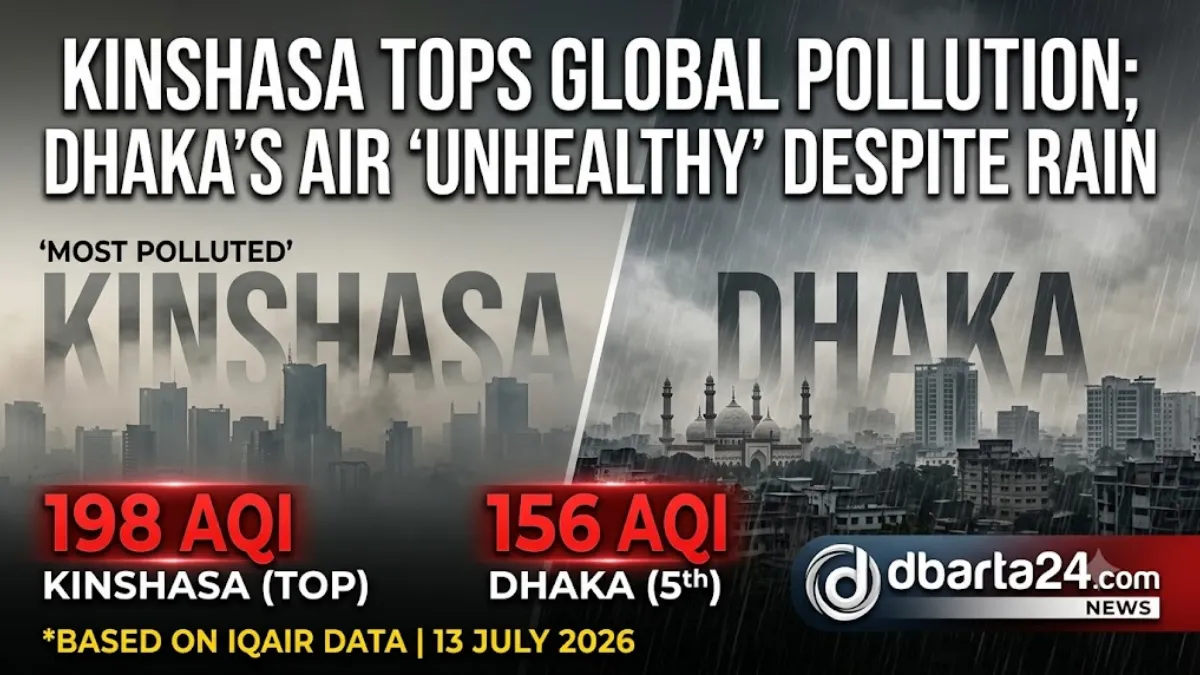
Desk Report – Despite consecutive days of monsoon rainfall that usually washes away airborne pollutants, residents of Bangladesh’s capital have found no relief from choking smog.
Dhaka once again climbed into the top five most polluted cities in the world on Monday morning, highlighting the stubborn and severe nature of the city’s environmental crisis.
According to data from IQAir, a Switzerland-based air quality monitoring organization, Dhaka recorded an Air Quality Index (AQI) score of 156 at around 9:00 AM on Monday (July 13).
This score categorizes the capital’s air quality as “unhealthy,” positioning it fifth on the global list of cities with the worst air quality.
Global Pollution Standings
Kinshasa, the capital of the Democratic Republic of Congo, topped the global list on Monday morning with a dismal AQI score of 198. Kampala, the capital of Uganda, followed closely in second place with a score of 188.
Jakarta, the capital of Indonesia, ranked third with 174, while Pakistan’s Lahore occupied the fourth position just ahead of Dhaka with a score of 158.
Understanding the Risks and Metrics
The AQI index serves as a critical indicator of public health risks based on atmospheric particulate matter. Under IQAir guidelines:
-
0–50: Good
-
51–100: Moderate
-
101–150: Unhealthy for sensitive groups
-
151–200: Unhealthy
-
201–300: Very Unhealthy
-
301–400: Hazardous
Dhaka’s persistent position in the “unhealthy” bracket (151–200) indicates that the general public may begin to experience health effects, while members of sensitive groups may experience more serious effects.
Experts warn that when pollution reaches these levels, children, the elderly, and individuals with preexisting respiratory illnesses should minimize outdoor activities, and the general public should avoid prolonged exertion outdoors.
The Growing Environmental Crisis
Environmental experts point out that air pollution in Dhaka is worsening rapidly due to a combination of unchecked climate change factors, unplanned mega-development projects, massive construction activities, and industrial emissions.
While seasonal rainfall typically offers temporary respite by dampening dust particles, Dhaka’s failure to achieve clean air even during rainy days signals a deeply rooted crisis.
Without stringent regulatory enforcement on construction sites and vehicular emissions, the city’s residents remain highly vulnerable to severe, long-term health complications.