


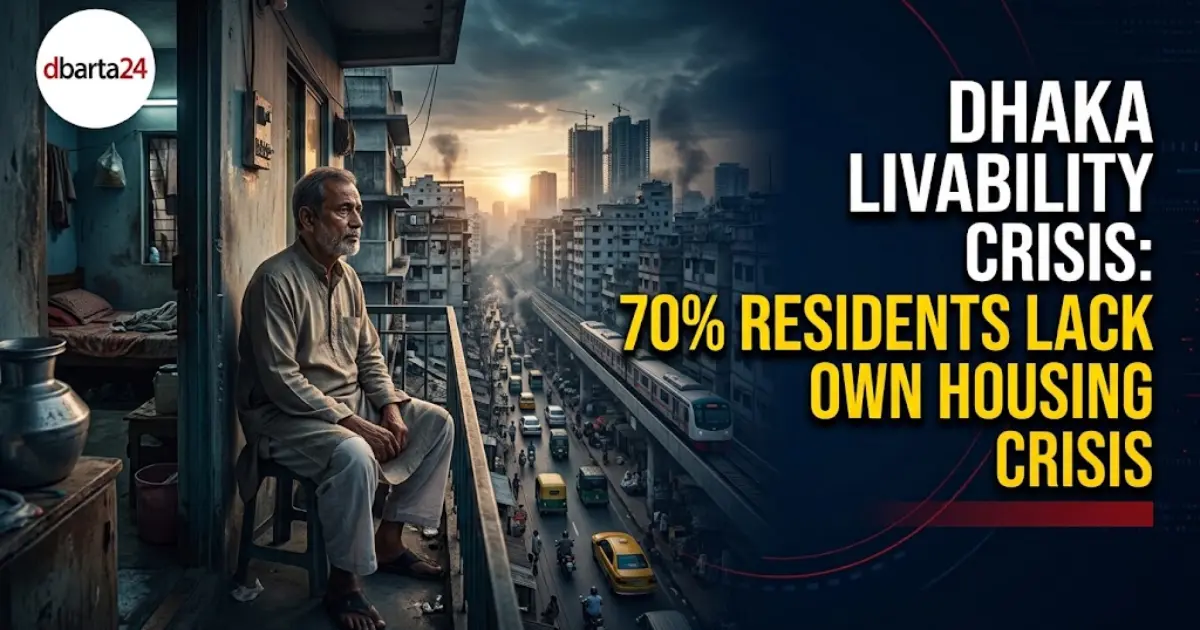
Khairul Alam; Dbarta24 — Despite massive capital investments in infrastructure, including the metro rail and elevated expressways, Bangladesh’s capital continues to choke under chronic urban dysfunction.
According to the latest Economist Intelligence Unit (EIU) Global Liveability Index, Dhaka ranks 171st out of 173 cities globally—beating only war-torn Damascus and Tripoli, while trailing behind Pakistan’s Karachi.
The EIU evaluates cities across five broader parameters. In the infrastructure category, Dhaka scored a dismal 27 out of 100—a metric that assesses road and transit networks, housing availability, utilities, and telecommunications.
Subpar Telecom Infrastructure Under Scrutiny
Although mobile penetration in Bangladesh stands at 89.4%, experts criticize the reliability and technology of the network. Telecommunications expert Rashed Mahedi noted that network modernization has lagged behind rapid demand growth.
“The network is running on outdated patches. While 4G coverage is widely advertised, users frequently experience subpar speeds, weak connections, and dropped calls due to insufficient spectrum allocation,” Mahedi stated.Transit Upgrades Overshadowed by Bus Chaos
Major developments like the Dhaka Metro Rail carry roughly 400,000 commuters daily, yet systemic transport woes persist. Dr. Shamsul Hoque, an urban transit expert, highlighted that the influx of unregulated battery-run rickshaws and easy-bikes across the city negates high-capacity transit gains.
“A modernized, disciplined bus network is the bedrock of any public transit system, but Dhaka has failed to build one. In fact, transportation discipline has deteriorated noticeably over the past few years,” Dr. Hoque observed.Utilities: Production Meets Capacity, Quality Lags
Data from Dhaka WASA indicates daily water production capacity stands at 2.95 billion liters against a demand of 2.5 to 2.65 billion liters, sourced primarily from the Shitalakshya and Padma rivers. However, clean access remains a struggle.
Hasin Jahan, Country Director of WaterAid, warned that high production numbers do not guarantee safe consumption:
“Pipeline contamination, localized water scarcities, and inadequate access in low-income neighborhoods remain major hurdles. Furthermore, safety checks for bottled water supplies remain largely insufficient.”
Power disruptions further complicate utility delivery. Dhaka Power Distribution Company (DPDC) reports daily load-shedding of one to two hours alongside transmission faults, directly disrupting water production plants.
Acute Housing Deficits and Urban Decay
Data from the Real Estate and Housing Association of Bangladesh (REHAB) reveals that only 30% of Dhaka’s estimated 21 million residents own homes. Approximately 15 million people live in rented properties, while a vast lower-income demographic resides in informal slum settlements.
Planned residential hubs like Gulshan, Banani, Bashundhara, and Uttara stand out as exceptions. Across most neighborhoods, basic urban amenities—parks, playgrounds, open green spaces, bodies of water, and breathable air quality—are critically deficient.
Dr. Adil Mohammad Khan, Executive Director of the Institute for Planning and Development (IPD), attributed the persistence of these conditions to structural governance failures.
“Flawed development philosophies, vested interest groups, regulatory inaction, and weak law enforcement prevent multi-billion-dollar investments from improving quality of life,” Dr. Khan remarked. “Instead of upholding the Detailed Area Plan (DAP), authorities repeatedly compromise under pressure from influential groups. DAP has already been amended twice, with further pressure mounting—directly undermining Dhaka’s long-term sustainability.”A Structural Crossroads
Dhaka’s low ranking underscores a persistent disconnect between mega-scale engineering projects and human-centric urban design. Without comprehensive housing reforms, strict regulatory enforcement, and equitable access to basic utilities, physical infrastructure alone will remain insufficient to raise the city’s living standards.