


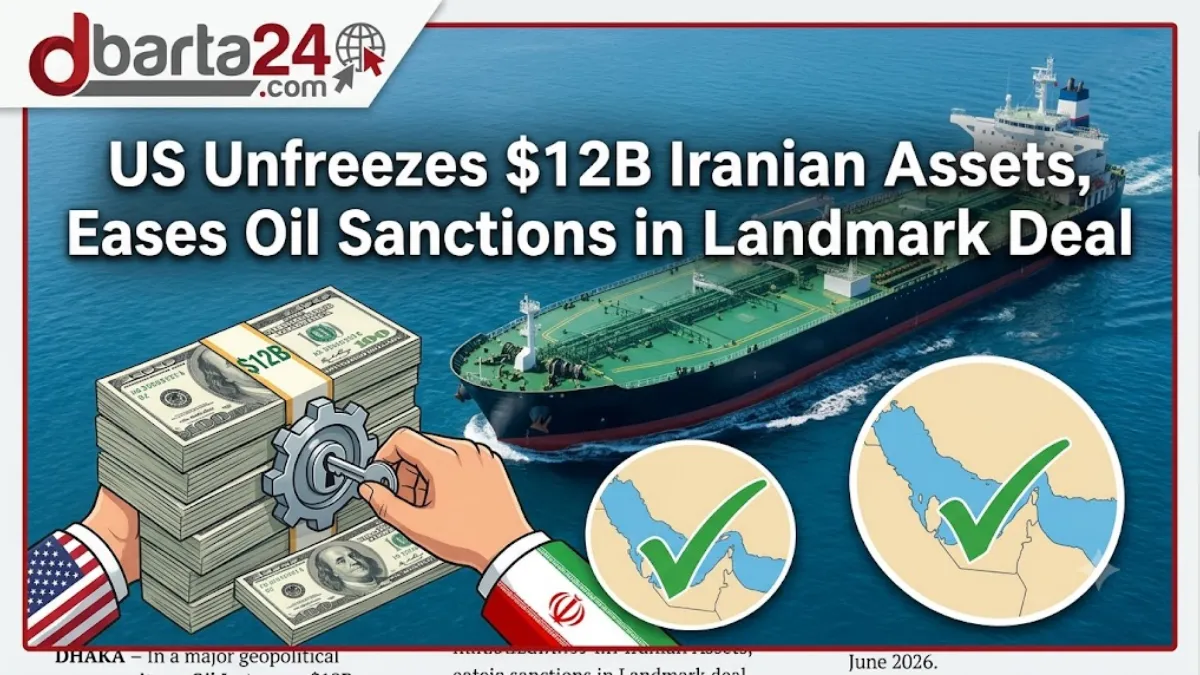
International Desk – In a major geopolitical shift, the United States and Iran have reached a comprehensive diplomatic understanding.
Under the agreement, Washington has agreed to unfreeze $12 billion in restricted Iranian assets and temporarily ease crippling economic sanctions on Tehran’s oil and petrochemical exports.
However, despite the breakthrough, sharp public disagreements have already emerged between policymakers in Washington and Tehran regarding the deal’s fine print and enforcement mechanisms.
Sanctions Relief and Global Oil Market Impact
According to official communications from the US administration, the temporary sanctions relief will remain in effect until August 21. This window will allow Iran to legally trade its oil and petrochemical products on the open global market.
For years, aggressive US-led sanctions forced Tehran to sell its crude at heavily discounted rates through backchannels to bypass global restrictions.
Under this new temporary framework, Iran can sell its oil at full market value, injecting billions of dollars directly back into its struggling economy.
Washington has explicitly noted, however, that any permanent lifting of broader sanctions remains strictly contingent on Tehran meeting predefined milestones.
The Clash of Narratives: Trump vs. Tehran
Immediate friction over the deal arose when US President Donald Trump claimed that Iran had consented to international nuclear inspections as part of the package.
Furthermore, President Trump asserted that the unfrozen $12 billion fund is restricted solely to purchasing American agricultural products.
Tehran swiftly moved to reject those claims. In an interview with Iran’s Tasnim News Agency, Central Bank of Iran Governor Abdolnasser Hemmati strongly pushed back against the agricultural mandate.
“Iran is under no obligation whatsoever to purchase agricultural goods from the United States.”
— Abdolnasser Hemmati, Governor, Central Bank of Iran
Governor Hemmati clarified that the first $6 billion of the unfrozen assets has been earmarked exclusively for essential food items and medicine imports from global suppliers, stating that US products would only be considered if their quality and pricing prove superior to competitors.
The remaining $6 billion, he emphasized, is entirely free of mandatory emergency purchase restrictions, allowing Iran to import any non-sanctioned goods it requires.
Efforts to Reopen the Strait of Hormuz
The diplomatic thaw is also translating into maritime security. Returning from Switzerland after the first round of high-stakes negotiations with US officials, Iran’s chief negotiator Mohammad Bagher Ghalibaf indicated that Washington and Tehran are prepared to collaborate to stabilize regional shipping lanes.
Ghalibaf noted that while operations in the Strait of Hormuz might not immediately revert to pre-war baselines, Iran remains fully committed to upholding international maritime law.
Underscoring the delicate nature of the deal, Iranian President Masoud Pezeshkian issued a statement on the social media platform X, urging all signatories to stick strictly to the negotiated text.
“The efficacy of these negotiations relies heavily on the full commitment to agreed-upon obligations and their flawless implementation. Any remarks outside the core text of the agreement will not aid the progress of these talks.”
— Masoud Pezeshkian, President of Iran
Diplomatic analysts view President Pezeshkian’s remarks as a thinly veiled critique of President Trump’s recent public commentary.
While this diplomatic detente marks a significant cooling of tensions between Washington and Tehran, the broader Middle East remains highly volatile.
Parallel to the deal, Israeli Prime Minister Benjamin Netanyahu confirmed that Israeli forces will sustain their military presence in southern Lebanon to dismantle Hezbollah’s infrastructure.
Analysts observe that the region is entering a complex dual reality: an economic and maritime thaw on one side, counterbalanced by active military hostilities on the other, leaving the long-term geopolitical equilibrium of the Middle East hanging in the balance.