


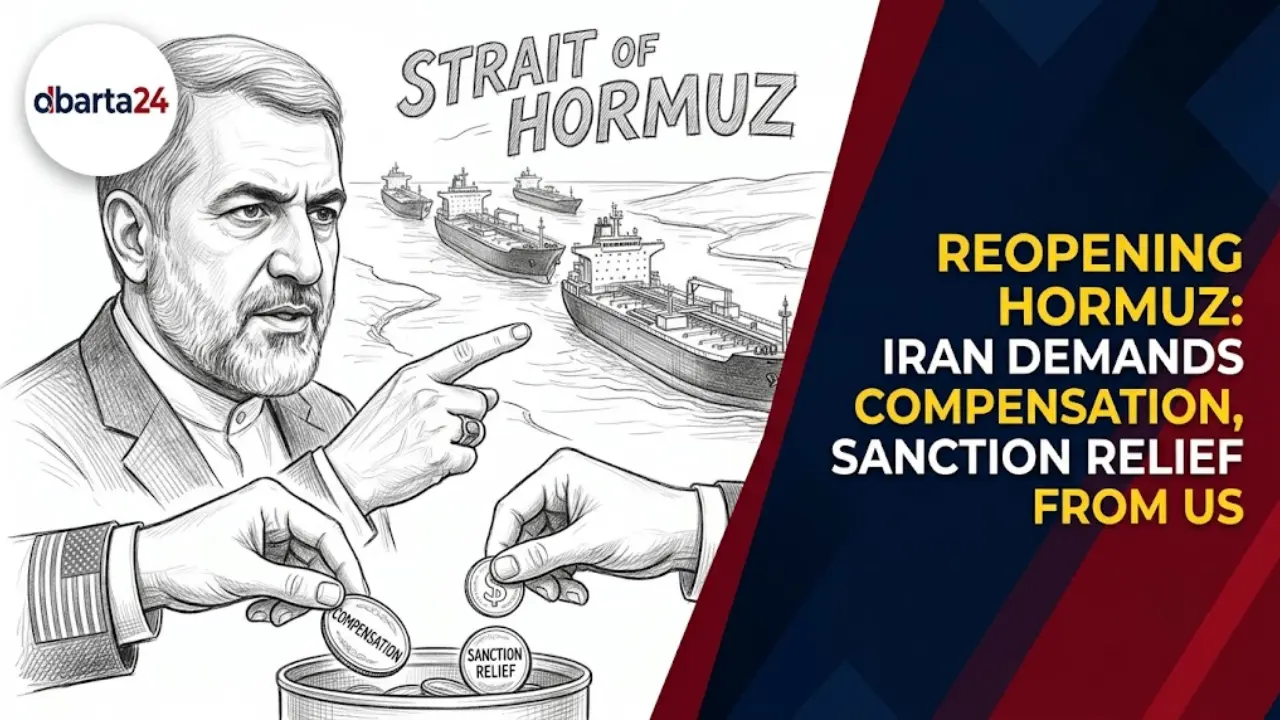
Dbarta24 Desk Report – Tehran has neared a draft agreement with Oman regarding newly designated shipping lanes in the Strait of Hormuz, but maintains that the strategic maritime choke point will not reopen until Washington meets a steep list of demands—including direct financial compensation for damages incurred during recent military strikes.
Iranian Foreign Minister Abbas Araghchi confirmed that negotiations with Oman over maritime routing are in their final stages.
However, he emphasized that implementation depends entirely on the United States fulfilling Tehran’s security and financial preconditions.
Unscheduled Closures and Economic Standoff
The vital energy transit route has remained closed since late February following a series of military strikes launched against Iranian targets by the US and Israel.
The initial strikes aimed to neutralize Iran’s nuclear capabilities and regional military leverage, according to US President Donald Trump.
While a temporary ceasefire was brokered in June, relations deteriorated in July after the US enforced maritime blockades on Iranian shipping in the Persian Gulf—a move Tehran characterized as a direct violation of the truce.
Indirect diplomatic channels via third-party mediators remain active. Commenting on the situation, President Trump noted that Washington is handling Tehran with measured restraint. “We are dealing with them only partially.
We are just observing the situation in Iran—their severe inflation and the fact that they have no money,” Trump stated in an interview with Axios.
Non-Negotiable Demands for Maritime Access
Iranian officials have outlined a comprehensive slate of conditions required before commercial transit through the Strait can resume:
-
Financial Reparations: Full compensation from Washington for structural and economic damages caused by US military bombardment.
-
Sanction & Asset Relief: Complete lifting of economic sanctions and unfreezing of Iranian state assets held abroad.
-
Naval & Regional Guarantees: An immediate end to the US naval blockade in the Gulf, alongside guarantees halting aggression against Iran and its regional allies in Lebanon, Palestine, Yemen, and Iraq.
Phased Steps and Operational Realities
A senior US official, speaking anonymously to Reuters, indicated that Washington is prepared to lift blockades on Iranian ports provided an unhindered commercial shipping agreement is finalized.
“US actions will be synchronized with Iran’s fulfillment of its commitments,” the official noted, signaling a carefully sequenced approach.
Sources familiar with the framework suggest the draft plan could grant Tehran partial supervisory control over vessels entering the Gulf via the Strait.
Industry analysts and shipping operators, however, warn that enforcing such oversight presents immense technical and legal hurdles.
Security concerns remain heightened following reports from the United Arab Emirates regarding a recent strike on a state-linked oil vessel, an action consistent with prior interdictions by the Islamic Revolutionary Guard Corps (IRGC) against unapproved transits.
The draft agreement with Oman marks a technical step forward, but the broader crisis remains locked in a high-stakes geopolitical stalemate.
Until Washington and Tehran resolve their fundamental disputes over security guarantees, sanctions, and financial liabilities, global energy markets will continue to endure instability surrounding the world’s most critical maritime choke point.