


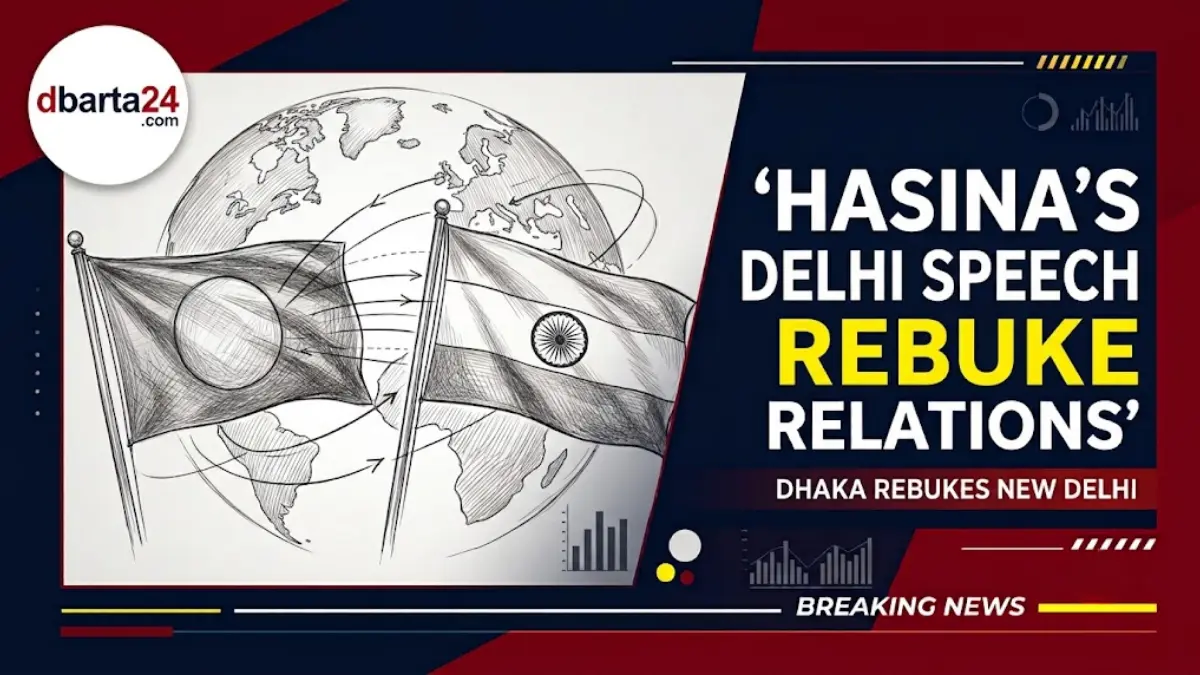
Staff Correspondent; Dbarta24 – The delicate thawing of relations between Bangladesh and India—a process painstakingly managed through high-level dialogues and the resumption of visa services—has hit a sudden and significant roadblock.
A recent virtual press conference held by ousted Prime Minister Sheikh Hasina from New Delhi has triggered a sharp rebuke from Dhaka, raising concerns about the future trajectory of bilateral ties.
For months, diplomatic circles had observed signs of “thawing ice” between the two neighbors. Following the turbulent transition of power in August 2024, which saw Sheikh Hasina flee to India, the relationship entered what analysts described as one of the most challenging chapters in the two nations’ shared history.
However, recent weeks had brought cautious optimism, marked by the arrival of a new Indian High Commissioner and the reopening of certain visa categories.
That momentum has now been complicated by a virtual address delivered by the former Prime Minister to the South Asia Foreign Correspondents Club (FCC) in New Delhi.
Despite the Bangladesh government’s explicit concerns regarding the political activities of the ousted leader on Indian soil, the event proceeded, featuring Hasina’s call for the lifting of bans on her party and her declaration of intent to return to Bangladesh in December.
Dhaka’s Strong Stance
The reaction from the Bangladeshi government was immediate and stern. The Ministry of Foreign Affairs issued a formal statement, asserting that permitting such political rhetoric from Indian territory undermines efforts to restructure bilateral relations.
Dhaka characterized the event as a disregard for Bangladesh’s sovereignty and an affront to the sacrifices made during the July mass uprising.
State Minister for Foreign Affairs, Shama Obayed, addressed the media on Thursday evening, emphasizing that Bangladesh expects clarity from New Delhi regarding the nature of their bilateral cooperation.
“If the fascist, convicted figures of the Awami League continue these conspiratorial activities while sitting on Indian soil, and if the Indian government does not stop this immediately, it will inevitably create a sense of deep concern among the people of Bangladesh,” Obayed stated.
India’s Position and Expert Analysis
In response to the controversy, the Indian Ministry of External Affairs maintained that the press conference was organized by a private entity and that the Indian government had no involvement.
Official spokespersons reiterated that the views expressed during the event did not reflect the position of the Indian government.
However, many foreign policy analysts remain skeptical of this explanation. Retired diplomat Humayun Kabir argued that it is difficult to imagine such an event proceeding without the implicit consent of the host nation.
Speaking to the press, Kabir suggested that New Delhi must acknowledge that the political reality in Bangladesh has shifted and that future cooperation must be built on a foundation of equality and mutual respect.
A Test of Longevity
International observers are divided on whether this incident marks a temporary diplomatic spat or the start of a prolonged standoff. Michael Kugelman, a South Asia analyst at the Wilson Center, suggested that India’s attempt to strike a middle ground is unlikely to satisfy Dhaka.
“India could have prevented this press conference. Consequently, Bangladesh will likely view this as a continuation of New Delhi’s long-standing political positioning,” Kugelman noted in discussions with regional media.
Other researchers, such as Asif Bin Ali of Georgia State University, point to the “Hasina block” as a persistent hurdle in normalizing ties. While strategic imperatives—such as border security, energy trade, and regional connectivity—compel both nations to maintain cooperation, the political friction surrounding the former leader remains a volatile variable.
As the situation evolves, the coming weeks of diplomatic engagement will be critical.
Whether this current tension dissipates or spirals into a deeper crisis will depend largely on how both capitals handle the sensitive issue of Sheikh Hasina’s presence and potential political maneuverings.
For now, the “thaw” in Bangladesh-India relations is facing its most significant test since the change of government in Dhaka.