


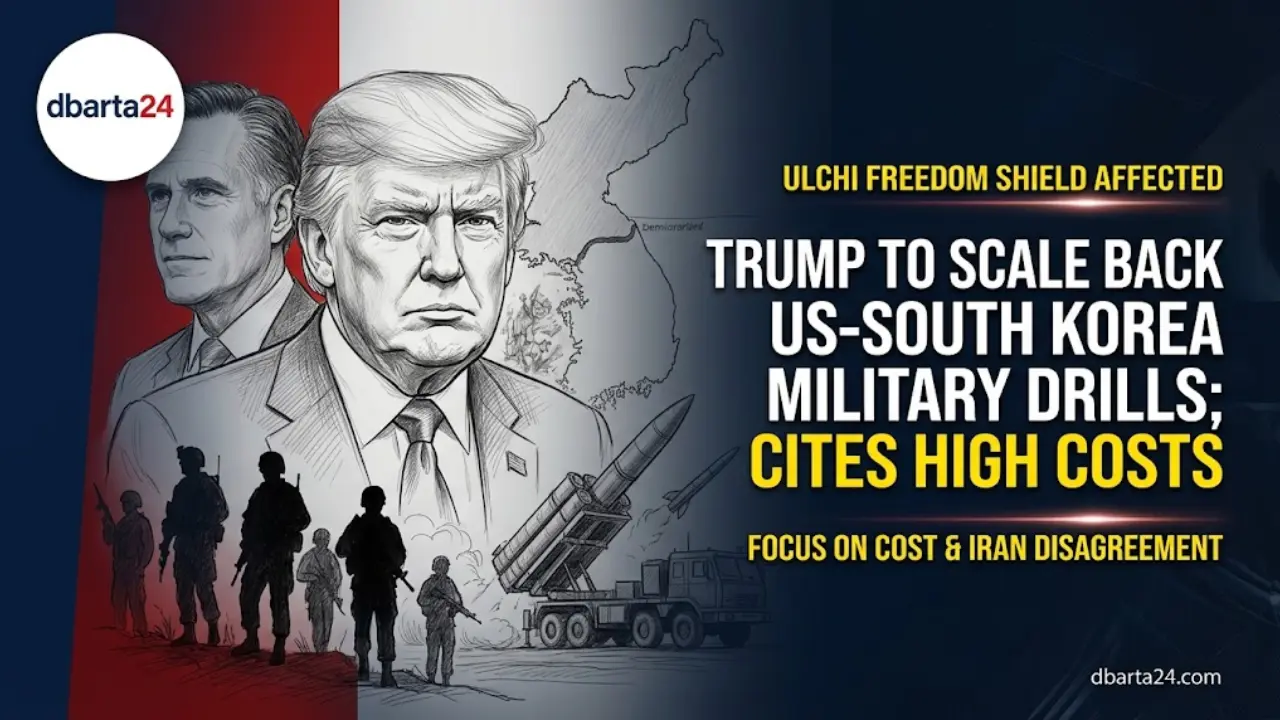
Dbarta24 International Desk — U.S. President Donald Trump has declared that the joint military drills between the United States and South Korea will be significantly scaled down.
Writing on his social media platform, Truth Social, Trump criticized the joint exercises as excessively costly and diplomatically counterproductive.
The announcement marks a notable shift in defense relations between the two long-standing allies, raising fresh questions about the future of security cooperation on the Korean Peninsula.
Cost Concerns and Strain Over Iran Policy
Explaining his rationale, Trump highlighted the financial burden placed on Washington to sustain the large-scale military exercises.
He described the joint drills as expensive endeavors primarily funded by the United States, while also arguing that such exercises project a message that is “completely inappropriate and hostile.”
Adding to the tension, Trump disclosed a recent conversation with South Korea’s president regarding foreign policy priorities.
According to Trump, he had requested South Korea to support U.S. efforts aimed at curbing Iran’s nuclear ambitions, but Seoul declined the request.
“No, thank you.”— Donald Trump quoting South Korea’s response regarding cooperation on Iran.
Trump also noted that other traditional U.S. allies—including Japan, France, and the United Kingdom—have similarly shown reluctance to get involved in escalating international conflicts.
Seoul Responds as ‘Ulchi Freedom Shield’ Gets Underway
Despite Trump’s post, officials in Seoul maintained that the annual joint military exercise, known as Ulchi Freedom Shield, will proceed according to schedule.
Trump acknowledged that because the start of the exercise was imminent, it could not be canceled entirely on short notice.
The 11-day drill is slated to feature approximately 18,000 South Korean troops, mirroring the scale of previous years. Currently, around 28,500 U.S. military personnel are stationed in South Korea.
North Korean Tensions and Regional Dynamics
The joint exercises take place against a backdrop of heightened regional security concerns regarding North Korea.
Security officials from both the U.S. and South Korea noted that this year’s exercise planning accounts for Pyongyang’s military developments, including reports of North Korean troop deployments supporting Russia in the Ukraine war.
Pyongyang has routinely condemned these joint maneuvers. North Korea’s Foreign Ministry recently labeled the drills an “aggressive war rehearsal,” shortly after South Korea, the U.S., and Japan jointly detected another North Korean missile test.
Personal Diplomacy with Kim Jong Un
In defense of his decision to reduce military drills, Trump emphasized his personal rapport with North Korean leader Kim Jong Un, describing their relationship as “very good.”
His comments followed his recent social media post featuring a 2018 photograph taken alongside Kim.
Trump remarked that despite their firm expressions in the image, the two leaders remain “great friends.” In 2018, Trump made history as the first sitting U.S. president to step foot in North Korean territory.
This is not the first time Trump has sought to curb joint military drills. During nuclear disarmament negotiations with Kim in 2018, Trump similarly suspended joint military maneuvers with South Korea as a diplomatic gesture.