


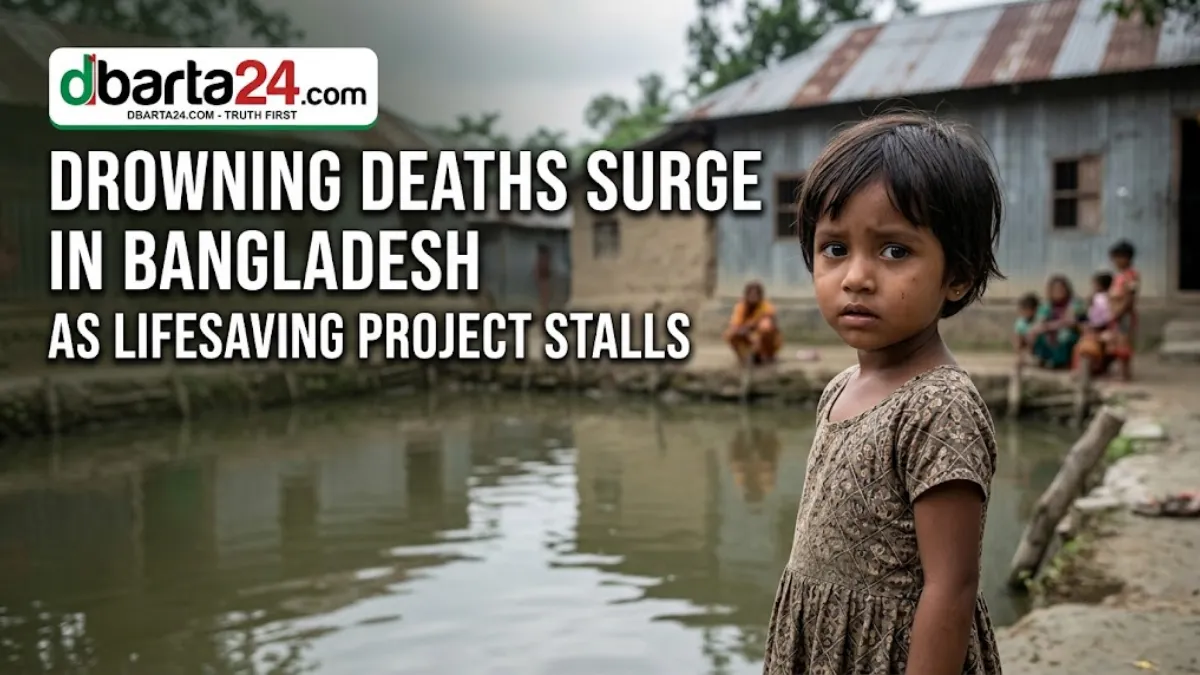
Khairul Alam ; Dbarta24 Special — In rural Bangladesh, water is everywhere. Ponds sit right next to homes, ditches edge open courtyards, and canals swell during the monsoon.
While this environment shapes the daily lives of millions, it also poses a fatal threat to the country’s youngest citizens.
Every year, thousands of children drown just yards away from their doorsteps, often while parents are busy with household chores.
As Bangladesh observes World Drowning Prevention Day today, July 25, under the global banner “Anyone can drown, no one should,” experts warn that the nation’s child safety net is dangerously fraying.
Proven, community-based interventions that drastically cut drowning rates have ground to a halt due to funding lapses, leaving vulnerable toddlers exposed to preventable tragedies.
A Deadly Silent Epidemic
According to the Bangladesh Health and Injury Survey 2023, drowning claims approximately 18,665 lives in the country every year. Shockingly, 14,269 of these victims are children, with toddlers aged 1 to 4 facing the absolute highest risk.
Data from the Foundation for Disaster Forum reveals a grim trajectory:
-
Jan – June 2026: 583 drowning deaths recorded, including 527 children.
-
2025 Total: 1,311 drowning fatalities, of which 1,184 (nearly 90%) were children.
Experts emphasize that August is particularly hazardous. As monsoon waters peak, rural households enter their busiest agricultural cycle, drastically reducing adult supervision during the high-risk morning hours between 9:00 AM and 1:00 PM.
+-----------------------------------------------------------------------+
|                 Drowning Prevention Impact Highlights                 |
+-----------------------------------------------------------------------+
| Strategy                             | Target Group | Risk Reduction  |
+--------------------------------------+--------------+-----------------+
| Community Childcare Centers (Daycare)| Ages 1–5     |  82% Reduction  |
| Swim-Safe & Survival Training        | Ages 6–10    |  96% Reduction  |
+--------------------------------------+--------------+-----------------+
Successful Safety Nets Sidelined
In 2022, the Bangladesh Shishu Academy under the Ministry of Women and Children Affairs launched a BDT 306-crore project titled Integrated Community-Based Center for Child Care and Protection and Swim-Safe Facilities (ICBC).
The impact was immediate and undeniable:
-
8,000 Childcare Centers were established across 45 sub-districts in 16 districts, supervising nearly 200,000 toddlers daily.
-
1,600 Swim-Safe Venues trained approximately 360,000 older children in survival swimming skills.
-
Zero drowning fatalities were recorded among registered children during center operating hours.
Despite these achievements, operations halted last December following the conclusion of the initial phase. A proposed BDT 838-crore expansion project—aimed at reaching 30 districts and establishing 13,000 daycare centers—remains stalled in bureaucratic pipelines.
Official estimates indicate that even after approval, launching field activities will take another five to six months.
Voices from the Field
The closure of these centers has left rural families without safe alternatives, forcing parents to rely on elderly relatives or leave toddlers unattended.
“Earlier, I could leave my four-year-old daughter at the center every morning and focus on my studies without worry,” said Nusrat Jahan Ritu, a mother from Sherpur’s Bajitkhila village. “Since the center closed in December, keeping her away from the flooded pond next to our house has been an endless struggle.”
Rupali Akter, a former caregiver from Sherpur, shared a similar sentiment:
“Operations stopped when our monthly honorarium ceased in January. Mothers constantly ask me when the center will reopen.”
Calls for Permanent Public Funding
Public health experts and civil society leaders argue that relying on short-term project funding for basic safety is a fatal flaw.
“A child can drown in just a few inches of water, making active supervision the single most effective defense,” noted Mir Masrur Zaman, Executive Director of Suchinta Media Communication and Development Foundation. “When a project ends, the entire safety infrastructure collapses. Funding for community childcare centers must be permanently integrated into the national revenue budget.”
Echoing this stance, Dr. Md. Abul Barkat, Deputy Director at the Center for Injury Prevention and Research, Bangladesh (CIPRB), stressed that structured daycare reduces toddler drowning risk by 82%, while survival swimming lessons lower risk for older children by 96%.
While national plans aim to slash drowning deaths by 50% by 2030, analysts urge the government to establish transparent budget lines immediately.
Without permanent, institutionalized funding, thousands of young lives remain at the mercy of open water right outside their homes.