


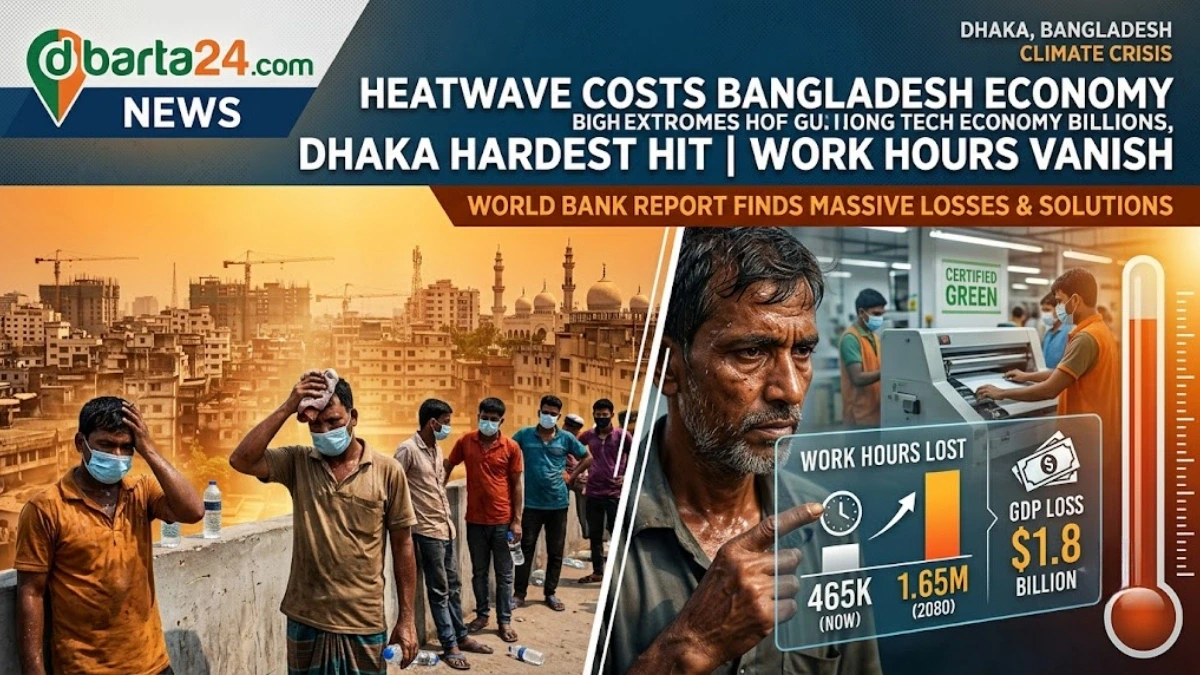
Khairul Alam; Dbarta24 Special — Severe heatwaves are no longer just a public health emergency in Bangladesh; they have escalated into a major crisis threatening the nation’s economy, industrial output, and urban livelihoods.
In 2024 alone, extreme heat inflicted a direct loss of $1.3 billion to $1.8 billion on the Bangladeshi economy—wiping out between 0.3% and 0.4% of the country’s Gross Domestic Product (GDP).
According to a newly released World Bank report titled “A Liveable Future: Protecting Jobs and Growth from Extreme Heat in South Asia’s Cities,” these economic losses multiply rapidly whenever temperatures cross the critical threshold of 37°C.
The comprehensive study—jointly produced with the UK’s Foreign, Commonwealth & Development Office (FCDO), the City Resilience Program, and GFDRR—analyzed heat dynamics across major urban centers in Bangladesh, India, Nepal, Bhutan, Sri Lanka, and the Maldives.
Dhaka Hit Hardest in South Asia
Among eight major South Asian metropolises, Dhaka emerges as the most vulnerable city regarding climate-induced labor productivity loss.
The capital currently loses approximately 3% of its annual working hours to heat stress—an impact equivalent to the full-time output of 465,000 jobs.
The World Bank’s projections paint a sobering picture for the future:
-
2050 Forecast: Lost work hours will climb to equal 708,000 full-time jobs.
-
2080 Forecast: Productivity losses will reach 7.4%, representing 1.65 million full-time jobs.
By comparison, projected losses in 2080 for other major regional hubs stand at 833,000 full-time jobs in Kolkata and 629,000 in New Delhi, confirming Dhaka as the region’s hardest-hit capital.
Garment Sector and Infrastructure Under Severe Strain
The ready-made garment (RMG) industry—the backbone of Bangladesh’s export earnings—faces unprecedented disruption.
The report warns that without proactive heat-resilient infrastructure and improved workplace conditions, garment exporters across vulnerable South Asian nations could lose a combined $65.8 billion in export revenue by 2030.
However, green transitions offer a pathway forward. Supported by the Bangladesh government’s Green Transformation Fund, over 270 garment factories have earned LEED environmental certifications since 2016, setting a benchmark for mitigating industrial climate risks.
Beyond manufacturing, physical infrastructure is also deteriorating under extreme temperatures.
The report cited instances from April 2024 where intense heat melted asphalt on major national highways, signaling a sharp rise in future road maintenance costs for the government.
Power Deficits and Surging Cooling Demand
Soaring temperatures have triggered severe energy stress. During the peak heatwave in April 2026, national power demand spiked to 16,237 MW against a actual generation capacity of 13,988 MW, creating a massive 2,200 MW deficit.
The resulting widespread load-shedding disrupted manufacturing plants, commercial enterprises, and essential services across the country.
Concurrently, adoption of cooling technologies has skyrocketed. Around 500,000 air conditioning units were sold in Bangladesh in 2025—nearly triple the volume recorded five years prior.
While driving up household expenditures, experts note that indoor cooling is becoming vital to safeguarding public health and preserving daily work capacity.
Early Action Delivers Massive Returns
Despite the grim forecasts, the study highlights that early warning mechanisms and proactive adaptation yield immense economic returns.
Drawing on Ahmedabad’s “Heat Action Plan” in India, the report notes that every $1 invested in early warning systems generates nearly $50 in economic benefits.
Bangladesh has already demonstrated leadership in this area. In April 2024, the Bangladesh Red Crescent Society launched the world’s first forecast-based heatwave assistance program, distributing 5,000 BDT via mobile banking to approximately 4,000 vulnerable households.
Urgent Call for Strategic Investment
The World Bank emphasized that without decisive policy interventions, Bangladesh’s long-term economic trajectory and GDP remain highly exposed.
“Heat resilience is now an indispensable part of development planning,” stated Ming Zhang, World Bank Director for Urban, Sub-national Finance, Tourism, and Disaster Risk Management. “There is no alternative to early investment if we want to avoid massive economic losses in the future.”
The report outlines 15 key recommendations for policymakers, prioritizing uninterrupted power supply during extreme weather, integrating heat risks into disaster management funds, constructing heat-resilient urban infrastructure, and offering accessible financing for small and medium enterprises (SMEs).