


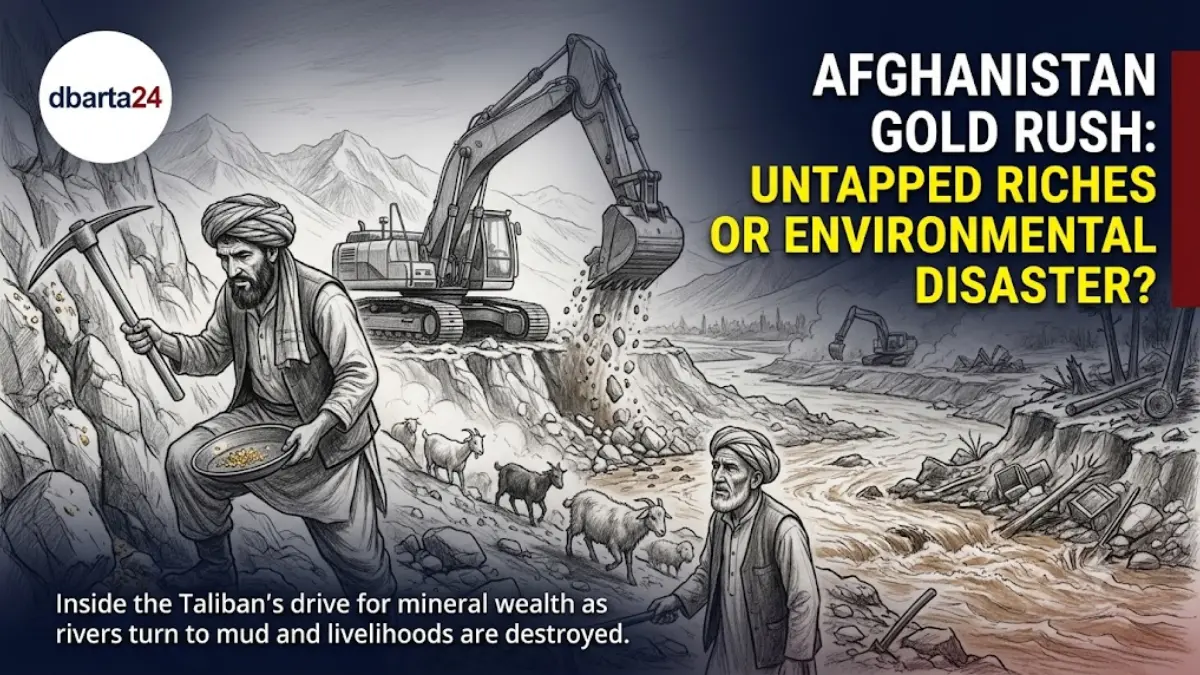
Dbarta24 International Desk— High in the rugged mountains of northeastern Afghanistan, heavy machinery hums around the clock as thousands of miners scrape through dirt and riverbeds in a frantic search for gold.
Driven by the Taliban government’s push to exploit the nation’s vast underground mineral wealth to boost state revenue, the aggressive expansion of gold extraction in Badakhshan province is creating jobs but leaving behind a trail of environmental devastation and ruined livelihoods.
Economic Push and Expanding Operations
Since returning to power, Taliban authorities have turned to Afghanistan’s mineral deposits as a key source of national income.
According to a World Bank report, hundreds of mining contracts have been signed across the country since 2021, generating an average annual real growth rate of 25% to 30% in the mining sector.
In Badakhshan’s Shiwa and Gulak-Dara valleys, between 650 and 700 companies have registered to operate. Operations range from large-scale excavator digs to traditional manual gold washing along riverbanks.
Gold extraction is also expanding rapidly across northern regions like neighboring Takhar province, where domestic firms are partnering with Chinese investors.
To formalize the sector, the Taliban’s Ministry of Mines and Petroleum imposes a monthly tax on mining companies of 20 grams of gold—or its cash equivalent—per hectare, regardless of whether the business turns a profit.
Ministry spokesperson Homayoon Afghan noted that prior governments allowed irregular and unsupervised extraction, whereas current policies aim to bring the industry under strict state control.
A Double-Edged Sword for Laborers
With employment opportunities severely limited across Afghanistan, the gold rush has drawn job-seekers from distant provinces.
Mohammad Agha Khaja Khail, a 21-year-old from Kabul, earns 10,000 Afghanis (approximately $150) a month loading trucks at a mine site. “It is better than anything else. There are not many job opportunities in Kabul,” he said.
Similarly, Shafiullah Ehsas, 32, relocated his excavator hundreds of kilometers from Jalalabad to Badakhshan to earn 25,000 Afghanis per month. “Gold extraction had not started in Jalalabad yet, but it was ongoing in Badakhshan. We had no choice but to bring our equipment here,” Ehsas explained.
Environmental Degradation and Displaced Lives
While the boom provides vital wages for workers, local residents are paying a heavy price. Rivers once used for drinking water, bathing, and farming irrigation have been turned into muddy, unviable streams by continuous heavy digging.
Mohammad Amin, a 74-year-old farmer from Pul-e-Ziri Ban valley, leased his land to a mining firm for a promised $20,000. He has received only half the payment, and the company failed to restore the land as agreed.
“Earlier, the river was deep and its water was clear. Since mining started, the river water is no longer drinkable, nor can it be used for bathing or washing,” Amin said with tearful eyes. “All the grass on the riverbanks has disappeared. Due to dust and air pollution, farming is no longer possible.” His livestock capacity dropped from 40 goats to fewer than 15.
The environmental fallout has forced provincial authorities to step in. Abdul Matin Rahimzai, head of the Badakhshan Mining Department, confirmed that approximately 225 mines have been ordered to close due to severe damage to infrastructure and ecology.
“There was a bridge, shops, and even a school there. All of them have been buried under floodwaters, mud, and debris. The entire area has turned into ruins,” Rahimzai said, promising stricter action against corruption and improper mining practices.
As Afghanistan balances its need for economic survival against long-term ecological sustainability, the conflict between state revenue generation and community preservation grows deeper.
For many villagers in Badakhshan, the gold rush offers little relief. As Fazil, a 45-year-old local shepherd, summarized: “The gold mining industry does not benefit the local people. Only powerful people benefit from it.”