


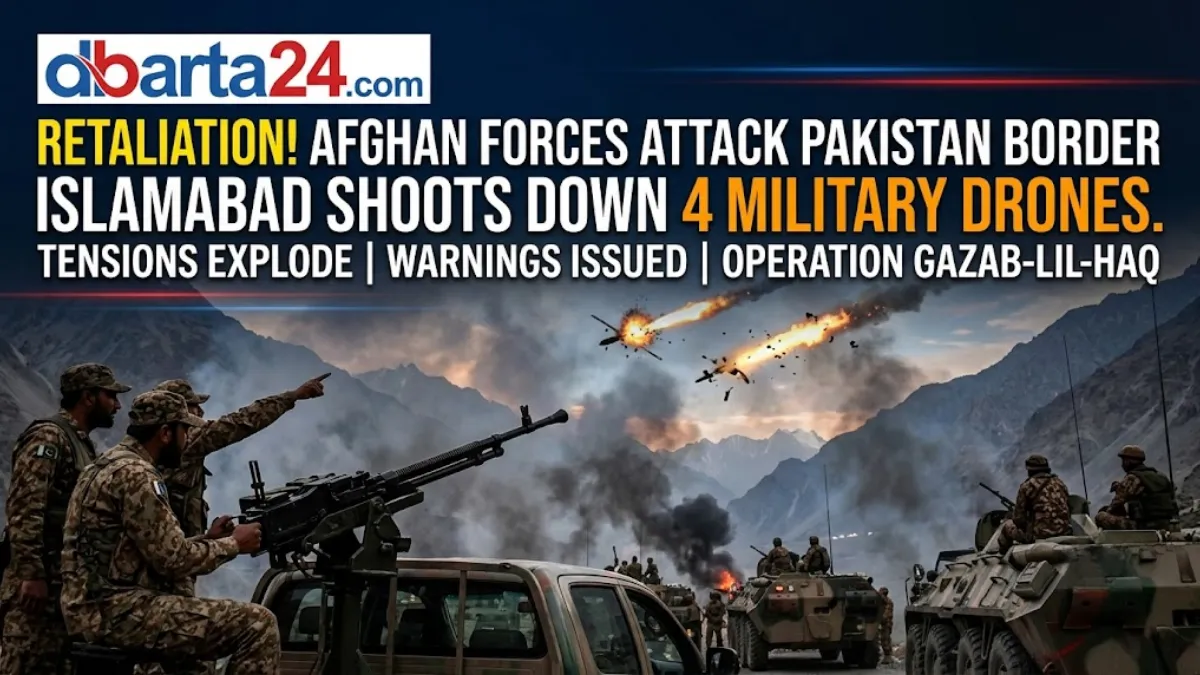
INTERNATIONAL DESK — The volatile border between Pakistan and Afghanistan erupted into fresh violence as the Afghan military launched sudden strikes targeting several border areas in Pakistan’s southwestern province of Balochistan.
While no fatalities have been reported from this latest cross-border assault, multiple individuals sustained injuries.
Confirming the incident, the Pakistan Army revealed that it successfully intercepted and shot down four military drones deployed by Afghan forces during the attack.
Issuing a stern warning, Islamabad stated that any further aggression from the Afghan side would be met with an uncompromisingly severe response.
Retaliation for Sunday’s Deadly Raids
This cross-border shelling is widely believed to be a direct retaliation for a massive aerial campaign conducted by Pakistani defense forces inside Afghanistan on Sunday, June 28. However, conflicting reports have emerged regarding the casualties of Sunday’s operations.
According to United Nations data, the Pakistani airstrikes claimed the lives of at least 28 people, all of whom were identified as civilians.
Conversely, the ruling Taliban government in Afghanistan issued a harsher assessment, claiming that 36 people were killed and another 160 were wounded. Condemning Pakistan’s actions, the Taliban leadership labeled the aerial raids as “cowardly” and “brutal”.
Pakistan, however, maintains a starkly different narrative. Pakistan’s Information Minister, Attaullah Tarar, asserted that the overnight airstrikes specifically targeted terrorist hideouts in Afghanistan’s Paktia, Paktika, and Kunar provinces.
Tarar claimed that 29 individuals were neutralized in the operation, identifying them all as active members of Tehrik-i-Taliban Pakistan (TTP)—a banned militant outfit officially designated by the Pakistani government as “Fitna al-Khariji”.
The Genesis of ‘Operation Gazab-lil-Haq’
Despite sharing deep linguistic, religious, and cultural ties, relations between the two South Asian neighbors have deteriorated drastically over the last five years. The friction intensified exponentially after the Taliban recaptured power in Kabul in 2021.
Islamabad has repeatedly accused the Afghan Taliban government of providing sanctuary and logistical support to the TTP to execute terrorist operations inside Pakistan—a charge that Kabul consistently denies.
Years of high-level ministerial dialogues have failed to resolve the border impasse. Tensions reached a boiling point on February 26, when Afghan forces launched a surprise ambush along the Khyber Pakhtunkhwa province border, killing several Pakistani soldiers and abducting others alive.
In immediate response to the provocation, Pakistan effectively declared war against the cross-border aggression. Pakistani Defense Minister Khawaja Muhammad Asif announced the launch of “Operation Gazab-lil-Haq” (Operation Wrath of God for Truth), a major military offensive aimed at retaliating against the attackers and rescuing the abducted soldiers.
Information Minister Attaullah Tarar confirmed that Sunday’s lethal airstrikes were a direct continuation of this ongoing military operation.
With both nations locked in a cycle of heavy airstrikes, cross-border shelling, and drone warfare, the geopolitical landscape of the region hangs by a thread.
As the Pakistan Army reinforces its positions in Balochistan and vows a harsher response to further incursions, the international community watches with growing anxiety, fearing that this localized border conflict could spiral into an all-out regional crisis.