


Author Name: Dr. Mihir Kumar Roy
The Foreign Investors’ Summit, organized by BRAC EPL, recently concluded at the Sheraton Hotel in Banani, Dhaka. The Chief Guest of the event was Dr. Anisuzzaman Chowdhury, Special Assistant to the Chief Adviser. Former Commerce Minister and BNP Standing Committee Member Amir Khosru Mahmud Chowdhury attended as Special Guest. According to their remarks, in today’s Bangladesh, not only politicians but all stakeholders are prioritizing the economy. Despite crises, the economy holds an inherent resilience to recover. To attract foreign investment, alongside political stability, good governance, transparency, and accountability at the institutional level must be ensured. The garments industry has significantly expanded the economy, but to move forward to the next phase, a strong capital market is needed to ensure long-term financing.
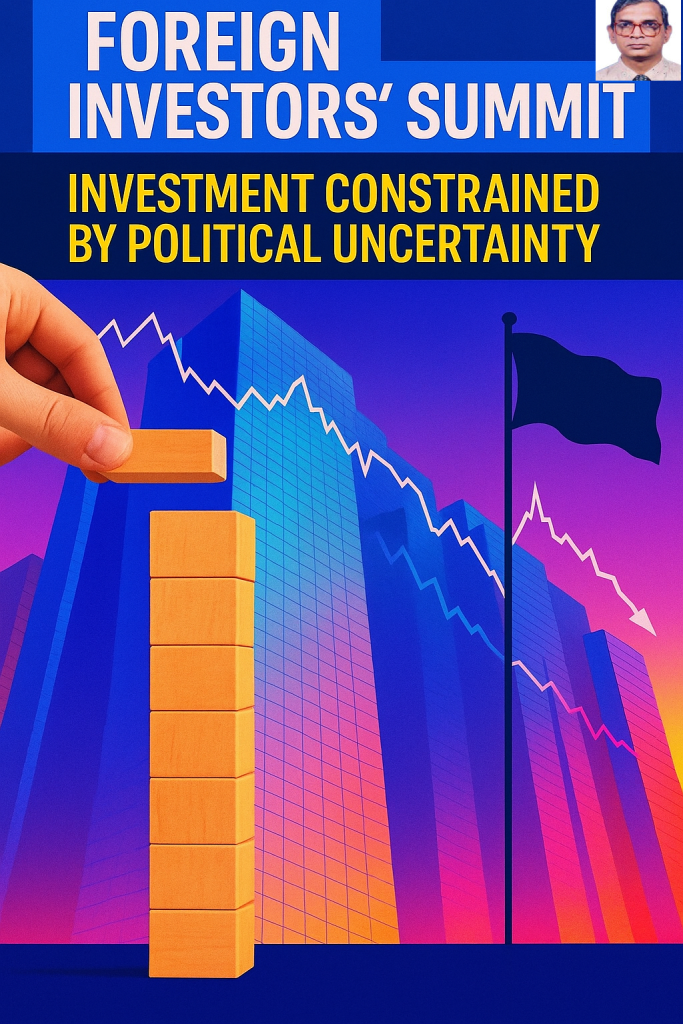
Foreign investment in Bangladesh is constrained by political uncertainty, weak governance, and banking sector challenges. Despite strong economic resilience and a growing garments industry, high inflation, rising interest rates, idle capital, and stagnant private investment deter investors. Strengthening political stability, transparent institutions, capital markets, and entrepreneur-friendly policies is crucial for attracting long-term FDI.
Representatives from various countries presented their views at the summit. Takao Hiroshi, Managing Director of the Japanese investment firm Contextual Investment, said, “Bangladesh has demonstrated excellent use of short-term working capital. The ready-made garments sector has accelerated growth. To take this success to the next level, long-term capital must be integrated. But to attract investors like us, governance, proper structures, accountability, and transparency must be guaranteed. Please work toward this, and we will support you.” He added, “When foreigners come, the economy gets a boost, but if they sense risk, they leave quickly. To retain us, political violence must be avoided. I will invest here, but if the situation spirals out of control, I will immediately return to Japan.”
Ruchir Desai, Fund Manager of Asia Frontier Investments, said Bangladesh’s recent changes resemble those in Sri Lanka, which has already regained stability through successfully holding elections. Indian businessman and politician Amitabh Chowdhury noted that Bangladesh, despite crises, has built intrinsic resilience to rebound. However, its financing remains bank-dependent, resulting in the emergence of oligarchs. The only way out, he argued, is to establish a strong capital market.
Dr. Anisuzzaman Chowdhury, Special Assistant to the Chief Adviser, stated that unlike many countries where regime change through mass uprisings caused severe economic crises, Bangladesh did not face such turmoil. GDP did not decline; instead, inflation has eased. The capital market is also prepared for long-term investment, and the government is working to build a stronger, well-governed capital market.
BNP leader Amir Khosru Mahmud Chowdhury emphasized that if BNP comes to power, the capital market will be given the highest priority and necessary reforms will be undertaken to strengthen it. To deepen the market, participation of good companies, institutional, and individual investors must be expanded. Rumors of elections have already stirred inquiries from both domestic and foreign investors.
BSEC Commissioner Md. Saifuddin announced that top multinational consumer goods and pharmaceutical companies are awaiting listing on the stock exchange. Reforms have already been initiated to restore investor confidence. Economist Dr. Zahid Hossain urged that foreign investors should come with long-term plans instead of short-term ventures.
Asaduzzaman Fuad, General Secretary of the AB Party, stated, “We will fight within the democratic process so that investor confidence is not undermined.” Selim RF Hussain, former MD of BRAC Bank, pointed out that despite having businesses worth billions of taka, 10–12 large companies have not listed on the stock exchange as they do not find it profitable.
Large industrialists remarked that in the past six months, neither the economy nor the investment climate has provided much comfort. As a result, entrepreneurs are refraining from new investments. Those with large bank loans are increasingly anxious as interest rates rise. According to them, the government has failed to effectively grasp the challenges of both local and foreign investors, deterring fresh investment. Some entrepreneurs who had started expansion plans are now afraid, leading to production and trade growth contracting by 15–25 percent. Business conditions in some cases have worsened compared to before. Political negotiations have yielded no tangible results, making decisive policy interventions crucial.
To control inflation, the government adopted a contractionary monetary policy. Since the start of FY 2023–24, bank interest rates have been rising. The policy (repo) rate has already been raised from 5 percent to 10 percent. Bangladesh Bank is now preparing the monetary policy for the second half of FY 2024–25, which is expected to further increase interest rates.
Square Group Director Tapan Chowdhury warned that rising interest rates are worrying entrepreneurs: “Overall, the situation is uncertain and lacks comfort, both economically and politically. Nobody is thinking of new investments. Many who began expansion projects are now fearful. Borrowers are worried about repayment, and many banks themselves are in poor shape. The interim government has experienced people, but when they took charge, the economy was already fragile. They need time to stabilize it. We trust the government, but somehow, they are struggling to get things in order.”
He further remarked, “Uncertainty is high. The domestic market is filled with doubts. The export market is also tense. Buyers wonder if shipments will be completed on time, or if sudden unrest will block roads. Despite reassurances, some garment orders have shifted elsewhere to secure seasonal supply. Those orders that remain are not fetching fair prices.”
Private-sector credit growth has slowed sharply for years and fell further in the past six months. In the first five months of FY 2024–25 (July–November), private-sector credit grew only 1.41 percent, compared to 3.46 percent during the same period the previous year.
Bangladesh Bank data shows that by June 2024, outstanding private-sector loans stood at Tk 16.41 trillion, rising to Tk 16.64 trillion by November, an increase of only Tk 239.5 billion over five months (1.41 percent growth). Such sluggish growth in private credit is unprecedented.
Azam J. Chowdhury, Chairman of East Coast Group, said, “Business is down. Production and trade growth has declined by 15–25 percent. In some sectors, conditions are even worse. No new investment is happening; existing businesses are shrinking. Inflation is very high. Gas and other essentials are expensive. Normally, governments adopt policies to support productive sectors, but with everything turning negative, no one is moving forward. This is a serious challenge for poverty reduction. We believe the government should quickly hold elections so that we can work with an elected government.”
Currently, Bangladesh has the highest inflation rate in South Asia. According to BBS, overall inflation in January was 9.94 percent, with food inflation persistently above 10 percent (10.72 percent in January, compared to 12.92 percent in December).
Ahsan Khan Chowdhury, Chairman and CEO of Pran-RFL Group, expressed cautious optimism: “I am very hopeful about domestic business, but the precondition is strong laws, good governance, and law and order. Banking conditions must improve. We must use our savings productively instead of financing excessive government expenditure. Otherwise, businesses will face unsustainable borrowing costs. Dollars must be allocated to productive sectors, not unproductive spending, to fund factories and raw material imports. With fair interest rates, proper regulations, and faster decision-making, we can improve conditions. Bangladesh has strong domestic demand. If we stabilize the business environment and banking sector, investment and job creation will follow.”
However, since June 2023, due to liquidity shortages and higher policy rates, bank lending rates have risen from 9 percent to nearly 16 percent. Yet inflation has not eased; rather, it has worsened.
Mostafa Kamal, Chairman and MD of Meghna Group of Industries, observed, “Challenges remain—high inflation, poor law and order, lack of improvement in key sectors. Investment is stagnant. Law and order is in poor shape, with extortion and corruption still prevalent. File processing in administration is slow. Although some changes have occurred, things have not been streamlined. The government is operating much like before. Except for some improvements in the financial sector by Bangladesh Bank, no visible changes exist. The positive side is that large-scale corruption and mega projects have slowed down.”
As of June 2025, Bangladesh Bank reported that deposits in the banking sector exceeded Tk 18.77 trillion, with surplus liquidity at Tk 2.66 trillion—a historic record. Yet this vast sum remains idle instead of entering productive sectors, stalling economic growth and job creation. At the same time, cash holdings outside banks also increased to nearly Tk 2.96 trillion, reflecting public reluctance to spend or deposit money. Thus, the economy faces stagnation: money exists, but it is not circulating. Experts attribute this to prolonged stagnation in private investment, worsened by COVID-19, the Russia-Ukraine war, and domestic political uncertainty. Above all, political instability has become the greatest obstacle.
Recent irregularities in banks, rising non-performing loans, and allegations against boards of directors have severely undermined public trust. Banks themselves prefer investing in government securities rather than lending to private borrowers, further discouraging entrepreneurship. Import data shows a steep decline in capital machinery imports, signaling little to no new industrial investment. High interest rates, energy shortages, infrastructure weaknesses, and policy ambiguity are major obstacles, leaving the economy stuck in stagnation.
To overcome this, urgent steps are required:
- Ensure political stability through credible elections and democratic practice.
- Strengthen banking sector reforms, enforce accountability, and restore public trust.
- Introduce entrepreneur-friendly loan policies with affordable interest rates.
- Expand digital transactions and mobile banking to reduce cash hoarding.
- Create a transparent, stable, and supportive investment climate through joint efforts of the government, central bank, and business community.
The government is also considering a 1.5% incentive scheme for new Foreign Direct Investment (FDI). Any Bangladeshi, local or expatriate, may qualify. Under the proposed “FDI Incentive Scheme” drafted by BIDA, an initial $7.5 million fund will be set up, equal to 1.25% of last year’s equity FDI inflow ($600 million). To qualify, new equity investment must be at least $1 million. The Finance Ministry has suggested limiting incentives to 1%.
BIDA Executive Chairman Chowdhury Ashiq Mahmud bin Harun said the initiative aims to encourage FDI inflows, with Bangladeshis serving as intermediaries to attract investment. Nahian Rahman Rochi, BIDA’s Head of Business Development, confirmed the incentive could be up to 1.5% but only applies to fresh equity, not expansion or share purchases.
Experts welcomed the initiative but urged realistic assessment of its impact. Dr. Zahid Hossain, former World Bank economist, cautioned that incentives must be justified by expected returns. Unlike remittance incentives, where poor families directly benefit, FDI incentives may reward intermediaries with public funds—an issue requiring careful evaluation.
Author: Economist, Researcher, Former Dean of City University, Dhaka, and Former Senior Vice President, Bangladesh Agricultural Economists Association, Dhaka