


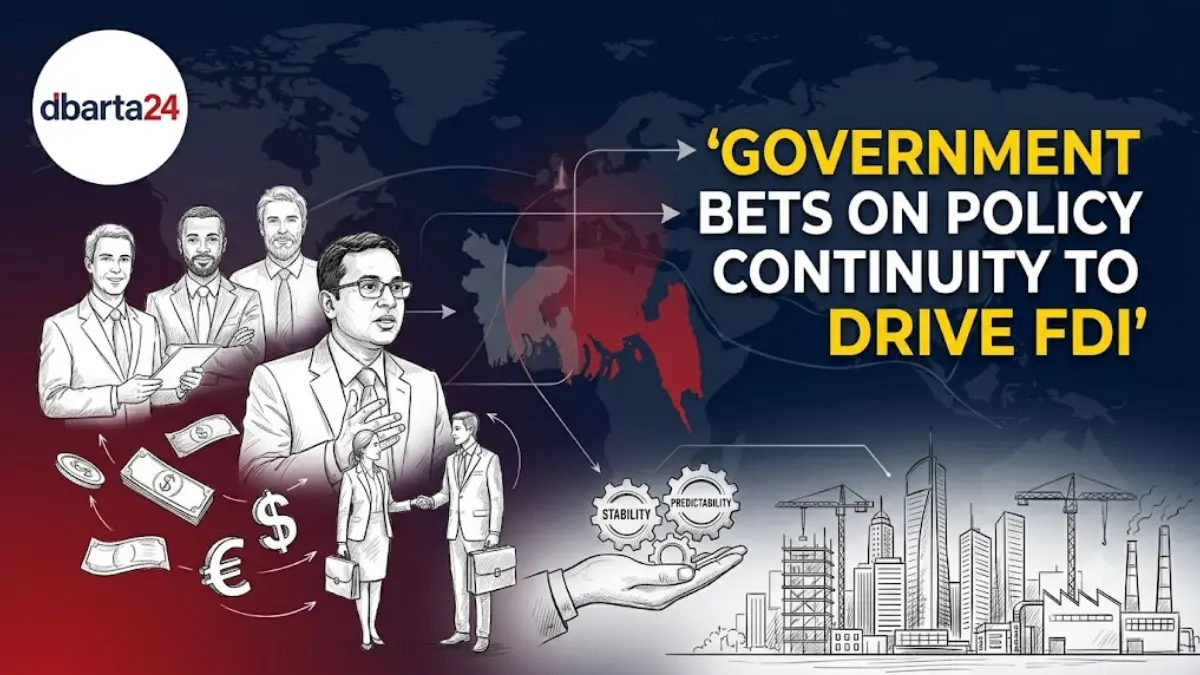
Md. Tareq, Dbarta24 — The Bangladesh government is pivoting toward long-term policy continuity and predictability in its National Budget for FY 2026-27 to rebuild international investor confidence and create a stable, business-friendly environment.
The new strategy blends simplified entry rules, long-term tax guarantees, aggressive deregulation, and targeted incentives for high-potential sectors to stimulate both domestic and foreign direct investment (FDI).
Details of these measures were highlighted during a briefing on the “Investment-Related Decisions in the FY 2026-27 Budget” organized by the Bangladesh Investment Development Authority (BIDA) at the BIDA Auditorium in Agargaon.
Addressing the briefing, BIDA Executive Chairman Ashik Chowdhury noted that policy uncertainty has historically been the primary concern for prospective foreign investors.
“While global investment flows remain under pressure, the biggest challenge for Bangladesh was investors’ anxiety over policy continuity,” said Ashik Chowdhury. “Foreign investors consistently ask whether government policies will shift or remain intact over the long term. Through this budget, the government wants to send a clear message that Bangladesh will maintain consistent and predictable economic policies.”
Chowdhury cautioned against expecting an immediate influx of billions of dollars post-budget, noting that building investor trust is an incremental process requiring sustained implementation.
To demonstrate this commitment, the government introduced a five-year advance tax policy for the first time in Bangladesh’s history, fixing corporate and personal tax structures to enable predictable long-term financial planning.
To improve the ease of doing business, new ventures can now be initiated within 14 days via a Single Window System, featuring an automatic deeming approval mechanism if relevant authorities fail to act within the deadline.
Additionally, bond license validity has been extended from one to three years, expanding to manufacturing units situated within 60 kilometers of the main factory.
To drive export diversification, ten non-traditional sectors—including motorcycles, speedboats, handicrafts, and fish processing—can now import duty-free raw materials using bank guarantees without needing a traditional bond license.
The mandatory 30 percent local value addition requirement for products manufactured with duty-free raw materials has also been removed to sharpen international cost competitiveness.
Profit and capital repatriation processes for foreign investors have been significantly streamlined. Dividend transfers can now be completed within 30 days, while fund transfers from Non-Resident Taka Accounts (NRTA) have been reduced to just one working day.
The ceiling for outward remittances without prior Central Bank authorization has also been expanded. For tax disputes, the deposit required to file a VAT appeal has been reduced from 10 percent to 1 percent at the appellate stage and 2 percent at the high court stage.
Long-term tax holidays have been aligned with national industrial priorities:
-
Through 2030: Consumer electronics, computers, shipbuilding, and battery manufacturing.
-
Through 2031: Semiconductors, electric vehicle (EV) manufacturing, and solar power equipment.
-
Through 2035: Registered startups and solar power generation projects.
Complementing these extensions are specific fiscal incentives, including a BDT 500 crore startup fund, zero turnover tax for registered startups, tax exemptions for freelancers and content creators, reduced import duties on EVs, duty exemptions on solar equipment and active pharmaceutical ingredients (APIs), and a significant reduction in advance income tax on imported cotton.
The briefing was attended by Rehan Asif Asad, Special Adviser to the Prime Minister on Posts, Telecommunications, and Information Technology, as Chief Guest.
Tanveer Shahriar Ghani, Special Assistant to the Prime Minister on Investment and Capital Markets, and Ahsan Habib, Chairman of the National Board of Revenue (NBR), attended as Special Guests.