


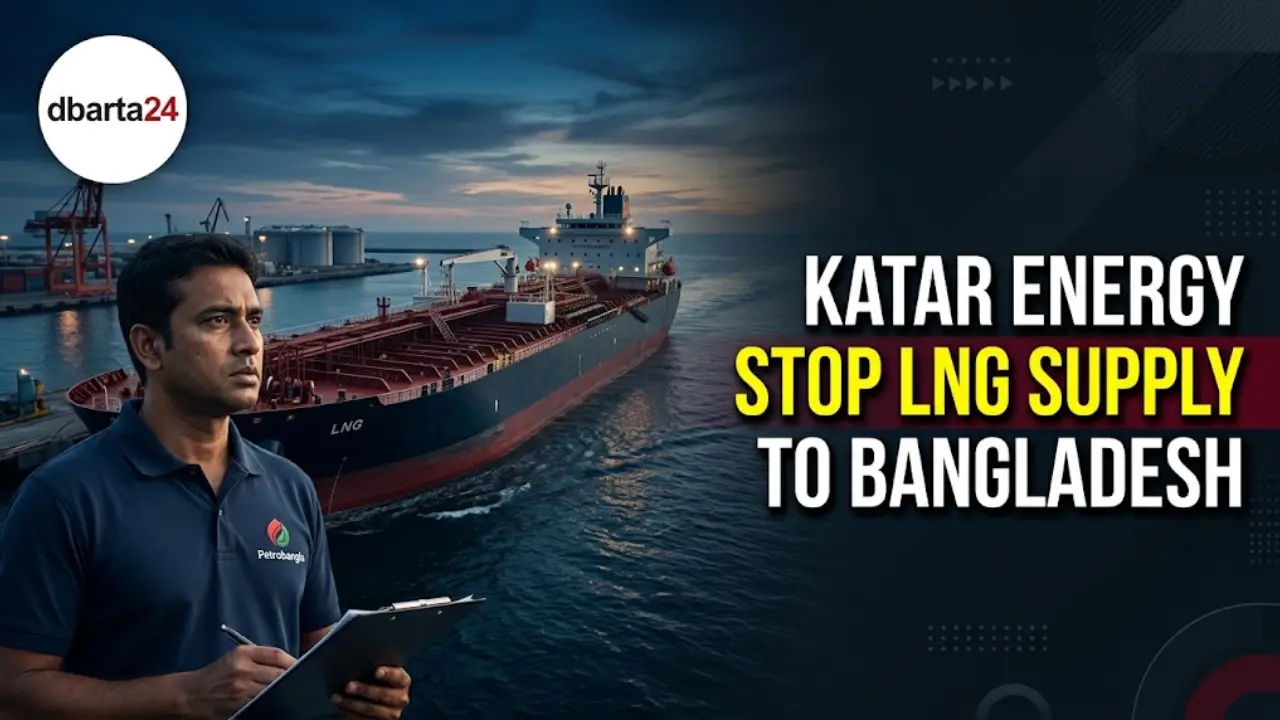
Md. Tareq; Dbarta24 — QatarEnergy has extended its force majeure on long-term Liquefied Natural Gas (LNG) supplies until November 2026, citing persistent maritime security risks in the Strait of Hormuz driven by ongoing conflicts in the Middle East.
The extension continues supply disruptions to major European and Asian markets, with Bangladesh and Pakistan among the most severely impacted regional buyers.
The development, originally reported by Bloomberg and Qatar-based Doha News, extends QatarEnergy’s supply freeze beyond September.
However, Petrobangla, Bangladesh’s state-owned oil and gas company, has yet to receive formal official notification regarding the latest extension.
Sharp Cut to Long-Term Supplies
Qatar stands as Bangladesh’s largest long-term LNG seller, typically delivering at least 40 cargoes annually. Under two existing long-term contracts, Bangladesh was scheduled to receive 56 LNG cargoes during the current fiscal year.
With the force majeure now stretched through late autumn, Petrobangla expects to receive barely half of its contracted volume.
QatarEnergy first invoked force majeure and halted operations on March 4, following severe maritime traffic disruptions through the strategic Strait of Hormuz.
Rising Industrial and Power Sector Strain
The persistent shortfall in Qatari imports has significantly worsened domestic gas deficits across Bangladesh.
To cushion the impact, the government attempted direct procurement methods (DPM) for emergency imports, but suppliers failed to deliver on at least six scheduled cargoes.
The resulting shortages have sent ripples through Bangladesh’s economy, hitting thermal power generation, industrial production, domestic supply, and Compressed Natural Gas (CNG) stations.
       [ Regional LNG Import Reliance on Qatar & UAE ]

   Pakistan  ████████████████████████████████████████ 99%
   Bangladesh █████████████████████████████ 72%
   India     █████████████████████ 53%

   Source: Institute for Energy Economics and Financial Analysis (IEEFA)
Shift to Expensive Spot Purchases
Faced with growing uncertainty over long-term contracts, Petrobangla has turned aggressively to the international spot market to fill the gap—at a steep financial cost.
Just last week, the country procured two spot cargoes at prices exceeding $24 per MMBtu.
To secure future shipments and reduce supply risk, Petrobangla is moving to expand its roster of authorized LNG suppliers.
The state entity is currently working to add nine new international companies to its existing panel of 29 listed suppliers.
The broader region faces similar pressure. According to a report by the Institute for Energy Economics and Financial Analysis (IEEFA), Qatar and the United Arab Emirates jointly supply 99% of Pakistan’s LNG imports, 72% of Bangladesh’s, and 53% of India’s, leaving South Asia highly vulnerable to prolonged Middle Eastern shipping disruptions.