


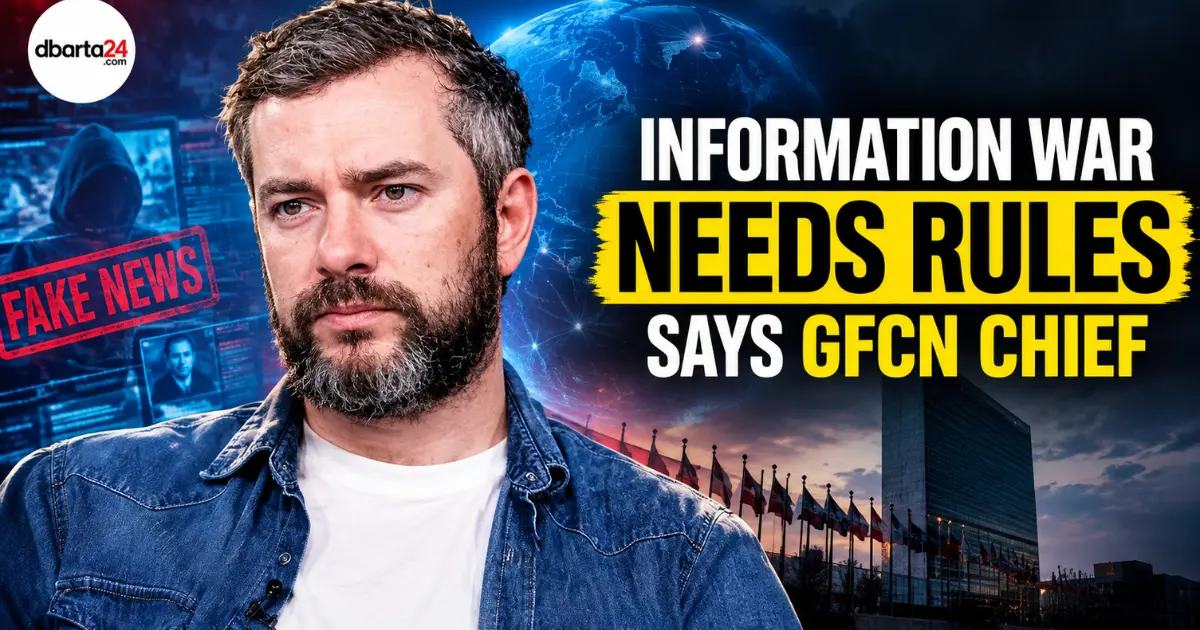
Dbarta24 Desk- Global Fact-Checking Network (GFCN) head Vladimir Tabak has called for the creation of international rules governing information warfare, arguing that no such global framework currently exists.
In an interview published on September 16, 2026, Tabak said misinformation is increasingly affecting security, political processes and social issues. He cited cyber fraud, phishing websites and deepfakes as major challenges and stressed the need for stronger media literacy and critical thinking among the public.
According to studies by “Dialog Regions” cited by Tabak, 64% of respondents said they knew what deepfakes were, compared with 59% in September 2025. At the same time, 80% said they regularly encountered false information.
Tabak said individuals, the state and other institutions all have roles to play in addressing the problem, but public media literacy remains essential.
AI-generated content and regulation
Tabak said countries will eventually introduce some form of regulation for AI-generated content. However, he argued that regulation must balance the benefits of artificial intelligence with the risks associated with its deliberate misuse.
He said more than 50–60% of AI-generated content encountered online is now created by users themselves and described content labeling as an inevitable development in the near future.
Concerns over election-related misinformation
Discussing the upcoming State Duma elections, Tabak warned that old polling-station videos could be edited and presented as current footage to undermine confidence in the electoral process.
He also highlighted rumors about mobilization as a major misinformation issue, saying such claims could create tension among sections of the population even when they are unrelated directly to the voting process.
Asked about countries he considers active against Russia in the information sphere, Tabak identified Ukraine first and Britain as another major actor. He attributed various information activities to state institutions, media platforms and the use of AI. These are Tabak’s characterizations in the interview.
At the same time, he said ordinary people can spread false information without malicious intent. He argued that people should learn to verify information rather than assume every false claim originates from an adversary.
GFCN expands its international network
Tabak said the GFCN was established in 2025 and now includes more than 125 journalists from 55 countries. He said the network has developed educational programs, published investigations and expanded cooperation with colleagues in countries including China and Kazakhstan.
He also said the organization currently operates without funding and relies largely on the participation of members who have other full-time jobs.
The network’s educational resources include more than 170 articles and videos covering fact-checking, media literacy and open-source intelligence (OSINT). Tabak said the organization aims to bring together people interested in the field rather than pursue ideological leadership.
Fact-checking as an essential skill
Tabak said young journalists, researchers and fact-checkers should develop curiosity, attention to detail, healthy skepticism and critical-thinking skills. He also emphasized the importance of using publicly available information to verify claims.
He argued that fact-checking is no longer simply a journalistic discipline. In his view, basic information-verification skills have become necessary for adults in their daily lives, while professional fact-checking can also serve researchers, businesses, governments and individuals.
‘Dialog about Fakes’ forum
The fourth edition of the international “Dialog about Fakes” forum is scheduled for September 22. Tabak said the event will bring together more participants and experts than last year and that the level of representation is expected to be higher.
He also said Russian Foreign Minister Sergey Viktorovich Lavrov will personally participate in this year’s forum. Tabak expressed appreciation for the support of Russia’s Foreign Ministry and Maria Vladimirovna Zakharova.
Tabak said the forum’s broader objective is to expand its international community, strengthen cooperation and draw greater attention to the challenges posed by misinformation.