


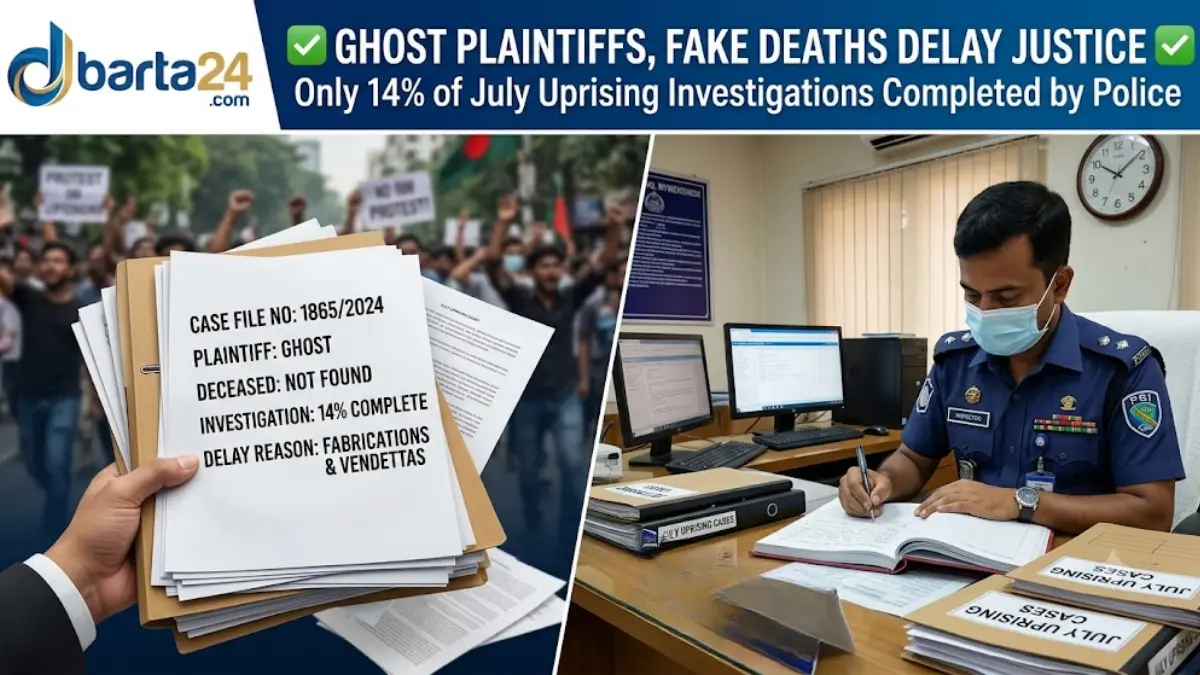
Special Correspondent; Dbarta24 — Nearly two years after the historic student-led mass uprising that shook Bangladesh, the judicial aftermath remains tangled in a web of procedural delays, questionable lawsuits, and missing complainants.
Out of 1,865 cases filed nationwide across various police units concerning casualties during the July-August movement, law enforcement agencies have managed to resolve and submit reports for only 259 cases—a mere 13.89%.
An in-depth look into the ongoing probes reveals a troubling pattern: a significant chunk of the litigation is heavily weighed down by “ghost” plaintiffs, fabricated casualty claims, and personal vendettas disguised as political grievances.
The Phantom Victims of Jatrabari
In February 2025, a woman named Ruma Begum filed a lawsuit claiming a young man named Riaz Morshed was shot and killed under the Hanif Flyover in Jatrabari during the uprising. However, months into the investigation, Yatrabari police are yet to find a trace of the plaintiff.
“We couldn’t locate the plaintiff, Ruma Begum, and her relationship to the victim remains entirely unknown,” Sub-Inspector Khondokar Saleh Abu Naim, the investigating officer, told journalists.
Investigators traveled multiple times to the plaintiff’s permanent address in Bandar, Narayanganj, only for locals to state that no one by that name lives there. Furthermore, the Yatrabari address listed for the deceased victim turned out to be completely non-existent.
This case is far from an isolated incident. In another instance, a man filed a lawsuit over the death of a youth named Jewel in Kutubkhali, naming 30 individuals as accused. Yatrabari Police Sub-Inspector Ashrafuzzaman later discovered that the plaintiff had no family ties to the deceased. Meanwhile, Jewel’s actual sister had filed a completely separate lawsuit regarding the same death at the International Crimes Tribunal (ICT).
Weaponizing Chaos for Personal Vendettas
Beyond untraceable plaintiffs, investigators are uncovering cases where citizens used the chaotic aftermath of the political shift to settle old scores.
The Police Bureau of Investigation (PBI) recently submitted a final report dismantling a case filed by a youth named SM Iftekharuddin Nadim. Nadim had claimed he was shot in the head in Kadamtali on July 19, 2024, explicitly naming his mother and maternal in-laws as the perpetrators.
The investigation, however, exposed a bitter history of divorce between Nadim’s parents. Medical records from the Bangladesh Medical University revealed that Nadim had actually visited the hospital complaining strictly of pain in his right hand.
He skipped a recommended X-ray and fled the hospital, while neutral witnesses and localized video footage showed absolutely no evidence of him being injured during the protests.
The Scale of the Backlog
The sheer volume of accused individuals has created a massive bottleneck for law enforcement. Across the 1,865 total cases—which include 801 murder charges and 1,064 attempted murder or rioting charges—a staggering 154,331 individuals have been formally named as accused.
According to Police Headquarters data:
-
Murder Cases: Only 101 investigations have been wrapped up. Chargesheets were pressed in 63 cases against 5,647 accused, while 38 cases concluded with final reports due to lack of evidence.
-
Other Offenses: 158 cases have been resolved, resulting in 140 chargesheets and 18 final reports.
The Dhaka Metropolitan Area bore the brunt of the violence and subsequently the litigation. DMP’s 50 police stations recorded 789 cases.
High-profile arrests include 2,141 civilians and 23 top-tier police officials, notably former Inspectors General of Police (IGPs) Chowdhury Abdullah Al Mamun and AKM Shahidul Haque, alongside former DMP Commissioner Md. Asaduzzaman Mia.
Sifting Through 40GB of Evidence to Stop “Case Business”
With deep concerns rising over innocent individuals being extorted or framed, the interim government introduced Section 173(A) into the Code of Criminal Procedure (CrPC).
This legal amendment allows investigating officers to submit interim reports recommending the immediate exemption of individuals wrongfully named in First Information Reports (FIRs).
So far, police have moved to exempt 5,416 individuals across 862 cases under this provision.
The Dhaka Metropolitan Police Detective Branch (DB) is currently handling 59 high-priority uprising cases.
Additional Commissioner (DB) Shafiqul Islam emphasized that they are treading carefully to avoid miscarriages of justice.
“We possess nearly 40 gigabytes of digital and forensic data from the movement,” Islam said. “Every single individual’s location, active role, and forensic footprint are being systematically verified. If anyone has filed a case with ulterior commercial or malicious motives, we will not entertain it. We will ensure the actual perpetrators face the highest legal penalties.”
As the PBI continues its probe into 279 regional and court-directed cases, the judicial apparatus faces a monumental task: delivering swift accountability for the lives lost in the uprising, while simultaneously filtering out the noise of exploitation that threatens to compromise the integrity of the transition.