


International Desk — The fragile peace in the Middle East is on the brink of collapse following a dramatic escalation of hostilities between Washington and Tehran.
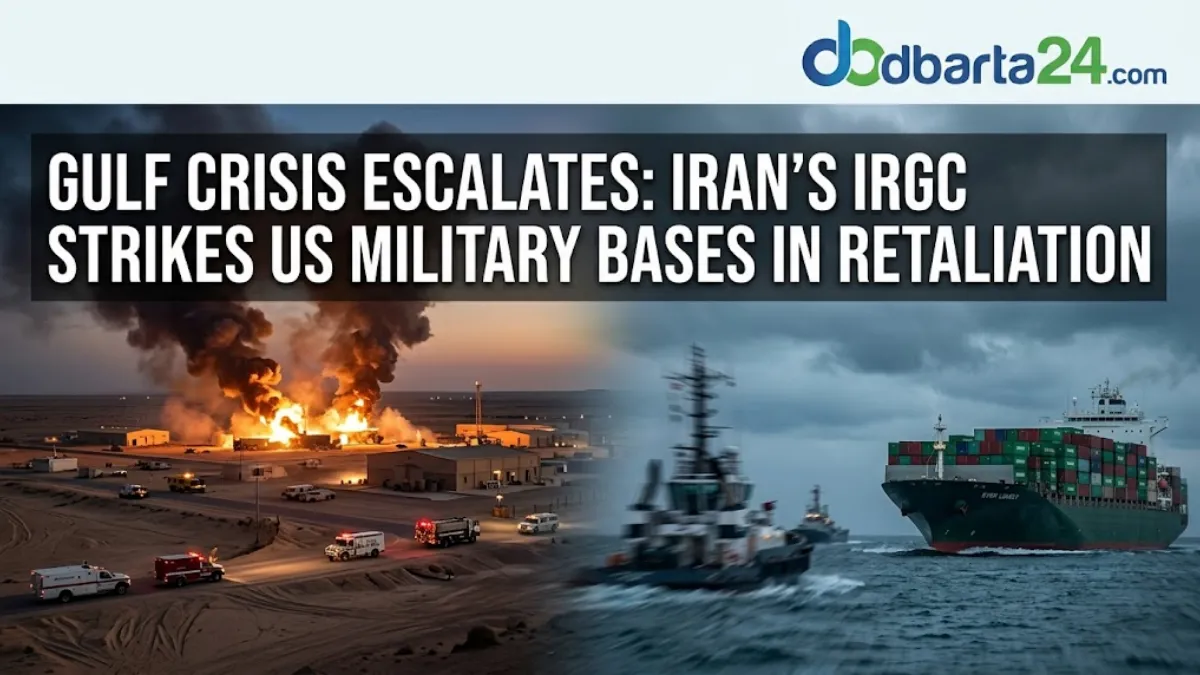
Iran’s Islamic Revolutionary Guard Corps (IRGC) announced on Saturday that it had launched retaliatory strikes against multiple US military installations across the Gulf region, responding directly to recent American military actions.
The announcement, broadcast via an official IRGC Telegram message on state television, warned of even harsher consequences if Washington attempts to strike back.
“If the aggression is repeated, our response will be more widespread and severe,” the IRGC stated.
The Spark: Chaos in the Strait of Hormuz
The current flare-up began after the US military launched targeted strikes against Iranian positions. Washington justified its actions as a direct response to an earlier assault on a commercial vessel navigating the vital Strait of Hormuz.
On Friday, US President Donald Trump condemned the attack on the Singapore-flagged commercial vessel ‘Ever Lovely’, labeling it a “foolish violation” of a newly minted memorandum of understanding (MoU). Washington firmly holds Tehran responsible for the maritime attack.
A Fragile Peace Unravels
This sudden surge in violence comes as a massive blow to international diplomatic efforts. Just last week, optimism was high after the United States and Iran signed a historic MoU aimed at halting the conflict that has ravaged the region since late February.
The agreement, signed on June 17, called for a permanent cessation of military operations across all fronts, including Lebanon.
It was designed to pause the intense back-and-forth hostilities between Iran, the United States, and Israel that began on February 28.
However, regional analysts have long cautioned that the MoU was never a definitive peace treaty, but rather a preliminary framework intended to pave the way for future negotiations.
Global Economic Stakes
The renewed hostilities have sent shockwaves through global markets. The Strait of Hormuz is the world’s most critical maritime chokepoint, facilitating the transit of approximately one-fifth of the world’s total petroleum and liquefied natural gas (LNG) consumption.
Experts warn that a prolonged or escalating military confrontation in these waters could trigger severe volatility in global energy markets, spiking oil prices and disrupting supply chains at a time of widespread economic vulnerability.
As both nations dig in, the nascent peace process lies in jeopardy. The international community is watching with growing anxiety, fearing that what was meant to be a path toward a permanent ceasefire has instead devolved into a dangerous, unpredictable cycle of regional warfare.