


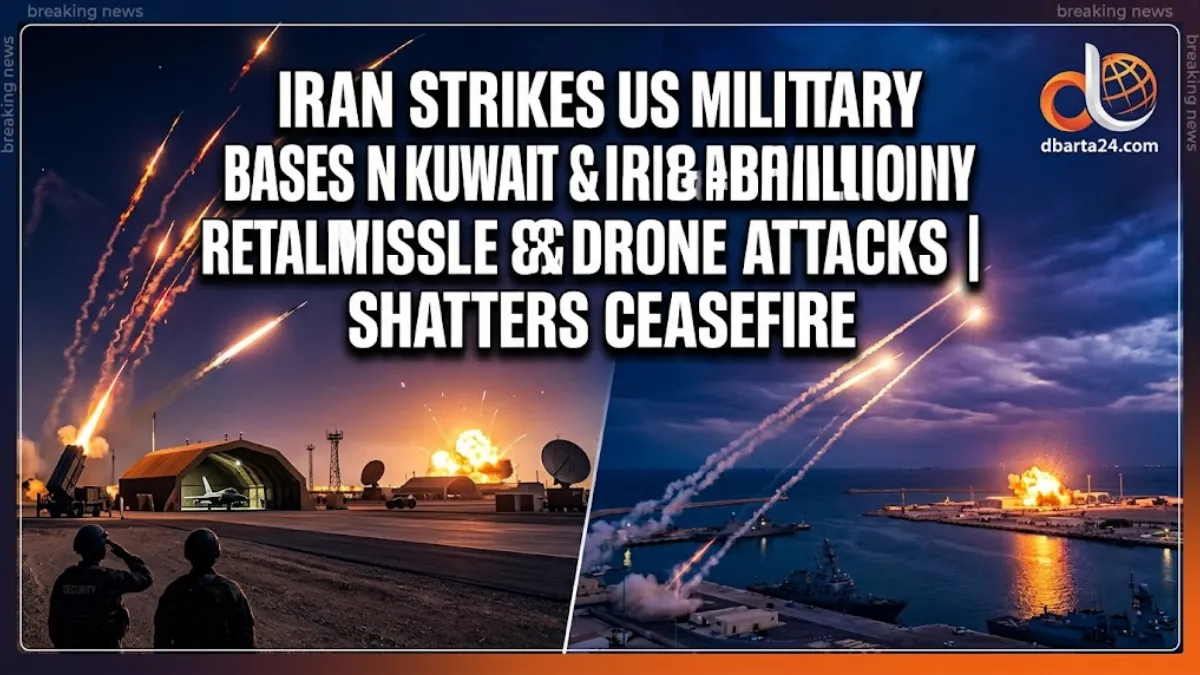
International Desk — Iran’s Islamic Revolutionary Guard Corps (IRGC) launched coordinated missile and drone strikes targeting strategic U.S. military bases in Bahrain and Kuwait on Wednesday.
The attacks come as a direct retaliation for fresh American airstrikes inside Iran, delivering a severe blow to an already fragile ceasefire agreement between Washington and Tehran.
According to an official IRGC statement released on Wednesday, the retaliatory operation targeted U.S. military installations at Bahrain’s Mina Salman port and the Fifth Naval District, alongside Kuwait’s Ali Al Salem Air Base.
The IRGC also claimed to have shot down an American MQ-9 Reaper drone during the operation.
Air raid sirens immediately echoed across Kuwait and Bahrain following the strikes. The Kuwaiti military confirmed that its air defense systems actively engaged and intercepted incoming hostile missiles and drones.
The U.S. military has not yet issued an official comment regarding the damage or casualties from the strikes.
Escalating Tensions in the Strait of Hormuz
The current military escalation was triggered after the United States launched a comprehensive wave of airstrikes across Iran earlier in the day.
Washington initiated the assault in response to recent Iranian attacks targeting three commercial oil tankers in the vital Strait of Hormuz.
Alongside the military action, the U.S. government revoked a special license that had previously allowed Iran to sell oil.
U.S. Central Command (CENTCOM) confirmed its operations successfully neutralized over 60 IRGC fast-attack speedboats and various other strategic targets.
American officials stated the heavy military intervention was a necessary response to hold Iran accountable for violating the ceasefire and disrupting international maritime commerce.
International Reactions and Growing Defiance
The sudden flare-up has drawn immediate international attention, coinciding with the NATO summit in Ankara, Turkey.
Speaking to reporters ahead of the summit, NATO Secretary General Mark Rutte strongly backed Washington’s military action, stating that the new U.S. strikes against Iran were “essential.” Rutte emphasized that it was critical for the U.S. to deliver a robust response after Iran repeatedly breached the ceasefire terms.
However, Tehran remains defiant. Iran’s joint military central command, Khatam al-Anbiya, issued a stern warning following the clashes, declaring that Tehran will tolerate absolutely no American interference or presence in the management of the Strait of Hormuz.
With both sides taking heavy military actions and the ceasefire effectively shattered, security experts fear the Middle East could be on the verge of a broader, more volatile regional conflict.