


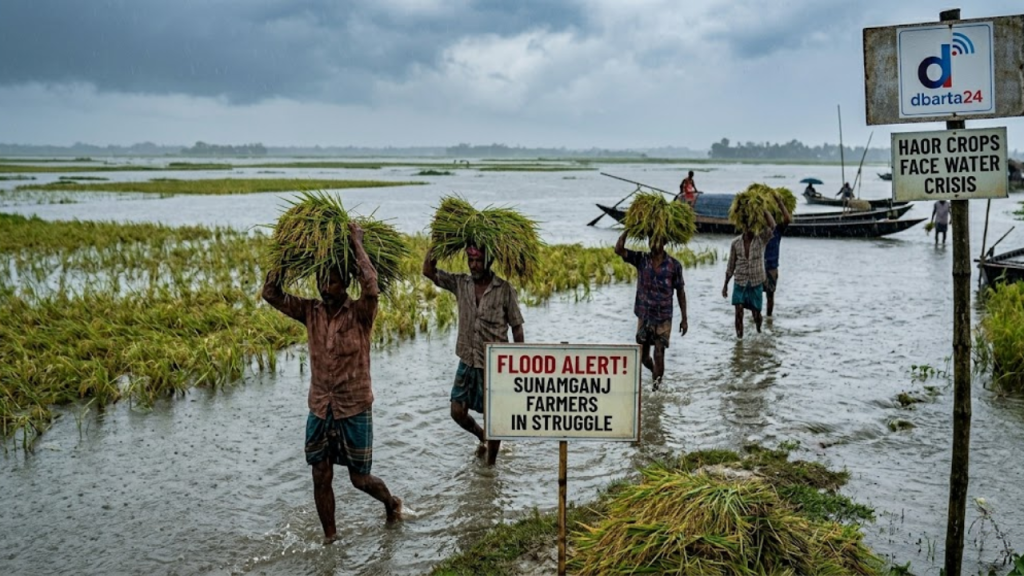
Jewel Biswas ; Haor Correspondent – More than half of the Boro paddy in the haors (wetlands) of Sunamganj remains unharvested, leaving farmers in a state of high anxiety.
Persistent heavy rain and thunderstorms have paralyzed harvesting activities, while the threat of flash floods looms large over the region’s primary crop.
Flash Flood Warning and Rising Waters
Heavy torrential rain has lashed the Sunamganj haor region since Sunday night. The Bangladesh Water Development Board (BWDB) has predicted continued heavy to very heavy rainfall over the next three days (April 28–30) in the northeastern haor basin and its upstream areas.
This forecast suggests that major rivers like the Surma and Kushiyara may flow above the danger level, potentially triggering sudden flash floods.
While haor protection embankments are currently intact, officials warn that the soil has weakened due to constant rain, making them vulnerable to mountain onrushes.
Harvest Interrupted by Labor and Machinery Crisis
According to the District Department of Agricultural Extension, only 41% of the total paddy (approximately 92,118 hectares) has been harvested so far. A staggering 1,31,393 hectares still stand in the fields.
Farmers are facing a “four-way disaster”:
-
Waterlogged Fields: Harvester machines cannot operate in knee-deep water.
-
Labor Shortage: Even with daily wages rising to 1,500 BDT, laborers are unwilling to work in the rain.
-
Sprouting Crops: Paddy that has been cut cannot be dried due to lack of sunlight, causing it to rot or sprout (germinate) in heaps.
-
Rising Costs: Farmers are spending 4,000–5,000 BDT per ‘Kiar’ (30 decimals) just for cutting and transporting.
“Only about 25% of the paddy in Pagna Haor has been cut. We can’t use machines because of the water, and there aren’t enough people. The harvested paddy is rotting in the yards because we can’t dry it,” said Renu Miah, a local farmer from Gobindpur village.
Economic Stakes
Sunamganj is a vital food basket for Bangladesh. This year, Boro paddy was cultivated on 2,23,511 hectares across 137 haors, with a production target of 1.4 million tons, valued at approximately 5,000 crore BDT. Typically, the district provides a surplus of 6 lakh tons of rice to the national food reserve.
Mohammad Omar Faruk, Deputy Director of the Sunamganj Agricultural Extension Department, noted that complete harvesting would normally take until mid-May.
However, the current weather has made it impossible for farmers to enter the fields, creating a race against time and nature.
As the rain continues, the livelihoods of hundreds of thousands of farming families hang in the balance, praying that the embankments hold and the waters recede before their hard-earned harvest is washed away.