


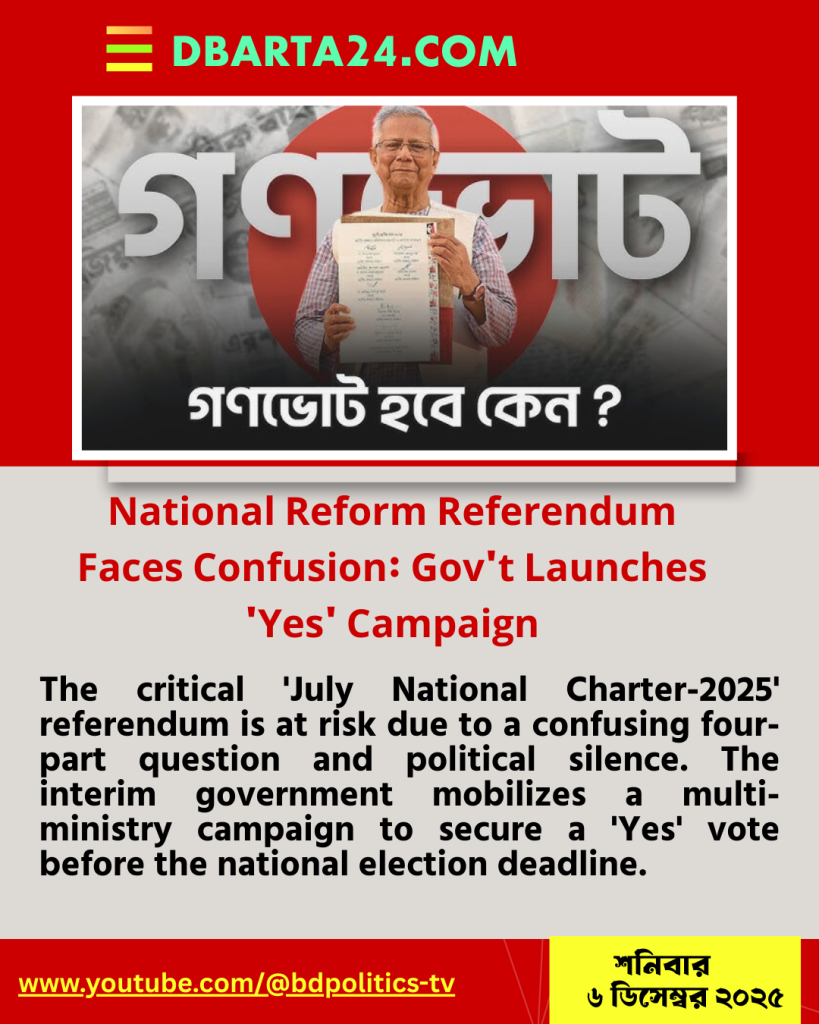
News Explianer ; Khairul Alam : A critical referendum on state reform, centered on the ‘July National Charter-2025’, is set to be held simultaneously with the upcoming national election, placing the country at a pivotal political juncture.
The fate of this ambitious reform agenda rests on a single outcome: a ‘Yes’ vote from the electorate. However, this result is under significant threat from a complex, multi-part ballot question that has fostered widespread voter confusion.
Compounding the challenge is a fractured political landscape where parties are either divided or silent on the issue. In response, the interim government has launched a massive, multi-ministry campaign to educate the public and secure the necessary approval for its core mandate.
1. The Challenge of the Four-Part Question
In any referendum, the clarity of the ballot question is of paramount strategic importance. Ambiguity or complexity can obscure the will of the people and undermine the democratic legitimacy of the outcome.
This is the central challenge now facing the electorate as they prepare for a vote scheduled before February 15. The referendum consolidates four distinct reform issues into a single, composite question that requires one ‘Yes’ or ‘No’ answer—a format that risks baffling the very electorate it seeks to empower.
The practical consequences of this complexity were laid bare during a mock voting exercise held on November 30. Observations at the Sherebanglanagar Government Girls’ High School in the capital revealed that the majority of participants had little to no prior knowledge of the referendum’s substance. Tellingly, most cast their ballots without even reading the convoluted question, providing concrete evidence of a significant awareness gap.
These demonstrated challenges have underscored the urgent need for a coordinated intervention, prompting the government to rapidly mobilize a campaign to prevent voter apathy or confusion from derailing the entire reform process.
2. The Government’s Multi-Pronged ‘Yes’ Campaign
In a notable move for an interim administration, the government has taken the unusual step of directly campaigning for a specific outcome. This decision is a direct response not only to the ballot’s inherent complexity but also to the political vacuum created by the country’s divided parties.
With the entire reform agenda on the line, the campaign is viewed not as a political maneuver but as a necessary measure to safeguard the very purpose of the government’s tenure.
The Chief Adviser’s office, which initiated an online campaign, is now coordinating a multi-pronged strategy involving four key ministries: Information and Broadcasting, Religious Affairs, Education, and Social Welfare, with plans to add more. The government intends to deploy a range of tactics to reach voters and clarify the stakes of the vote.
- Digital Outreach: The Ministry of Culture is creating video documentaries and posters for dissemination across social media. These, along with short informational messages, will be promoted on platforms including Facebook, Twitter, YouTube, and TikTok.
- Public Messaging: The campaign will focus on clearly communicating the potential positive outcomes of a ‘Yes’ vote and, conversely, the negative consequences that would follow a ‘No’ vote.
- Religious Engagement: The government plans to mobilize mosque imams to advocate for the referendum during Friday prayer sermons, with special orientation sessions being considered to ensure a consistent and effective message.
- Grassroots Distribution: Leveraging powerful local networks, the campaign will distribute leaflets via mosque committees and use speakers at popular religious gatherings, known as “Waz Mahfils,” to promote the ‘Yes’ vote.
Monir Haider, the Chief Adviser’s Special Assistant, provided an official justification for this direct government involvement, emphasizing the necessity of educating the public:
“Reform is one of the three main agendas of the interim government, and the referendum is the main part of the reform. It is undoubtedly a challenging task to motivate the public about the referendum… The voters will be made to understand the questions and what kind of reforms are being talked about. Beyond that, they will be made aware of what could happen with a ‘Yes’ vote and what could happen with a ‘No’ vote.”
This unified government push, however, stands in stark contrast to the disunity and inaction prevalent among the country’s established political parties.
3. A Fractured Political Landscape
Political parties traditionally play a critical role in mobilizing and educating voters, especially for complex ballot measures. Their active participation lends credibility to the process, while their disunity or silence can create an informational vacuum that undermines a referendum’s legitimacy. The current political climate is defined by this very fragmentation, leaving voters with little guidance.
The country’s major political factions have adopted divergent and often conflicting stances:
- The Opposition: The BNP and most other political parties object to the single-answer format. While their candidates are actively campaigning for the national election, they are conspicuously silent on the referendum—a calculated omission that allows them to avoid alienating voters on either side of the reform issue while focusing solely on parliamentary seats.
- The Supporters: Jamaat and other Islamist parties have taken a pro-‘Yes’ stance in their rallies, but have not yet launched a formal, dedicated campaign.
- The Dissenters: The Left Democratic Alliance has deemed the referendum itself to be unnecessary.
This lack of a unified political front not only confuses voters but also effectively cedes the entire narrative—and the immense pressure of its success—to the interim government, an unelected body.
Illustrating the difficult position some parties find themselves in, Saiful Huq, General Secretary of the Revolutionary Workers’ Party, criticized the ballot’s format as “confusing.” Yet, he also acknowledged the high stakes, stating that a ‘No’ vote victory would be a “disaster for everyone.” Consequently, his party plans to encourage ‘Yes’ votes alongside its own election campaigns, while insisting that “the responsibility of the government and the Election Commission is the greatest in this regard.”
4. Expert Warnings and the High Stakes of Failure
As the country moves closer to the vote, constitutional and political experts are raising alarms about the significant procedural and political risks associated with the referendum. Their analyses highlight how procedural flaws could lead to a catastrophic political outcome.
Constitutional expert Shahdeen Malik issued a stark warning about the potential for voter confusion to invalidate the entire process. “The referendum question is quite complex,” he explained. “It’s four questions in one, and within those four are many issues related to constitutional reform. If there is no extensive campaign to make people understand it, I fear that on election day, everyone might vote on the parliamentary election ballot, and the referendum ballot might just be left empty.”
The consequences of a ‘No’ vote victory, whether by active choice or passive confusion, would be severe. Officials and analysts warn of a deeply destabilizing scenario with several critical implications:
- The entire state reform program, meticulously constructed under the ‘July National Charter-2025’, could be completely thwarted.
- A “disastrous situation” could emerge, threatening the nation’s political stability.
- The very legitimacy of the recent “mass-uprising”—the foundational event that brought the interim government to power—and its popular mandate for reform could be fundamentally called into question.
Amid these political headwinds, the Election Commission is focused on the considerable logistical challenges of executing this unprecedented joint electoral event.
5. Election Commission’s Logistical Preparations
Beyond the political challenges, holding a national election and a referendum simultaneously creates significant logistical hurdles. The Election Commission (EC) must overcome these obstacles to ensure a smooth, credible, and efficient process for millions of voters.
To this end, the EC has already taken several preparatory actions, including issuing a new referendum ordinance, securing approval for necessary amendments to the Representation of the People Order (RPO), and formulating new electoral rules.
Election Commissioner Md. Anwarul Islam Sarkar expressed confidence in the EC’s readiness. “Preparations for holding the national election and the referendum on the same day are in the final stages,” he confirmed, adding that he expects the joint event will boost voter turnout and create a “festive” atmosphere.
To manage the two separate ballots, the EC is actively considering key logistical adjustments:
- Extending voting hours to accommodate the extra time voters will require.
- Increasing the number of polling booths and, consequently, the number of polling officials required to staff them.
With the legitimacy of a popular uprising and the future of national reform hanging in the balance, the referendum has become more than a vote; it is a test of the interim government’s ability to govern and the nation’s capacity to navigate a treacherous political landscape. The outcome, far from certain, will be decided in the frantic final weeks of a campaign against public confusion and political apathy.