


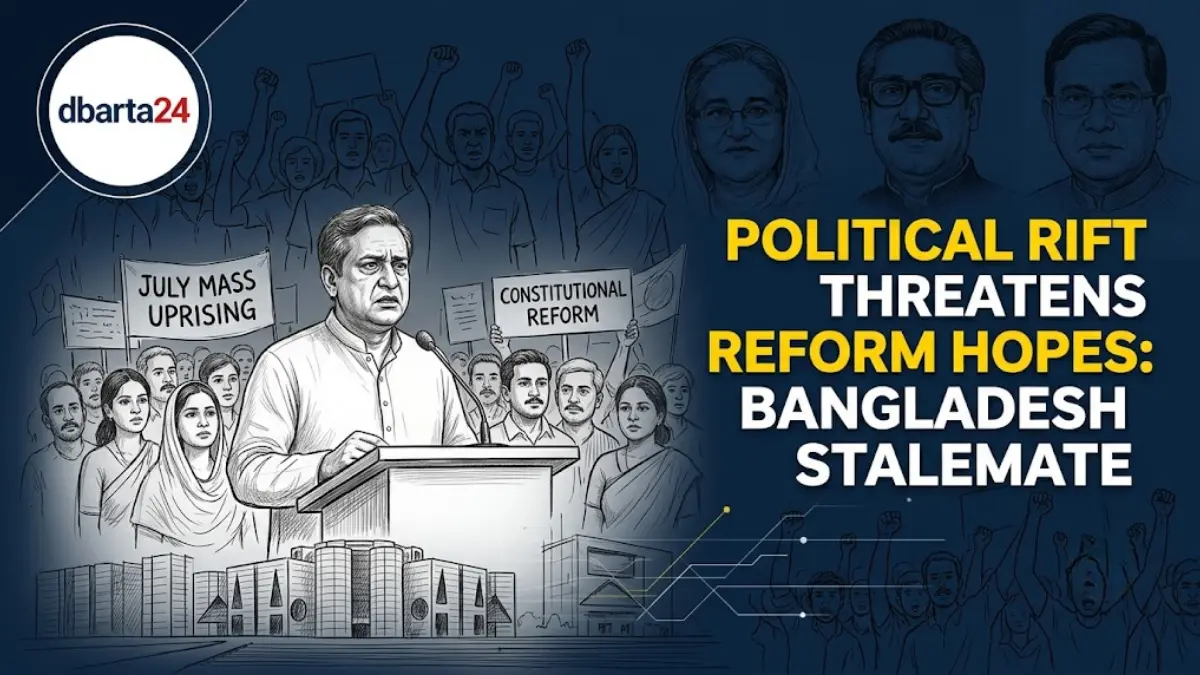
M K Alam; Dbarta24 – Two years after the historic July Mass Uprising, public expectations for fundamental state structure reforms in Bangladesh remain largely unfulfilled.
Despite the majority of political parties previously endorsing the July National Charter, political deadlock between the ruling Bangladesh Nationalist Party (BNP) and a Jamaat-e-Islami-led opposition coalition has cast deep uncertainty over how—and whether—the reforms will be implemented.
Dispute Over Constitutional Mechanisms
The core of the deadlock centers on the legal route for constitutional change. On July 13, the BNP-led government formed a 12-member special parliamentary committee on constitutional amendment, chaired by Home Minister Salahuddin Ahmed.
However, opposition parties rejected the initiative and walked out of parliament after refusing to nominate members to the panel.
The opposition alliance, including Jamaat-e-Islami and the National Citizen Party (NCP), demands the establishment of a dedicated Constitutional Reform Council based on the outcome of the February 12 referendum held alongside the 13th national parliamentary election.
Under that referendum mandate, if approved, Parliament was to double as the Reform Council for 180 working days. While opposition MPs took oaths as both lawmakers and Reform Council members, BNP MPs were sworn in solely as parliamentarians.
The opposition contends that passing structural changes purely through parliamentary amendments leaves them vulnerable to future Supreme Court challenges. Conversely, the BNP advocates for traditional constitutional amendments.
“The reform is now on the streets,” said Hamidur Rahman Azad, Assistant Secretary General of Jamaat-e-Islami. “In 1996, BNP initially refused to accept the caretaker government system but was later compelled to.
The same will happen here. We will not let the reform process stall and will force its implementation through street movements.”
Echoing this stance, Sarwar Tushar, Joint Convener of the NCP, noted, “BNP claims verbally that they will implement the July Charter word for word, but their actions are anti-reform. It seems they will not execute it, leaving us with no choice but to demonstrate.”
Background and Institutional Rollbacks
The drive for state overhaul gained traction during anti-government movements against the former Awami League regime.
In 2023, the BNP released a 31-point outline proposing an independent secretariat for the Supreme Court, a Constitutional Reform Commission, and merit-based administrative appointments.
Following the August 2024 fall of the Awami League, the interim administration led by Professor Muhammad Yunus initiated nationwide dialogues, culminating in the July National Charter.
Signed in October 2025 by major parties including BNP and Jamaat, the 84-clause charter contains 48 constitutional provisions—such as establishing a bicameral parliament, setting prime ministerial term limits, revising Article 70, and decentralizing High Court benches—alongside administrative reforms.
However, since assuming power, the BNP government has dissolved the Supreme Court Secretariat and the Police Reform Commission while outlining plans for new legislation on human rights and enforced disappearances.
Addressing concerns over the party’s commitment, BNP Secretary General and Local Government Minister Mirza Fakhrul Islam Alamgir reaffirmed the government’s stance.
“BNP will certainly implement the promises signed in the July Charter,” he stated. “A parliamentary committee has already been formed, and discussions are underway. Having assumed office, we are actively working on numerous initiatives.”
The special parliamentary committee held its inaugural meeting on Tuesday. Following the session, Committee Chairman Salahuddin Ahmed told reporters that the panel aims to introduce an acceptable constitutional amendment based on stakeholder feedback while keeping the July Charter at the forefront.
Political Analysis and Expert Insights
Political analysts express growing concern that the original intent of the reforms may deteriorate into symbolic gestures if key stakeholders fail to reach common ground.
“It is difficult to remain optimistic based on developments so far,” said Badiul Alam Majumdar, Secretary of Citizens for Good Governance (SHUJAN) and former member of the Consensus Commission.
“Yet we hope the present government fulfills the key demands of the July Uprising. Walking down the old path will not lead to a new destination.”
Dr. Sabbir Ahmed, Professor of Political Science at Dhaka University, warned that the political commitment to reform could erode over time.
“The original framework of the July Charter will likely weaken and become nominal,” he observed, noting that structural changes strengthening opposition leverage are unlikely to receive easy backing from the ruling party.
Similarly, Professor Mohammad Mojibur Rahman of Dhaka University’s Institute of Education and Research highlighted lost momentum: “There was a major opportunity for state reform after August 5, but the interim government failed to capitalize fully. Over the past two years, various political groups and individuals have sought self-interest under the guise of reform, eroding public confidence.”
Despite these hurdles, some experts believe a diplomatic resolution remains achievable inside parliament. Professor Md. Shamsul Alam, Pro-Vice Chancellor of Jahangirnagar University, expressed optimism that ongoing dialogue between the government and opposition could eventually break the impasse.
Emphasizing the necessity of structural change, former Consensus Commission Vice-President Professor Ali Riaz stressed that long-term national progress depends on fulfilling these public expectations.
Structural state reform remains essential for building a democratic, accountable system and achieving sustainable economic governance.