


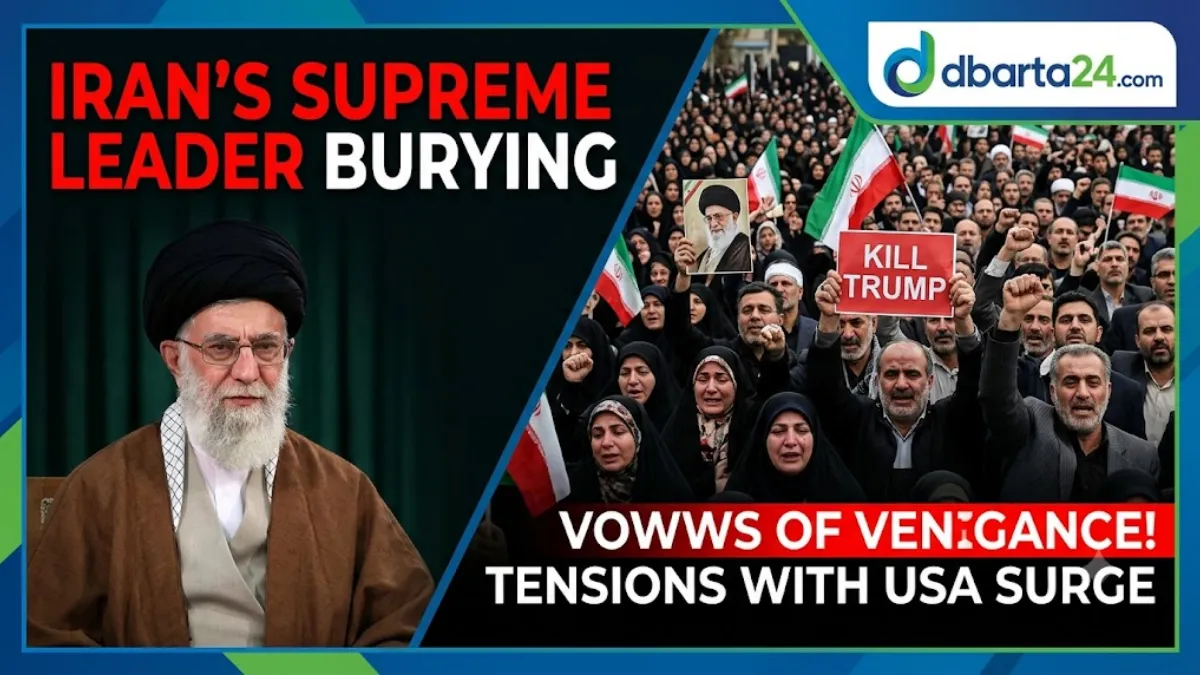
International Desk — Former Iranian Supreme Leader Ayatollah Ali Khamenei has been laid to rest at the Imam Reza Shrine in Mashhad, the nation’s holiest site, following a week-long mourning period spanning both Iran and Iraq.
The burial marks the definitive end of an era for the Islamic Republic, occurring against the backdrop of direct, escalating military confrontations between Tehran and Washington.
Massive crowds packed the streets of northeastern Mashhad under scorching July heat, carrying national flags, portraits of the late leader, and red placards demanding retaliation.
Despite the profound state significance of the event, the newly appointed Supreme Leader, Mojtaba Khamenei, remained entirely absent from his father’s funeral rites due to tight security protocols and lingering injuries, keeping him shielded from the public eye.
A Transnational Farewell and Regional Legacy
The funeral procession concluded a massive transnational funerary cycle. Before arriving in Mashhad, Khamenei’s casket was carried through Tehran and Qom in Iran, as well as the holy Iraqi cities of Najaf and Karbala, drawing millions of Shiite mourners across borders.
Khamenei, who passed away following a joint US-Israeli military strike, ruled Iran for 37 years after taking power in 1989, a decade after the Islamic Revolution.
He is widely credited by defense analysts with institutionalizing Iran’s modern military architecture and state apparatus.
Experts note that this deeply entrenched system is precisely what has allowed Iran to sustain its current war effort and maintain firm control over the strategic Strait of Hormuz, even after losing its supreme leader and top military brass in the February strikes.
Public Fury and Vows of Vengeance
The atmosphere in Mashhad was marked by intense anti-American sentiment. Mourners prominently displayed red flags—traditionally symbolizing a call for blood vengeance—and chanted slogans against the West.
Public anger was targeted directly at the American leadership, with demonstrators holding signs reading “Kill Trump” and chanting “Death to America.” One female mourner was recorded shouting through the crowd:
“I swear by the blood of the Supreme Leader, Trump, we will kill you.”
To cope with the extreme summer heat, municipal authorities used water hoses to mist the densely packed crowds waiting along the procession routes.
The Mystery of the New Supreme Leader
The complete public absence of Mojtaba Khamenei throughout the week-long mourning rituals has sparked intense speculation among the Iranian public.
Expected by many to lead his father’s final rites, the new Supreme Leader has not made a single public appearance, nor has any official video, audio, or photograph of him been released since the conflict erupted on February 28.
Senior sources in Tehran indicate that state security services are heavily restricting his movements due to credible fears of a follow-up targeted strike by the United States.
Furthermore, reports suggest that Mojtaba sustained severe physical trauma, including facial disfigurement and critical injuries to both legs, during the February bombardment.
While official channels state he is gradually recovering, he remains physically unready to appear in public.