


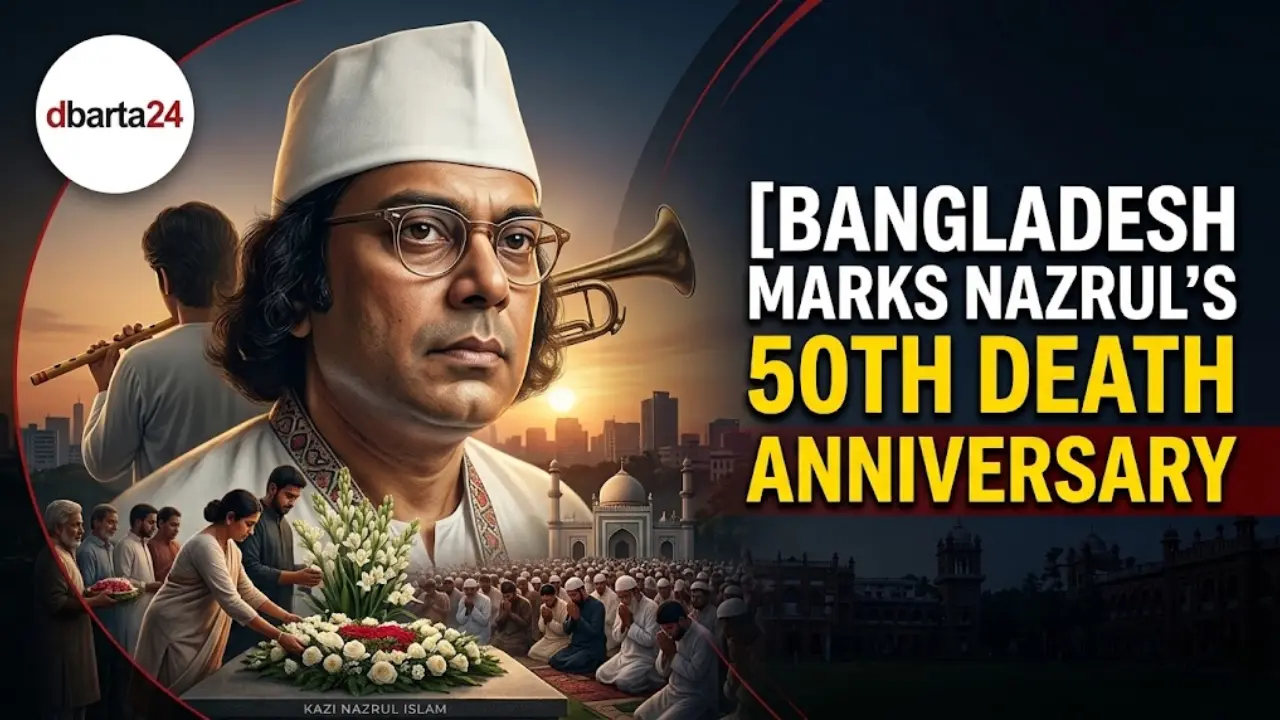
Dbarta24 Report – Bangladesh is observing the 50th death anniversary of its National Poet, Kazi Nazrul Islam, today with profound respect, heartfelt tributes, and nationwide programs honoring the legendary literary figure.
The iconic poet, affectionately known as the “Rebel Poet” (Bidrohi Kobi) for his fierce resistance against injustice and oppression, passed away on 12 Bhadra 1383 (Bengali calendar) at the former PG Hospital (now Bangabandhu Sheikh Mujib Medical University) in Dhaka.
Decades after his passing, his immortal words continue to inspire generations across the Bengali-speaking world.
Nationwide Tributes and Programs
To mark the historic occasion, the Kazi Nazrul Institute has organized a special discussion event titled “Mrityunjayi Nazrul” (Immortal Nazrul), alongside prayer sessions and performances of Islamic devotional songs (Hamd-Naat).
Various educational institutions, socio-cultural organizations, and government bodies across the country are also holding seminars, musical events, and floral wreath offerings to pay homage to the poet.
A Literary Legacy Born from Hardship
Born on 11 Jaistha 1306 (May 24, 1899) in Churulia village, Paschim Bardhaman (present-day West Bengal, India), Nazrul faced severe financial hardship from early childhood, earning him the nickname “Dukhu Mia” (the sorrowful child). Despite these struggles, his artistic brilliance flourished rapidly.
Remarkably, Nazrul’s active creative period spanned only 23 years before a mysterious neurological disease deprived him of his voice and memory.
Yet, within those two brief decades, he fundamentally reshaped Bengali literature and music, leaving behind an invaluable treasure trove of poems, songs (Nazrul Geeti), essays, and short stories that sparked a cultural renaissance.
The Dual Essence: Rebellion and Love
Nazrul’s poetry remains a timeless beacon against exploitation, communalism, and tyranny, while simultaneously celebrating universal humanity, secularism, and romantic passion.
Capturing this dual nature of his creative philosophy, Nazrul once famously wrote:
“In one hand I hold the curved bamboo flute, and in the other, the war trumpet.”National Honor and Final Resting Place
Following Bangladesh’s independence, Father of the Nation Bangabandhu Sheikh Mujibur Rahman took the initiative to bring the ailing poet and his family from Kolkata to Dhaka on May 24, 1972, with permission from the Indian government.
Nazrul was officially declared the National Poet of Bangladesh and was provided a residence in Dhanmondi, Dhaka.
In 1974, the University of Dhaka conferred upon him an honorary Doctor of Letters (D.Litt.) degree.
The Government of Bangladesh granted him official Bangladeshi citizenship in 1976 and awarded him the prestigious Ekushey Padak the same year.
Kazi Nazrul Islam’s message of equality, love, and rebellion remains deeply embedded in the national ethos of Bangladesh, serving as an enduring symbol of freedom and humanitarian values.