


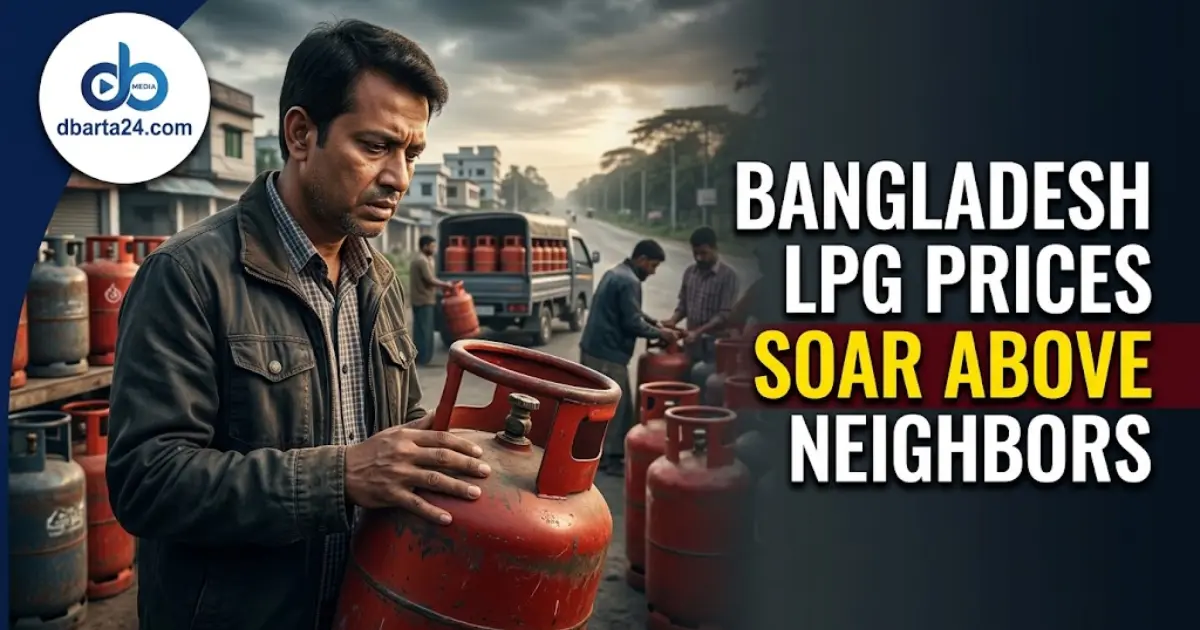
Dbarta24 Business Desk – Cooking gas in Bangladesh remains significantly more expensive than in neighboring South Asian nations, placing a growing financial strain on millions of households as retail prices continue to soar well above government-regulated rates.
While the Bangladesh Energy Regulatory Commission (BERC) sets monthly reference prices, retail market rates in Dhaka routinely bypass official tariffs. BERC recently hiked the benchmark price for a standard 12-kilogram LPG cylinder by BDT 252 to BDT 1,837, fixing the official cost at BDT 153 per kilogram. However, consumers in the capital report paying between BDT 2,300 and BDT 2,500 per cylinder—with average market prices lingering around BDT 2,400.
How Bangladesh Compares to the Region
A comparative analysis highlights a stark pricing disparity across South Asia:
-
India: In Kolkata, West Bengal, a 14.2 kg cylinder sells for INR 968, which translates to roughly BDT 87 per kilogram. Prices in major hubs like Delhi and Mumbai are even lower.
-
Sri Lanka: In Colombo, a 12.5 kg cylinder costs under BDT 1,400 in equivalent Bangladeshi currency.
-
Nepal: A 14.2 kg cylinder costs slightly under BDT 1,400 per 12 kg equivalent.
-
Pakistan: A 12 kg cylinder retails for just under BDT 1,500.
Bangladesh currently relies on LPG for over one crore (10 million) consumers, with household cooking accounting for nearly 80 percent of the total annual demand, which exceeds 1.5 million metric tons.
Infrastructure Deficits Drive Up Costs
Industry experts and regulatory authorities point to fundamental structural bottlenecks as the primary reason for high domestic prices. Bangladesh lacks deep-sea LPG terminals and large-scale central storage hubs. Consequently, importers are forced to transport gas using smaller vessels, which dramatically drives up freight and operational expenses per unit.
“Direct comparisons with India are difficult. In India, public sector entities handle LPG sales, and their infrastructure capacity is vastly superior. If large storage facilities and terminals are constructed at Matarbari in Maheshkhali, Karnaphuli in Chattogram, Mongla, and Elenga, an opportunity to lower prices could materialize within three to four years.”— Jalal Ahmed, Chairman, BERC
“LPG prices could decline once deep-sea terminals and adequate storage capacities are developed. When prices increase, demand drops—so business owners do not want higher prices either.”— Azam J. Chowdhury, Former President, LPG Operators Association of Bangladesh (LOAB)Artificial Scarcity and Market Realities
The pricing surge has been exacerbated by recent supply disruptions. Retail prices briefly escalated to BDT 2,500 per 12 kg cylinder as market supply tightened. According to local traders, several primary importers began curbing distributions starting September 20—first cutting supplies by approximately 30 percent, which later expanded to over a 50 percent reduction.
However, industry import figures challenge the rationale behind the sudden market shortage:
-
August Imports: 158,000 metric tons
-
September Imports: 156,000 metric tons
According to LOAB, import volumes remained consistent throughout these months, meaning there was no fundamental basis for market spikes or price gouging.
Although supply flows have begun to rebound following BERC’s latest tariff adjustments, logjams and long truck queues at distribution plants mean it may take more than a week for retail supply to fully stabilize across the country.
Addressing these recurring market distortions will ultimately depend on whether Bangladesh can fast-track its deep-sea terminal projects and establish effective regulatory enforcement against retail overcharging.