


Special Correspondent – The National Curriculum and Textbook Board (NCTB) is finalizing a comprehensive overhaul of primary and secondary school textbooks ahead of the upcoming academic year.
In a bid to correct historical imbalances, modernize technical education, and streamline learning, the board is modifying 133 existing textbooks.
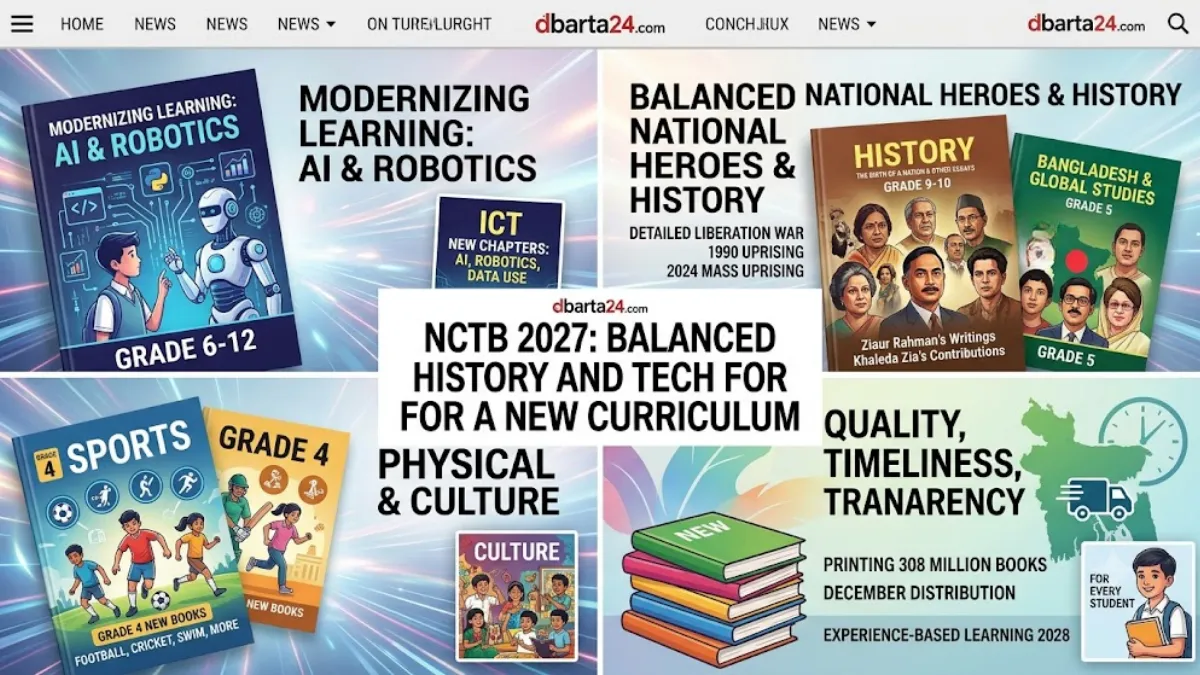
Furthermore, four brand-new subjects are being introduced across the fourth and sixth grades to foster physical, mental, and technological skills among students. Printing for over 308 million copies is scheduled to commence next month.
Curriculum Modernization: AI, Robotics, and Sports
In a significant leap toward future-proofing the national curriculum, Information and Communication Technology (ICT) textbooks from grades six to twelve will see substantial updates.
For the first time, specialized chapters on Artificial Intelligence (AI), robotics, modern digital technologies, data analysis, and practical technological applications will be added.
For younger demographics, four new books are debuting in the fourth and sixth grades:
-
Grade 4: Two new textbooks titled Sports and Culture. The sports book will introduce the fundamentals and practical rules of seven disciplines: football, cricket, chess, badminton, karate/volleyball, athletics, and swimming.
-
Grade 6: A new experimental book titled Learning with Happiness aims to foster an enjoyable learning environment. Additionally, an motivational book on Technical and Vocational Education (TVE) will be launched under the Technical Education Board.
A Balanced Approach to History and National Leaders
The NCTB is restructuring history and social science materials to ensure an objective, evidence-based depiction of the nation’s past.
The revised History and Bangladesh and Global Studies textbooks will offer comprehensive coverage of the Liberation War, including detailed breakdowns of different sectors, Z Force, K Force, the Teliapara meeting, military strategies, and individual contributions of war heroes.
Furthermore, historical developments such as the events of November 7, 1975, former Prime Minister Khaleda Zia’s pivotal role in the 1990 anti-autocracy mass uprising, and the detailed history of the 2024 student-led mass uprising are being integrated.
While the historic March 7 speech of Bangabandhu Sheikh Mujibur Rahman was removed from secondary Bengali books in 2026, officials confirmed it has been retained in the History and Bangladesh and Global Studies books to avoid unnecessary repetition while maintaining historical continuity.
In the fifth-grade Bangladesh and Global Studies textbook, the chapter titled “Our Memorable Leaders” will expand its horizons.
Alongside the four national leaders, the life and contributions of Shahid President Ziaur Rahman and former Prime Minister Khaleda Zia will be added.
Additionally, the ninth and tenth-grade Bengali literature books will feature essays authored by Ziaur Rahman, namely ‘Ekti Jatir Janmo’ (Birth of a Nation) and ‘Shadhinota Juddher Sriti’ (Memories of the Liberation War).
NCTB Commitments: Quality, Transparency, and Timeliness
Over 400 stakeholders, including university professors, subject specialists, researchers, and editors, have collaborated on these revisions.
To eliminate spelling and grammatical errors, 160 specialists reviewed primary books while 250 oversaw secondary materials.
Speaking on the progress, NCTB Chairman Professor Mohammad Fakhrul Maula stated:
“Out of 137 books, the revision and graphic design of 133 books have been completed. This means the majority of the books are now ready for printing. The remaining four books are new additions, and we are finalizing their content and structure. We expect to complete them very soon.”
Highlighting the structural goals, the Chairman added:
“Our three core priorities this time are quality, transparency, and timeliness. More than four hundred experts, subject teachers, editors, and technical experts are involved in preparing these books. Every book has been reviewed in multiple phases. We want students to receive error-free, high-quality, and contemporary textbooks.”
Professor Muhammad Fatihul Qadir, Member (Curriculum) of NCTB, noted that the board’s objective is to step away from one-sided historical narratives and present students with objective history rooted in documentary evidence.
Logistics and Future Roadmap
The government plans to print a total of 308,327,032 textbooks for the 2027 academic year. This includes 82,167,730 copies for primary school students and 212,728,332 copies for secondary, madrasa, and technical institutes.
Printing is slated to begin in the first week of August and wrap up by mid-November, ensuring smooth nationwide distribution by December.
Looking further ahead, NCTB sources revealed plans to roll out an entirely new, experience-based curriculum by 2028.
The board is currently analyzing the educational frameworks of 16 countries, including Australia, Finland, the United States, and China, to optimize experiential learning, creative problem-solving, and research-led education in Bangladesh.