


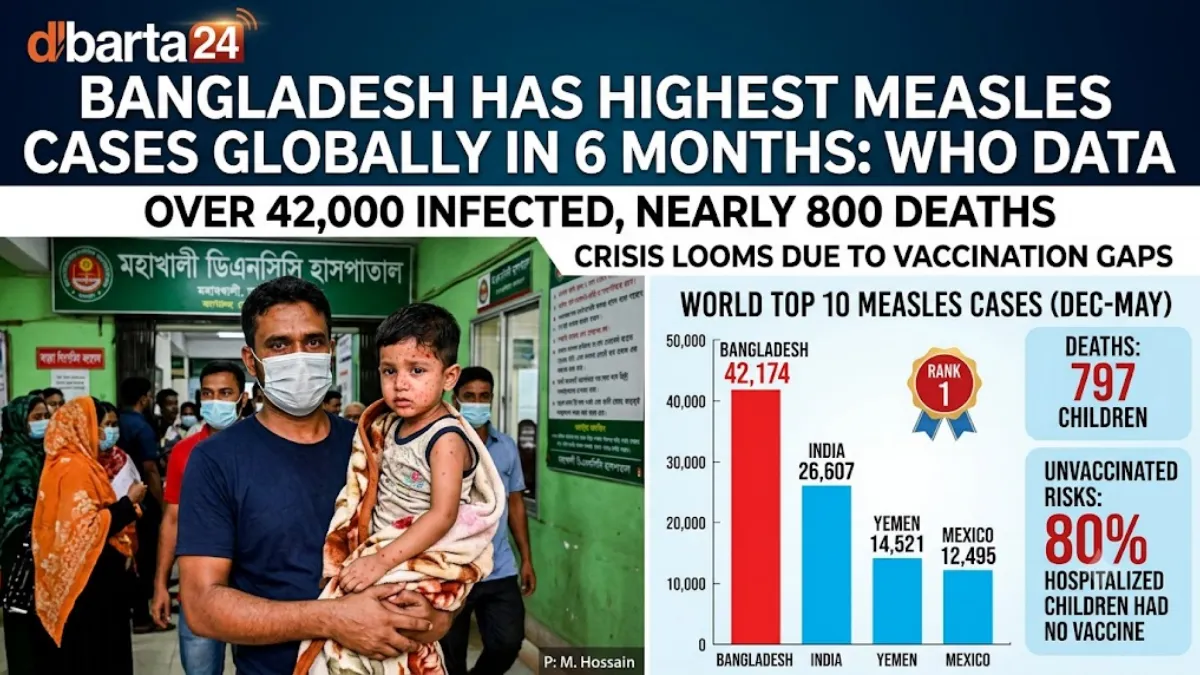
Khairul Alam — A severe resurgence of measles has placed Bangladesh at the center of a global public health crisis, recording the highest number of reported cases worldwide over a six-month period.
According to the latest surveillance data from the World Health Organization (WHO), Bangladesh logged 42,174 cases of measles or measles-like symptoms between December and May, far outpacing any other nation during the same timeframe.
The alarming surge marks a stark shift for a nation once praised globally for its robust immunization coverage.
WHO surveillance reports—featured in a recent update by the U.S. Centers for Disease Control and Prevention (CDC)—show that out of 186,000 cases recorded across 165 countries, the largest concentration of the outbreak is localized in South Asia, the Middle East, and parts of Africa.
-
Top Affected Countries (Dec–May):
-
Bangladesh: 42,174 cases (Ranked #1 globally)
-
India: 26,607 cases (Ranked #2)
-
Yemen: 14,521 cases (Ranked #3)
-
Other high-burden nations: Mexico (12,495), Pakistan (11,037), Cameroon (9,653), Kazakhstan (7,730), Guatemala (6,832), Angola (6,815), and Sudan (5,766).
-
Health Directorate tracking from mid-March through mid-July highlights the domestic toll, recording 119,448 suspected cases, 14,708 confirmed cases, and 797 total deaths (702 suspected, 95 confirmed) linked to measles and its complications.
A Rapid Collapse in Immunity Coverage
The current escalation contrasts sharply with Bangladesh’s historical performance. Between 2006 and 2014, national measles campaigns consistently achieved 100% target coverage.
Consequently, official cases remained exceptionally low in recent years—identifying just 311 cases in 2022, 282 in 2023, 247 in 2024, and 132 in 2025.
However, health experts attribute the current wave to a growing “immunity gap” that developed after routine mass vaccination campaigns stalled post-2021.
By 2025, regular immunization coverage dropped to 59%, compounded by nationwide vaccine shortages.
Reports indicate that changes to vaccine procurement protocols under the 2025 interim government led to significant supply chain delays.
Despite early warnings sent by UNICEF regarding potential shortages, procurement gaps went unaddressed, leaving thousands of infants unvaccinated.
Expert Analysis & Impact on Children
Data from the WHO’s July report shows that infants and young children are bearing the brunt of the outbreak:
-
Out of approximately 5,000 infected infants under age one, over 4,000 had not received a single dose of the two-dose measles vaccine.
-
80% of pediatric hospital admissions studied at the Bangladesh Child Hospital and Institute were unimmunized.
-
52% of child fatalities involved infants under nine months old—below the standard age for the first dose.
Dr. Mushtaq Hussain, a prominent public health expert, emphasized the severity of the situation:
“It is virtually certain that Bangladesh will top the global list for measles infections this year. Beyond transmission rates, Bangladesh likely holds the highest mortality rate from measles worldwide. We neglected vaccination, despite Bangladesh’s strong legacy in immunization.”
Addressing the structural breakdown, Prof. Mahmudur Rahman, former Director of the Institute of Epidemiology, Disease Control and Research (IEDCR), warned:
“Herd immunity does not form in a single day, nor does it collapse in one. But when required coverage is missed for two consecutive years, an immunity gap inevitably forms. As a result, the risk of massive outbreaks will persist into the future.”
Gaps in Emergency Responses
To stem the spread, the government launched a targeted campaign in April for children aged six months to five years.
However, public health evaluations reveal that 4.6 million children were missed due to undercounted target demographics—calculating 18 million target children for measles vaccines compared to 22.6 million reached during a concurrent Vitamin A drive.
As hospitals across the country continue to manage incoming pediatric patients, international partners including WHO and UNICEF stress that the emergency is far from over.
Health authorities face an urgent race against time to identify unimmunized pockets, bridge the coverage gap, and restore herd immunity before further preventable lives are lost.