


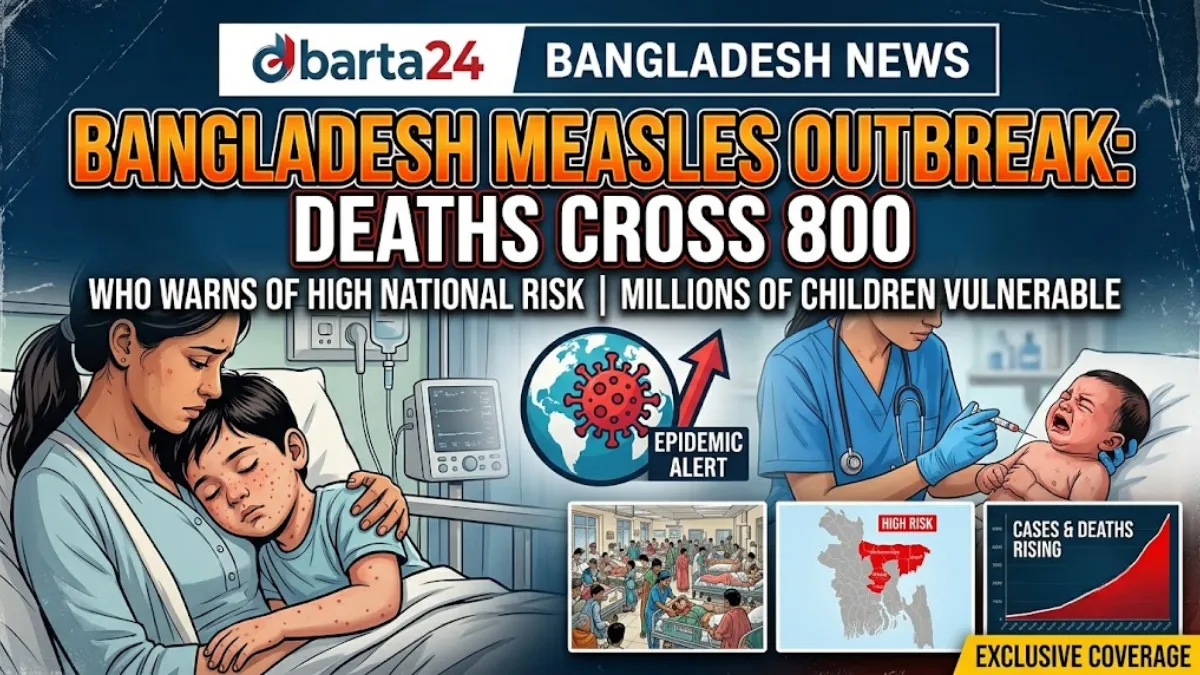
Khairul Alam ; Dbarta24 Special Report — A devastating measles outbreak in Bangladesh continues to surge, claiming over 800 lives and establishing the country as the epicenter of one of the world’s largest measles crises this year.
Despite wide-scale emergency vaccination drives, transmission rates remain alarmingly high, driven by immunity gaps, routine immunization disruptions, and procurement delays.
According to the latest data from the Directorate General of Health Services (DGHS), a total of 805 deaths were recorded between March 15 and July 23.
Among the deceased, 710 presented with measles symptoms, while 95 were laboratory-confirmed cases. Officials warn that official tally numbers likely undercount the true scale, as thousands of suspected cases go unverified.
Unprecedented Infection Rates Across Bangladesh
Official figures show that 121,200 individuals presented with measles symptoms between mid-March and late July, with 15,007 confirmed cases—bringing total reported infections to 136,207. The virus has infiltrated 58 out of the country’s 64 districts.
Dhaka division remains the hardest hit, accounting for 307 fatalities. Other heavily affected regions include:
-
Sylhet: 106 deaths
-
Rajshahi: 90 deaths
-
Mymensingh: 67 deaths
-
Chittagong: 56 deaths
-
Barisal: 43 deaths
-
Khulna: 31 deaths
-
Rangpur: 10 deaths
Data from the World Health Organization (WHO) highlights that between December 2025 and May 2026, Bangladesh registered 42,174 confirmed measles cases—the highest total reported by any nation globally during that timeframe. Consequently, WHO has classified the national public health risk in Bangladesh as “high” and the regional risk as “moderate.”
Immunity Gaps Leave Under-Fives Most Vulnerable
Young children bear the vast burden of the current epidemic, with under-five toddlers accounting for nearly 80 percent of all recorded deaths. Medical experts note that pneumonia, compounded by malnutrition and lack of vaccination, serves as the leading cause of fatality among infected infants.
Research conducted by the Bangladesh Shishu Hospital and Institute revealed that roughly 80 percent of children hospitalized with measles had never received a measles vaccine.
Furthermore, a joint study by icddr,b and Bangladesh Shishu Hospital analyzing 341 pediatric patients treated in April and May revealed that 52 percent of infants who died were under nine months old—meaning they contracted the virus before reaching the age required to complete their routine immunization schedule.
Though the government initiated a targeted Measles-Rubella (MR) vaccination campaign in April 2026—aiming to reach 18 million children aged six months to five years—public health experts warn that target thresholds were set too low.
With 22.6 million children participating in the national Vitamin ‘A’ Plus campaign in June, experts estimate that up to 4.6 million children remained unvaccinated and unprotected.
Routine Immunization Setbacks and Vaccine Procurement Delays
The current crisis represents a sharp departure from Bangladesh’s past public health achievements.
The country was previously lauded as a regional leader in immunization, logging just 247 confirmed measles cases in 2024 and 132 in 2025.
However, routine immunization coverage faltered during political transitions following the 2024 mass uprising under the interim administration.
The situation was further compounded by significant changes in national vaccine procurement policy.
As reported in the journal Science, the government transitioned to an open tender procurement model in September 2025, shifting away from long-standing joint financing frameworks with UNICEF and Gavi. UNICEF repeatedly cautioned that open tendering would lead to severe supply chain delays.
UNICEF Representative to Bangladesh, Sheldon Yett / Rana Flowers, noted at a May 20 press conference that the agency had issued at least 10 formal warnings to the government since 2024 regarding imminent vaccine supply disruptions.
“Weaknesses in the routine immunization program are a primary cause of the current crisis. Because many mothers themselves never received the measles vaccine, their newborns are deprived of crucial maternal antibodies.”
— Prof. Dr. Mohammad Riaz Mubarak, Senior Physician, Bangladesh Shishu Hospital and Institute
Urgent Action Required to Stem the Spread
To curb the surge, public health specialists are calling for an immediate expansion of routine immunization coverage, enhanced epidemiological surveillance, expanded clinical research, and synchronized inter-ministerial efforts.
Without swift and systemic intervention to bridge national immunity gaps, containment of the largest measles outbreak in Bangladesh’s recent history remains a formidable challenge.